


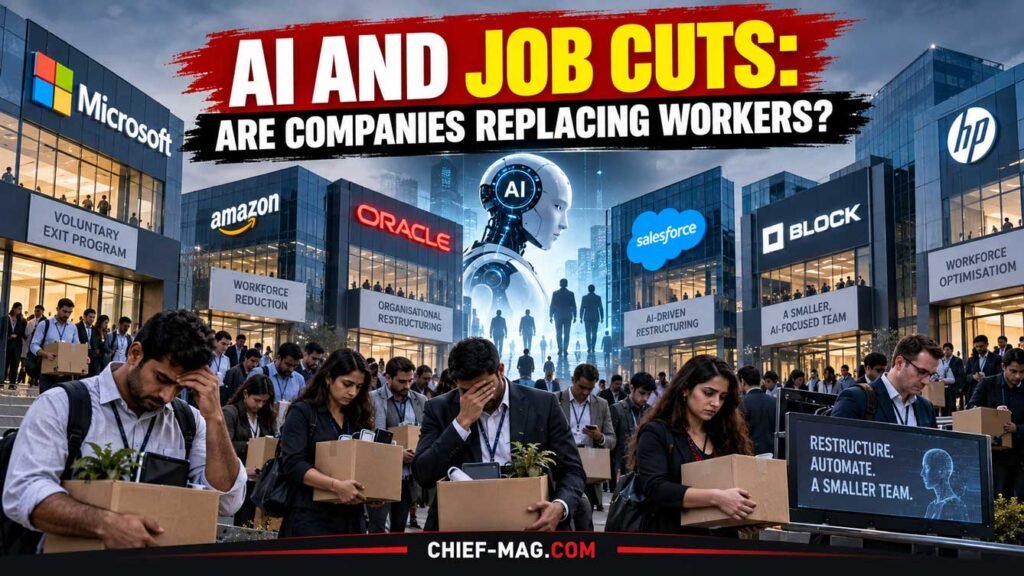
As technology companies pour billions into artificial intelligence, workforce reductions are becoming part of the corporate story. But separating genuine AI-driven job displacement from cost-cutting, restructuring and changing business priorities is essential to understanding what is really happening.
When Microsoft announced a voluntary exit offer potentially available to around 60,000 employees, the headline seemed to capture the defining contradiction of the artificial intelligence boom: technology companies are investing enormous sums in AI while rethinking how many people they need.
Microsoft is not alone. Amazon has announced corporate workforce reductions, Oracle’s headcount has declined amid restructuring and AI adoption, Salesforce has acknowledged reducing customer-support roles as AI agents take on more work, and Block has made AI central to a major organizational restructuring.
These developments raise an uncomfortable question. If AI is making businesses more productive, why does the path to that productivity so often appear to involve fewer employees?
The answer is more complicated than the headlines suggest. Some jobs are already being displaced by automation. Some companies are eliminating positions because AI changes how work is performed. Others are cutting costs, removing management layers, correcting earlier hiring decisions or shifting investment towards new business priorities.
The AI revolution is changing employment, but not every job cut during the AI boom is an AI job cut. Understanding that difference is the starting point for a serious discussion about the future of work.
The numbers behind the headlines
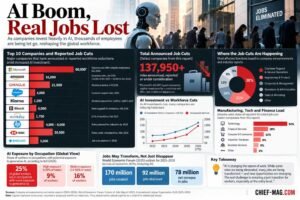

The following companies illustrate different aspects of the transition. They are not ranked by the number of employees affected. Instead, they are selected because their announcements or reported workforce changes offer useful evidence of how AI, automation and corporate restructuring are interacting.
| Company | Workforce change reported | What the evidence says about AI |
|---|---|---|
| Microsoft | A voluntary exit offer potentially covering around 60,000 eligible employees, announced in October 2026 | The company described a voluntary programme to help participating organizations adapt their workforce. It did not announce 60,000 confirmed departures or say AI was the sole cause. Source |
| Amazon | Approximately 14,000 corporate roles announced for reduction in October 2025, followed by around 16,000 roles in January 2026 | Amazon cited fewer organizational layers, reduced bureaucracy and investment priorities. AI is part of its wider transformation, but the company did not attribute every cut directly to AI. October announcement · January announcement |
| Oracle | Workforce declined by approximately 21,000 employees during fiscal 2026 | Reuters reported that AI adoption was among the factors behind restructuring. Oracle also cited product changes, acquisitions, performance issues and strategic shifts. Source |
| Salesforce | Customer-support headcount reduced from around 9,000 to 5,000, according to CEO Marc Benioff in 2025 | One of the clearest examples of management explicitly connecting AI agents with reduced staffing needs in a particular function. Salesforce also said hundreds of employees had been redeployed to other areas. Source |
| Klarna | Workforce fell from approximately 5,000 to 3,800 in 2024, largely through attrition and a hiring freeze | Klarna said its AI assistant was doing work equivalent to about 700 customer-service employees. Subsequent reporting documented a renewed emphasis on human customer support. Source |
| Block | Nearly 4,000 roles targeted for elimination in February 2026, reducing staff from over 10,000 to just under 6,000 | CEO Jack Dorsey explicitly described AI and intelligent tools as changing how the company operates. This is a strong example of AI being central to a restructuring rationale. Source |
| Workday | Approximately 1,750 roles, or 8.5% of its workforce, announced for elimination in February 2025 | Workday linked the restructuring to a strategic shift towards AI and platform innovation. Company announcement |
| HP | Between 4,000 and 6,000 roles planned for reduction through fiscal 2028 | Its regulatory filing explicitly connects the plan to productivity, customer satisfaction and product innovation, primarily through AI adoption and enablement. SEC filing |
| HSBC | Around 20,000 roles were reportedly under consideration in March 2026 | Reuters reported that the bank was weighing potential reductions as part of an AI-related overhaul. This was a reported proposal, not a confirmed programme to eliminate all 20,000 roles. Source |
| Barclays | Approximately 5,000 job cuts planned during 2026, according to Reuters in October | The bank cited fixed-cost reduction and technology adoption, including AI, as part of its efficiency strategy. The announcement did not establish that AI alone caused every reduction. Source |
Editorial note: These figures describe different periods and different types of workforce changes. They should not be added together as a total of AI-related job losses. Some are planned reductions, some are reported headcount changes, and Microsoft’s figure represents eligibility for a voluntary exit offer rather than confirmed departures.
The table reveals a pattern, but not a single explanation. In some cases, executives have explicitly acknowledged that AI reduces the need for particular roles. In others, the technology forms part of a much broader effort to simplify operations, improve margins and redirect capital.
That distinction matters because it changes how we should understand both the scale of displacement and the responsibilities of employers.
When AI really does replace people
Customer support offers one of the clearest examples of AI-driven workforce change.
Salesforce’s experience is particularly revealing. Its CEO said that customer-support headcount had declined from around 9,000 to 5,000 as AI agents began handling a larger share of customer interactions. The company said that it no longer needed to backfill some support-engineering positions and had moved hundreds of employees into professional services, sales and customer-success functions.
This is more than a theoretical forecast. It is a business publicly describing how automation is changing staffing requirements.
Klarna offers another example. Its AI assistant was reported to perform work equivalent to about 700 customer-service employees. The company reduced its workforce substantially during a period of AI adoption and restricted hiring. Yet the subsequent shift back towards human support also exposed the limits of a strategy that measures success primarily through cost reduction.
The lesson is not that AI cannot handle customer service. It clearly can handle many routine interactions. The lesson is that the economic value of an automated interaction depends on whether it resolves the customer’s problem, not simply whether it avoids employing a person.
Routine queries, transaction processing, document classification, standard reporting and repetitive administrative tasks are among the activities that businesses can increasingly automate. As AI agents improve, they may also take on more complex workflows that previously required several employees to coordinate.
This does not mean every job containing these tasks will disappear. It means the number of people required to perform them may decline, especially where companies can standardize processes and accept the remaining limitations of automation.
The less visible story: companies are redesigning themselves
Some of the largest workforce announcements are not clean examples of direct replacement.
Amazon’s reductions in 2025 and 2026 were presented as part of a continuing effort to reduce management layers, increase ownership and remove bureaucracy. The company has also invested heavily in AI and other strategic businesses. But the official announcements did not claim that AI had individually replaced all the employees whose positions were affected.
Oracle’s experience is similarly complex. Reuters reported that its workforce fell by around 21,000 during fiscal 2026 amid restructuring that included AI adoption, product changes, acquisitions and other strategic decisions.
These examples illustrate a corporate reality: AI investment and workforce reduction can happen at the same time without the former being the sole cause of the latter.
A company might automate a process, redesign the department that performs it, remove a management layer and then decide not to replace departing employees. The resulting reduction may be partly attributable to AI, partly to organizational restructuring and partly to a business decision about how much capacity the company needs.
There is also a financial incentive to simplify operations while investing in AI infrastructure. Training and running advanced models, building data centers and securing computing capacity require enormous capital commitments. Companies may respond by reallocating budgets, cutting costs elsewhere or changing their staffing plans.
That does not prove that companies are using AI as an excuse for layoffs. It does mean that attributing every reduction to AI without examining the underlying evidence is poor analysis.
The productivity paradox: more output, fewer people?
The most consequential question is whether AI allows companies to grow without expanding their workforce—or even to grow while employing fewer people.
Imagine a customer-support operation handling 100,000 enquiries each month. Previously, the company needed a large team to answer routine questions, update records and route complex problems. An AI system now handles a substantial share of these interactions, allowing the same operation to serve more customers with fewer employees.
The business may become more productive. Customers may receive faster answers. Costs may fall. The company may also redeploy people to more complicated cases or other activities that generate revenue.
But if customer demand does not increase, and the company can deliver the same service with fewer employees, the productivity improvement may translate directly into fewer jobs.
The outcome depends on what the business does next. Does it expand into new markets, introduce new services and hire people for emerging roles? Or does it retain the productivity gains while reducing its workforce?
Both outcomes are possible. The technology creates the opportunity; management decides how to use it.
This is why the AI employment debate cannot be settled by counting layoffs alone. We also need to examine hiring, internal redeployment, wages, new business creation, output and the quality of work.
The global research offers a more nuanced picture
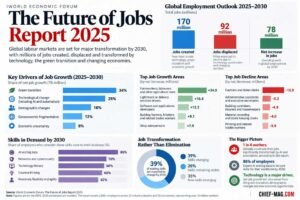

The World Economic Forum’s Future of Jobs Report 2025 projected that broad labor-market changes between 2025 and 2030 could create 170 million jobs and displace 92 million, resulting in a net increase of 78 million. These estimates cover multiple structural trends, including technological change, economic shifts and the green transition. They are not a forecast of jobs lost to AI alone. Read the report.
The International Labor Organization offers another important perspective. Its 2025 study, Generative AI and Jobs: A Refined Global Index of Occupational Exposure, estimated that one in four workers globally is in an occupation with some exposure to generative AI. However, it concluded that transformation of jobs is more likely than complete replacement for most occupations. Read the ILO research.
More recent evidence is equally important. In June 2026, the ILO published a review of empirical research on generative AI, productivity and work organization. It found that productivity gains were real but uneven, while large-scale job displacement remained limited in the evidence examined. The review also highlighted risks to employment opportunities for younger workers and changes in job quality and worker autonomy. Read the ILO’s 2026 research brief.
These findings do not mean that workers are safe. They mean that exposure to AI is not the same as job loss, and that the effects differ by occupation, organization and the way technology is deployed.
The distinction is critical. A role may be transformed without disappearing. A company may eliminate some positions while creating others. And an occupation may remain in demand even as many of its tasks become automated.
Why India should pay particular attention
For India, the implications extend beyond the technology sector.
The IT services industry has historically relied on large teams to deliver software development, testing, maintenance, business-process outsourcing and customer support. Its commercial model has often been tied to the number of employees assigned to a client, the hours worked and the scale of delivery operations.
AI challenges that model. If a smaller team can deliver the same work in less time, clients may demand lower prices, faster turnaround or a different commercial arrangement.
In August 2026, Reuters reported that AI was reshaping India’s $315 billion IT services sector. Clients were increasingly demanding measurable productivity gains rather than paying simply for staff time, and the traditional staffing pyramid faced pressure as coding and other tasks became more automated. Read the Reuters report.
For Indian companies, this presents both a threat and an opportunity.
The threat is that some traditional entry-level work may shrink. Junior developers, testers, support analysts and business-process employees may find that tasks once used to train new workers are increasingly handled by AI tools. If organizations hire fewer graduates into these roles, the route from education to professional experience could become narrower.
The opportunity is that Indian companies can use AI to move towards higher-value work: architecture, domain consulting, cybersecurity, AI implementation, data engineering, governance and complex business transformation. But that transition will require investment in skills, new service offerings and a willingness to change the way projects are priced and delivered.
The risk is assuming that retraining alone will solve the problem. Workers cannot transition into new roles if employers are not creating enough of them, if training is disconnected from real demand, or if the new jobs require experience that displaced employees have not had the opportunity to develop.
India therefore needs a coordinated response involving employers, educational institutions, government and the technology industry. It must prepare workers for changing roles while creating pathways into emerging occupations.
The entry-level problem: who trains tomorrow’s experts?
One of the most overlooked risks is the potential erosion of entry-level opportunities.
Many professionals develop expertise through routine work: writing and testing code, responding to customer enquiries, preparing reports, reviewing documents and learning how business processes operate. These tasks may be repetitive, but they also provide the experience needed to progress.
If AI handles more of this work, employers may require fewer junior employees. Yet if companies stop hiring and training junior workers, they may weaken their own future talent pipeline.
A senior engineer cannot emerge fully formed. Neither can an experienced consultant, product manager or cybersecurity specialist. These professionals need opportunities to learn, make mistakes under supervision and develop judgement.
Companies adopting AI should therefore consider not only which tasks can be automated today, but also how they will develop the next generation of talent. Apprenticeships, supervised AI-assisted work, structured rotations and new entry-level roles may become increasingly important.
The question is not whether graduates should learn to use AI. They must. The question is whether organizations will continue to invest in developing people when technology makes it possible to reduce the number of junior employees.
What responsible AI adoption should look like
Businesses cannot be expected to ignore technologies that improve productivity or remain competitive. Nor should they preserve every existing role indefinitely. But responsible adoption requires more than announcing efficiency gains and measuring the reduction in payroll.
First, companies should distinguish genuine automation benefits from general cost-cutting. If a role is eliminated because AI can perform its work, employers should explain that clearly rather than hide behind vague language about restructuring.
Second, they should evaluate whether employees can be redeployed before making roles redundant. A customer-support employee may be able to move into escalation management, quality assurance, customer success or AI-system supervision with appropriate training.
Third, productivity gains should be measured through outcomes, not headcount alone. Faster service, fewer errors, improved customer satisfaction and increased revenue are meaningful indicators. A smaller workforce is not automatically evidence of a better business.
Finally, governments and educational institutions should treat reskilling as a continuing economic priority. That includes accessible training, stronger links between education and employers, support for displaced workers and better labor-market information.
The real question is what happens to the gains
AI will change the workforce. Some tasks will disappear, some jobs will be redesigned, and new occupations will emerge. The pace and distribution of these changes will vary across industries and countries.
The companies in this article demonstrate that the transition is already under way. Salesforce has described direct reductions in support staffing as AI agents take on more work. Block has presented AI as central to a leaner organization. HP has explicitly linked its workforce plan to AI-enabled productivity. Microsoft, Amazon, Oracle and others illustrate how difficult it can be to separate automation from wider organizational change.
The evidence does not support the claim that every company reducing its workforce is doing so because of AI. Nor does it support the opposite assumption that AI will only augment workers and never eliminate jobs.
The more useful question is whether businesses can turn AI-driven productivity into sustainable growth—and whether workers will share in the benefits.
If AI enables a company to serve more customers, develop better products and create new markets, employment may grow in different areas. If the technology simply allows a business to perform the same work with fewer people, the benefits may accrue mainly through lower costs and higher margins.
Neither outcome is predetermined.
The AI era should not be judged only by how much work machines can perform. It should also be judged by what businesses, governments and societies do with the productivity they create.
For workers, the challenge is to develop skills that complement increasingly capable systems. For employers, it is to redesign work without undermining the talent and trust their businesses depend on. For policymakers, it is to ensure that technological progress does not leave entire groups of workers without realistic routes into the economy.
AI is changing the economics of employment. The responsibility for shaping the outcome remains human.