


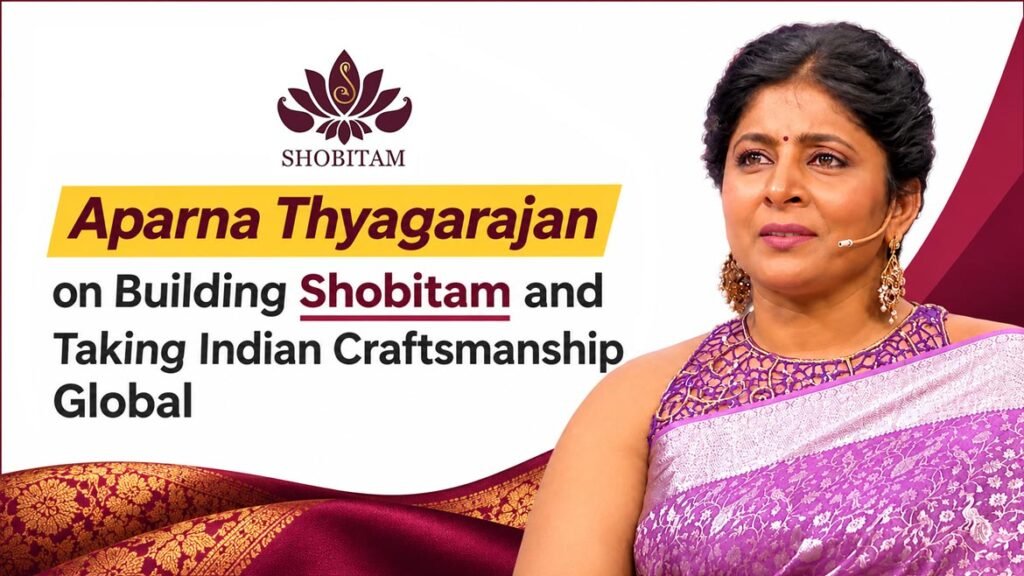
India’s rich textile and craftsmanship heritage holds immense global potential. Yet, many artisans and independent brands still face challenges in reaching international markets. Unlocking this opportunity requires combining traditional craftsmanship with technology, contemporary design and a global business vision.
This is the opportunity that Aparna Thyagarajan, Co-founder and Chief Product Officer of Shobitam, is working to address. With a vision to take India’s ethnic fashion and craftsmanship to the world, she is building Shobitam into a global platform that connects India’s artisan communities and emerging brands with customers across international markets.
The company works closely with more than 960 weavers and artisans across 25 clusters in India and partners with over 75 emerging brands to bring their creations to customers worldwide. Shobitam’s approach combines traditional craftsmanship with technology, contemporary design and a customer-centric global shopping experience. With more than 12,000 five-star reviews and a growing customer community across 45+ countries, the company is working to make Indian craftsmanship more accessible to international audiences while creating wider market opportunities for artisans and independent brands.
Before embarking on her entrepreneurial journey, Aparna spent over seven years at Microsoft in Seattle and Silicon Valley, working as a Tech Lead across Bing and Dynamics. Her experience in technology, e-commerce and global product development has played an important role in shaping her approach to building Shobitam.
Beyond entrepreneurship, Aparna is also an active investor across India and the United States. She serves as a Lead Investor on Startup Singam Show on Vijay TV and has backed more than 20 ventures as an Indian Angel Investor. Her involvement extends beyond capital, with a strong emphasis on collaboration, mentorship and helping early-stage entrepreneurs build sustainable businesses.
In this conversation with Chief Magazine, Aparna reflects on the journey from a personal interest in Indian textiles to building a global business, the role of technology in traditional industries, the complexities of working with artisan communities, and what it will take for Indian craftsmanship to become a globally recognized business category.
1. From a handmade dress to a global business
You once stitched a dress for your sister using leftover saree fabric. Years later, a sabbatical and an encounter with a Zardosi artist helped shape Shobitam. When did you realize this personal interest could become a business?
I have always had a deep appreciation for Indian textiles, craftsmanship and design. Even as a young girl, I enjoyed experimenting with fabric and creating things. I remember stitching a dress for my sister using leftover saree fabric. At the time, it was simply an expression of creativity and a love for design. I never imagined that this interest would eventually become a business.
The more defining moment came much later, during a sabbatical from my corporate career. I had the opportunity to reconnect with my interest in Indian craftsmanship and engage with artisans. An encounter with a Zardosi artist made me think more deeply about the incredible skill and heritage that existed within India’s artisan communities, and how little of it was accessible to customers outside the country.
Having lived in the United States, I had also experienced the difficulty of finding authentic Indian ethnic wear internationally. There was demand, particularly among the Indian diaspora, but the shopping experience was fragmented. Customers had to navigate multiple sellers, with varying levels of quality, product information and reliability.
I began to see that the opportunity was not simply to sell sarees online. It was to bridge two worlds: India’s rich craftsmanship ecosystem and a global customer base that wanted access to it.
On March 8, 2019, we launched Shobitam on Etsy with just 15 sarees. Within three days, we received our first order from France. That early response was incredibly encouraging. It gave us the confidence that there was a real market for what we wanted to build.
Looking back, the personal interest gave me the starting point, but the customer problem gave me the business opportunity. Shobitam grew from the intersection of the two.
2. Bringing an engineering mindset into a traditional industry
After nearly a decade at Microsoft, you moved into fashion. How does your engineering background influence the way you approach product development, customer experience and innovation at Shobitam?
My years at Microsoft shaped the way I approach problems. Engineering teaches you to break down complex challenges, understand the underlying problem before jumping to a solution, and build systems that can scale. I have carried that mindset into Shobitam.
Fashion and craftsmanship are creative industries, but building a business around them requires a great deal of structure. A beautiful product is only one part of the customer experience. Customers also care about authenticity, product information, sizing, customization, quality, delivery and what happens if something goes wrong.
I tend to look at the entire customer journey and ask where the friction points are. For example, when we recognized that buying a saree internationally could be complicated because of blouse stitching, fall and pico finishing, we did not want the customer to have to coordinate with multiple service providers. Our acquisition of House of Blouse helped us bring these services together into a more complete offering.
Similarly, the 1-Minute Ready-to-Wear Saree offering addresses a practical customer need. It takes a traditional garment and makes it more convenient for someone who may love wearing sarees but find the draping process difficult or time-consuming.
My engineering background also influences how I think about scale. If we want to grow from approximately 20,000 products to 100,000, we cannot rely on manual processes and individual interventions at every stage. We need technology-led systems for catalogue management, inventory visibility, partner integration, product discovery and fulfilment.
I do not see technology and tradition as opposing forces. Technology should make craftsmanship more accessible, while preserving the human skill and cultural identity that make these products special.
3. Making Indian fashion relevant to a new generation
You have spoken about how Indian fashion preferences differ across markets. With concepts such as ready-to-wear sarees, how do you adapt traditional fashion for global customers without losing its cultural identity?
One of the most important things we have learnt is that there is no single global Indian customer. Preferences differ across generations, geographies, occasions and even individual lifestyles.
A customer in India may be very comfortable buying a saree and arranging the blouse and finishing independently. A customer in the US, on the other hand, may want a more complete solution, including blouse stitching, fall and pico, tassels and convenient international delivery. Younger customers may want to wear traditional garments but prefer silhouettes and formats that are easier to style and carry.
Our approach is to understand these differences without diluting the essence of the product.
The 1-Minute Ready-to-Wear Saree is a good example. We are not changing what a saree represents. We are making it easier for someone to wear one. A customer can enjoy the elegance and cultural significance of a saree without having to spend time learning how to drape it.
Similarly, our customized blouse offering recognizes that the blouse is an integral part of the saree experience. By making customization and finishing more accessible, we remove some of the barriers that might otherwise discourage a customer from purchasing.
We also believe that education is important. International customers may not always understand the difference between weaving techniques, fabrics, regional crafts or the work involved in creating a particular product. We have a responsibility to communicate that story through our product descriptions, imagery and overall shopping experience.
For us, innovation is not about making traditional fashion look Western or changing its identity to suit a global market. It is about making Indian craftsmanship relevant, convenient and desirable to customers across generations and geographies.


4. The complexity behind the artisan-first model
Shobitam works with artisans across multiple clusters. How do you balance fair compensation, consistent quality, customer expectations and business sustainability while scaling this model?
This is one of the most important and complex aspects of our business. Handcrafted products cannot be managed in exactly the same way as mass-produced goods. Every weaving cluster has its own specialization, production capacity, timelines and working practices. The skill involved in creating a handloom saree, for example, cannot simply be increased by asking for more units in a shorter period.
Our philosophy is guided by two principles: Customers First and Weavers First. We believe that these principles have to work together. The customer should receive an authentic, high-quality product, and the artisan should have a dependable market for the work they create.
We work with an extensive artisan network across weaving clusters rather than owning all the manufacturing infrastructure ourselves. This allows us to support specialized craftsmanship and work with artisans who have developed expertise in particular techniques.
However, working with a distributed network requires discipline. We need to match the right product to the right artisan, understand production capacity, plan around lead times and maintain quality standards. We also evaluate partners on parameters such as craftsmanship, consistency, timely delivery, order fulfilment and communication.
There is also a commercial balancing act. Handcrafted production involves time, skill and often higher costs than standardized manufacturing. We have to price products in a way that recognizes this value while remaining accessible and commercially viable for customers.
We have learnt that sustainability in this model is not achieved by putting pressure on artisans to produce faster or cheaper. It comes from better demand planning, realistic production commitments, efficient operations and building long-term relationships.
Our responsibility is to create a business in which the artisan’s skill is valued, the customer receives a product they can trust, and the economics allow the relationship to continue over time.
5. Building a platform, not just another fashion brand
With its growing partner ecosystem and expansion beyond its own products, could Shobitam become a global platform for Indian craftsmanship? What would it take to make that transition?
Absolutely. In fact, that is the larger ambition we are working towards. We do not want Shobitam to remain only a saree brand or even a conventional ethnic fashion retailer. Our ambition is to become the No. 1 global marketplace for Indian ethnic products.
India has an extraordinary ecosystem of designers, independent brands, manufacturers, weavers and artisans. However, much of this ecosystem remains fragmented. A talented regional brand or artisan-led business may create exceptional products but may not have the technology, marketing capabilities, international logistics or distribution infrastructure to reach customers globally.
This is where we see an opportunity for Shobitam.
Our marketplace model brings different brands and sellers onto one platform, allowing them to access a wider customer base while giving customers a curated selection across categories. We already have a network of more than 100 curated partners, and our ambition is to grow that to 500.
Similarly, we want to expand our catalogue from approximately 20,000 products to 100,000. This expansion is not simply about adding more listings. It is about building meaningful depth across sarees, womenswear, menswear, jewellery, kidswear, home décor, gifting and other Indian ethnic categories.
For this transition to work, three things are critical.
First, trust and curation. A marketplace cannot become valuable simply by having the largest number of products. Customers must trust the authenticity, quality and relevance of what they find on the platform.
Second, technology and operations. We need systems that allow partners to onboard efficiently, manage catalogues and inventory, fulfil orders and maintain consistent standards. As the ecosystem grows, these processes must become increasingly automated and scalable.
Third, global customer experience. We need to solve the complexities of international shopping, including product understanding, customization, quality control, delivery and customer support.
Our goal is to build a platform where a customer anywhere in the world can discover the best of Indian ethnic products in one place, while a brand or artisan in India can access global demand without having to build an international business independently.
6. The Kalaneca acquisition: More than adding another product category
What made Kalaneca a strategic fit for Shobitam? As you integrate its relationship with Uppada Jamdani weavers, how will you scale the business while preserving the trust and practices behind its craft?
Our acquisition of Kalaneca in 2026 was driven by our ambition to take the distinctive craft of Uppada weaving to a global audience.
We believe that India’s regional weaving traditions have enormous potential internationally, but many of these crafts are not easily accessible to customers outside their traditional markets. Uppada is a beautiful example of the depth of Indian weaving expertise, and we saw an opportunity to bring greater visibility and market access to this category through Shobitam.
The strategic fit was therefore not simply about adding another saree collection to our catalogue. It was about strengthening our ability to represent specialized Indian craftsmanship and connecting it with customers across the world.
When working with a traditional weaving ecosystem, scaling has to be approached thoughtfully. The relationships between a brand, its weavers and its production communities are built over time. They are based on trust, an understanding of craftsmanship, production realities and consistent engagement.
Our intention is to build on the existing relationships and expertise rather than disrupt the practices that have made the craft distinctive. We want to understand the capabilities of the weaving network, the time and skill involved in production, and the kinds of designs and quantities that can be developed sustainably.
Shobitam can bring its strengths in global distribution, digital discovery, customer reach and international fulfilment to this ecosystem. At the same time, the craft and the people behind it must remain central to the proposition.
For us, the real success of this acquisition will be when more customers around the world recognize and appreciate Uppada craftsmanship, while the weaving ecosystem has a stronger and more sustainable market for its work.
7. What changes when an online brand enters physical retail?
What prompted Shobitam’s move into physical retail with its Bengaluru store? What have in-person customer interactions taught you that online data alone could not?
Shobitam began as a digital-first business, and online commerce continues to be central to our model. However, as we grew, we realized that certain aspects of buying Indian ethnic wear are difficult to replicate entirely online.
A saree is a tactile product. Customers want to feel the fabric, understand its texture, see how it drapes and compare colours in person. They may want help with styling, blouse combinations or selecting the right garment for a particular occasion.
We saw physical retail as an opportunity to bridge that gap and create a more immersive brand experience. Our Bengaluru experience store in Jayanagar, which opened in February 2025, was an important step in that direction.
What physical interactions have taught us is that the purchase journey is often much more emotional and consultative than digital data alone can reveal.
Customers may come looking for one particular saree but discover an entirely different weave or style after seeing it in person. A customer who is uncertain about wearing a particular color or silhouette may become confident after trying it. We also get to hear questions and concerns directly, rather than interpreting them through website behavior or customer support interactions.
These conversations help us understand what customers value, where they need guidance and what prevents them from making a purchase.
Physical retail also allows us to tell the story of our products more effectively. We can explain the craftsmanship, the regional origins and the details that make a particular piece special.
We do not see offline retail as a replacement for digital commerce. We see it as complementary. Our larger ambition remains global, and digital gives us the ability to reach customers across geographies. Physical stores add experience, trust and a deeper connection with the brand.
8. The transition from being a founder to owning the decisions
You once reflected on learning to take ownership of product and design decisions rather than always seeking team alignment. How has your leadership evolved as Shobitam has grown, and what has been the hardest decision to own?
One of the biggest lessons I have learnt as a founder is that building consensus and taking ownership are two different things.
In the early days of a company, you are involved in almost everything. You work closely with a small team, discuss every decision and often arrive at solutions collectively. As the organization grows, the number of people, functions and perspectives increases. Alignment becomes important, but waiting for complete agreement on every decision can also slow the business down.
I have learnt that as a founder, I need to listen to different perspectives, understand the implications and then be willing to make the call. Not every decision will make everyone equally comfortable, and not every decision will turn out to be right. But ownership means accepting responsibility for the outcome rather than continually looking for validation.
My leadership has also evolved from being involved in execution to thinking more about building the organization and systems that allow others to execute well. That means creating clarity around priorities, empowering teams, setting expectations and ensuring that the business does not depend on individual intervention for every outcome.
I also believe that a founder has to balance conviction with the willingness to change their mind. You need conviction to build something that does not yet exist, but you also need humility to recognize when the market or the customer is telling you something different.
Perhaps the hardest decisions are those where there is no perfect answer: balancing customer expectations with business economics, deciding where to invest limited resources, or choosing between an attractive growth opportunity and the operational readiness required to support it.
I have come to understand that leadership is not about having all the answers. It is about being willing to make decisions with the information available, take responsibility for them and learn quickly.
9. Seeing startups from the other side of the table
Your involvement in startup investing gives you a perspective beyond building Shobitam. What do you look for in early-stage founders and technology ventures, and how has your own entrepreneurial experience shaped your investment decisions?
Building Shobitam has given me a very practical understanding of what it takes to turn an idea into a business. It has also changed how I look at entrepreneurship and early-stage companies.
When you are a founder yourself, you understand that a compelling presentation or a large addressable market is only the beginning. The real test is whether the business is solving a meaningful problem, whether customers are willing to pay for the solution and whether the team can execute consistently.
When I evaluate early-stage founders and technology ventures, I am interested in the clarity of the problem they are solving. Is it a real pain point? How are customers addressing it today? What makes this solution meaningfully better?
I also look closely at the founder. Early-stage businesses go through constant uncertainty, and the founder’s ability to learn, adapt, attract talent and keep moving despite setbacks is critical. I value founders who are deeply connected to their customers, understand the economics of their business and are open to challenging their own assumptions.
Technology is particularly interesting when it solves a problem at scale rather than simply adding another layer of convenience. I look for solutions that can create meaningful efficiencies, improve access or fundamentally change how an industry operates.
My experience at Shobitam has also made me more conscious of the gap between a product that works in a controlled environment and a business that can scale commercially. Operations, distribution, customer acquisition, working capital and team-building are not secondary considerations; they are fundamental to the success of a venture.
I also appreciate that founders do not need to have everything figured out at the beginning. What matters is their ability to identify what they do not know, seek the right expertise and respond to evidence.
Ultimately, my own journey has made me value resilience, customer understanding and execution as much as the original idea.
10. What will it take for Indian craftsmanship to become a global business category?
What is still missing for India’s traditional crafts to compete globally? Is the opportunity primarily in branding and distribution, or does it require deeper changes in technology, design, financing and the artisan ecosystem?
I believe Indian craftsmanship has everything it takes to become a significant global category. We have an extraordinary diversity of textiles, weaving traditions, embroidery, techniques and regional artistry. The challenge is that this richness has not yet been translated into a sufficiently accessible and organized global shopping experience.
The opportunity is certainly not limited to branding and distribution. Those are important, but building a sustainable global category requires progress across the entire ecosystem.
First, we need stronger discovery and distribution. Many exceptional artisans and regional brands have limited access to customers beyond their immediate markets. They may have the skill and product quality but lack the technology, marketing capabilities and international distribution infrastructure to reach a global audience. Platforms can play an important role in bridging this gap.
Second, we need to invest in design and product innovation. Craft traditions should be preserved, but that does not mean products cannot evolve. We need to understand how different generations and markets want to wear, style and experience Indian products. Innovation such as ready-to-wear sarees, contemporary silhouettes and customized offerings can make traditional craftsmanship relevant to new customers without losing its identity.
Third, technology must become an enabler. Better digital cataloguing, product storytelling, inventory management, demand forecasting and international fulfilment can help bring greater efficiency to a fragmented ecosystem. Technology should support the artisan and the customer, not replace the craftsmanship itself.
Fourth, we need stronger supply-chain and financing systems. Handcrafted production has different requirements from mass manufacturing. Artisans need realistic production commitments, dependable demand and working arrangements that recognize the time and skill involved. Businesses need to plan inventory and working capital carefully so that scaling does not come at the expense of the artisan ecosystem.
Finally, we need to change how the world perceives Indian craftsmanship. It should not be seen only as something worn for festivals or cultural occasions. Indian textiles and crafts have the potential to be part of everyday fashion, contemporary design, gifting, home interiors and global lifestyle choices.
At Shobitam, this is the opportunity we want to pursue. Our ambition is to become the No. 1 global marketplace for Indian ethnic products, bringing together brands, artisans and customers on one platform. We want to make it easier for a customer anywhere in the world to discover Indian craftsmanship, understand its value and purchase it with confidence.
For me, the opportunity is much bigger than selling more products. It is about building a global market for the people, skills and traditions behind those products.
About Chief Magazine
Chief Magazine brings stories, perspectives and conversations from the world of business, entrepreneurship, technology and leadership, highlighting the people and ideas shaping industries and the future of business.