


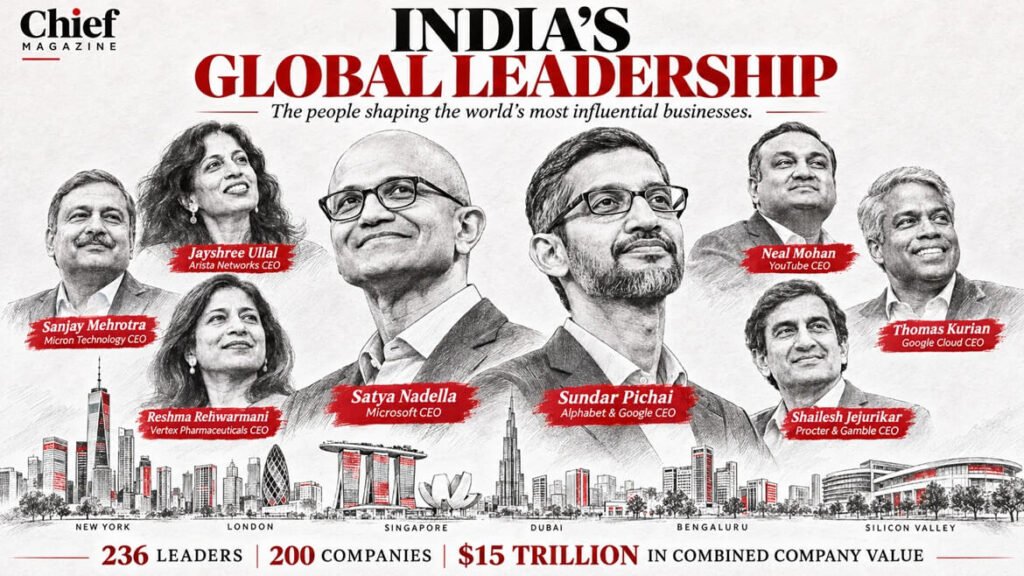
From Sundar Pichai and Satya Nadella to a new generation of entrepreneurs and corporate leaders, Indian-origin talent is shaping some of the world’s most valuable businesses. The latest HSBC-Hurun report reveals the scale of that influence — and why India’s contribution to global business extends far beyond its startup ecosystem.
For years, India’s global business success has largely been discussed through two familiar narratives: its technology workforce and its startup ecosystem.
One story is about the millions of engineers, developers and technology professionals who power global companies. The other is about the entrepreneurs who have built businesses such as Flipkart, Zomato, Freshworks and Razorpay.
Both are important. But there is another dimension to India’s global economic influence that deserves considerably more attention.
It is the growing presence of Indian-origin leaders at the helm of some of the world’s largest companies.
The recently released HSBC Hurun Global Indians List 2026 offers an interesting perspective on this phenomenon. According to the report, 236 Indian-origin individuals are associated with the leadership of 200 companies headquartered outside India. The combined value of these companies stands at approximately $15 trillion, representing a 53% increase from $9.9 trillion in the inaugural 2024 edition.
These businesses collectively employ approximately 5.3 million people and generated $2.5 trillion in revenue during 2025.
The numbers are significant. But the more interesting story is what they reveal about India’s contribution to global business leadership.
Beyond the Familiar Names of Sundar Pichai and Satya Nadella
The global influence of Indian-origin executives is often represented through a handful of familiar names.
Sundar Pichai, CEO of Alphabet. Satya Nadella, Chairman and CEO of Microsoft. Neal Mohan, CEO of YouTube. Thomas Kurian, CEO of Google Cloud.
Their journeys have become reference points in discussions about Indian talent and global corporate leadership.
The HSBC Hurun ranking places Sundar Pichai at the top, with Alphabet valued at approximately $4.2 trillion. Satya Nadella follows with Microsoft at $2.6 trillion, while Sanjay Mehrotra of Micron Technology ranks third, with the company valued at approximately $1.4 trillion.
But the list extends considerably beyond these familiar names.
It includes leaders across technology, semiconductors, financial services, healthcare, consumer businesses and other industries.
Shailesh Jejurikar of Procter & Gamble, Jayshree V. Ullal of Arista Networks, Reshma Kewalramani of Vertex Pharmaceuticals and Gunjan Kedia of U.S. Bancorp are among the individuals demonstrating the breadth of Indian-origin leadership across global industries.
This is no longer simply a Silicon Valley story.
It is a story about Indian-origin professionals influencing businesses across multiple sectors and geographies.
The Most Interesting Number Is Not $15 Trillion. It Is 125.
One of the most revealing findings in the report is that 125 of the 236 individuals did not found the companies they currently lead.
They were selected to lead businesses established by others.
This distinction is important.
Entrepreneurship and corporate leadership require different capabilities. Founders create organizations, identify opportunities, take risks and establish businesses. Professional leaders inherit organizational responsibilities and are expected to scale operations, manage complexity, allocate capital and navigate competition.
Being selected to lead a global corporation with millions of customers, employees and shareholders requires a different kind of institutional trust.
It suggests that Indian-origin professionals are not merely participating in global business. They are increasingly being entrusted with some of its most consequential leadership responsibilities.
This is perhaps one of the strongest arguments emerging from the report.
India’s global business contribution cannot be measured only by the number of entrepreneurs it produces. It must also account for the people who rise through organizations, earn the confidence of boards and eventually take responsibility for running them.
In other words, India’s contribution to global business is not restricted to creating companies. It also includes the capability to lead them.
The Indian Education Connection
Another important finding concerns where these leaders began their educational journeys.
According to the report, approximately 58% of the individuals completed their undergraduate education in India before building careers with global companies.
IIT Delhi has the highest representation among undergraduate institutions, with 15 individuals, followed by the University of Mumbai with 12 and IIT Madras with 11.
This is a significant observation.
India’s educational institutions have been part of the talent pipeline feeding global technology and business organizations for decades. Their graduates have moved into international markets, gained professional experience and progressed into increasingly influential positions.
The journey is not always straightforward. Education alone does not produce global leaders. Professional exposure, organizational experience, the ability to manage people, commercial judgement and opportunities to take on responsibility all play important roles.
Nevertheless, the educational data provides an important connection between India’s domestic talent ecosystem and its international leadership footprint.
It also raises a question worth considering: how many more global business leaders could emerge if India’s universities, management institutions and research organizations were better connected to international business opportunities?
India’s Global Leadership Is Closely Connected to the AI Economy
Perhaps the most strategically significant finding in the report is the relationship between Indian-origin leadership and the artificial intelligence industry.
Of the 200 companies represented, 103 are classified as AI-driven or AI-integrated businesses. Together, these companies account for approximately $10.7 trillion in value, or 71% of the combined valuation.
The list includes companies operating at the center of the AI transformation, from Alphabet and Microsoft to businesses involved in semiconductors, enterprise software and emerging AI applications.
This is particularly relevant because the next decade of global business leadership will increasingly be shaped by how organizations adopt and commercialize artificial intelligence.
AI is changing more than technology products. It is transforming business models, productivity, capital allocation, workforce structures and competitive advantage.
The presence of Indian-origin leaders in many of these organizations places them close to some of the most consequential decisions shaping the global economy.
It also demonstrates that India’s global leadership footprint is not limited to traditional IT services or software outsourcing.
Indian-origin executives are operating within the industries that will influence the next generation of global economic growth.
The Economic Times examines the AI-driven value represented in the HSBC-Hurun ranking.
The Other Side of the Story: Where Are the Women?
The report also exposes a significant gap.
Of the 236 individuals featured, only 16 are women.
Although this represents an increase from the 2024 edition, the number remains disproportionately low.
Jayshree V. Ullal of Arista Networks leads the women represented in the ranking, followed by other influential executives, including Reshma Kewalramani of Vertex Pharmaceuticals and Gunjan Kedia of U.S. Bancorp.
Their achievements demonstrate that Indian-origin women are reaching some of the highest positions in global business.
But their relatively small representation also raises questions about the leadership pipeline.
India has made considerable progress in women’s participation in education and professional employment. Yet representation at the highest levels of corporate decision-making remains a challenge.
The next phase of India’s global leadership story should not only be about increasing the number of Indian-origin executives. It should also be about expanding the diversity of people who reach those positions.
The opportunity is considerably larger than the existing list suggests.
Brain Drain or Brain Bridge?
For decades, the movement of highly educated Indian professionals to the United States, the United Kingdom, Singapore and other international markets has been discussed through the lens of brain drain.
The concern was understandable. India invested in educating talented individuals, but many of them built their careers, businesses and professional networks elsewhere.
The new report introduces another way of looking at this relationship.
Hurun India founder and chief researcher Anas Rahman Junaid described it as a transition from brain drain to brain bridge, with Indian-origin leaders now running companies worth $15 trillion across five continents.
The distinction is worth exploring.
A professional who moves abroad does not necessarily sever their economic or intellectual connection with India. They may eventually invest in Indian businesses, mentor entrepreneurs, establish professional networks, create opportunities for Indian talent or participate in cross-border business relationships.
Successful founders and executives can also become important sources of capital and knowledge for emerging entrepreneurs.
However, it would be simplistic to assume that the entire value created by these overseas companies directly benefits India.
These businesses are headquartered outside India. Their employees, operations, tax contributions and economic activities are distributed across different countries.
The $15 trillion figure represents the combined value of the companies in the ranking. It is not India’s GDP contribution, the personal wealth of the executives or money flowing back into the Indian economy.
The distinction matters.
The real opportunity lies in strengthening the connections between global Indian leadership and India’s domestic business ecosystem.
India’s Next Challenge: Producing Global Companies, Not Just Global Leaders
There is an interesting contradiction in India’s global business story.
India has produced a significant number of professionals capable of leading some of the world’s largest corporations. It has also produced entrepreneurs who have built billion-dollar businesses outside the country.
But the next challenge is to create more opportunities for these capabilities to translate into globally significant businesses headquartered in India.
The domestic startup ecosystem has developed considerably. India now has experienced founders, venture capital firms, a large engineering workforce, enterprise technology capabilities and a growing number of businesses serving international customers.
Yet building a global company requires more than access to talent.
It requires patient capital, world-class research infrastructure, strong intellectual property protection, access to international markets, experienced management teams and an environment where businesses can scale without unnecessary friction.
The ambition already exists. The question is whether the surrounding ecosystem can support it.
There is also an opportunity for India’s global business leaders to play a more active role in this transition.
Their experience in managing multinational organizations, building global products, navigating international markets and allocating capital could become valuable to the next generation of Indian entrepreneurs.
The relationship need not be limited to occasional investments or mentorship programmes. It could evolve into a stronger network connecting global executives, founders, universities, investors and emerging businesses.
That would create a more meaningful two-way exchange between India and its global diaspora.
India’s Global Business Story Is Still Being Written
The HSBC Hurun Global Indians List 2026 provides a compelling snapshot of India’s international leadership footprint.
Two hundred companies. 236 individuals. Approximately $15 trillion in combined company value. 5.3 million employees.
But the most important takeaway is not the size of the companies or the number of executives represented.
It is the breadth of capability that these figures reveal.
India has produced founders who build global companies. It has produced professionals who rise to lead organizations they did not establish. It has developed talent that is influencing industries ranging from technology and finance to healthcare and consumer businesses.
This is a broader story than India’s startup success alone.
In an earlier Chief Magazine article, India’s Biggest Startup Export Isn’t Software. It’s Founders, we examined how Indian-origin entrepreneurs have helped build hundreds of high-value companies outside the country.
The latest HSBC-Hurun findings extend that argument.
India’s global contribution is not confined to the founders who create businesses. It also includes the leaders who scale them, the professionals who transform them and the executives who shape their future.
The next milestone should be ensuring that more of this talent, experience and ambition can create globally competitive businesses from India itself.
Because India’s biggest opportunity may not simply be to produce more people who can lead the world’s largest companies.
It may be to build an ecosystem where the next generation can create those companies at home.
Sources and further reading
- The AI-driven valuation of global Indian-led businesses – Economic Times
- The global Indian leadership ranking – Business Today
- India’s Biggest Startup Export Isn’t Software. It’s Founders. – Chief Magazine
Editorial note: Company valuations in the HSBC-Hurun ranking are based on market capitalization for listed companies and Hurun Research estimates for privately held companies, with a valuation cut-off of 25 June 2026. The ranking includes founders, CEOs, managing directors and chairpersons, not exclusively CEOs.