


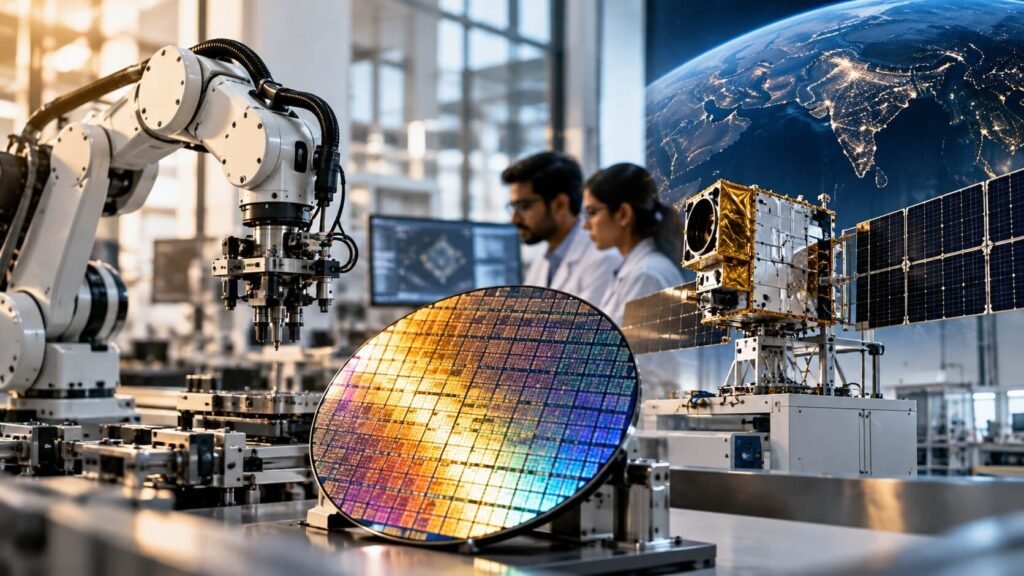
From robotics and semiconductors to satellites and AI-powered industrial systems, India’s next generation of startups is tackling problems that require more than software. The opportunity is growing, but so are the demands on capital, engineering talent and patience.
For much of the past decade, India’s startup story followed a familiar formula. Entrepreneurs identified an everyday problem, built a digital product to address it and used smartphones, internet access and venture capital to reach millions of customers. Food delivery, digital payments, e-commerce, online education and software-as-a-service became defining categories of the country’s entrepreneurial expansion.
That model created valuable businesses, transformed consumer behavior and helped establish India as one of the world’s largest startup ecosystems. But the next chapter may look considerably different.
A growing number of Indian founders are working on problems that cannot be solved by building another app. They are developing robotics systems for industrial environments, satellite technologies for space-based intelligence, semiconductor architectures, advanced manufacturing systems and AI that operates within complex physical or technical environments.
The shift is visible in the latest cohort announced by Peak XV Partners’ Surge accelerator. Its 12th cohort includes 18 early-stage startups spanning AI, robotics, space technology, healthcare, consumer products, financial services and music. The selection reflects a broader range of ambitions, from rethinking familiar consumer experiences to building technology for environments that have traditionally been difficult to monitor or operate.
The important question is not whether India’s software-first startup model is disappearing. It is whether the country’s next generation of significant technology companies will increasingly emerge from a wider range of engineering disciplines.
India’s startup opportunity may be expanding from digitizing existing markets to building the underlying technology that powers them.
The next startup wave is not confined to a screen
The distinction between software startups and deep technology businesses is not always straightforward. AI-native software companies can develop sophisticated intellectual property, while a hardware business may depend heavily on established components and manufacturing partners. Nevertheless, the nature of the technical challenge often differs significantly.
A company building a consumer application can frequently launch an initial product, study user behavior and improve it through successive releases. A startup developing a satellite system, semiconductor or autonomous industrial robot must solve additional engineering problems before commercial deployment becomes possible. It may need to validate hardware, conduct extensive testing, meet regulatory requirements and establish supply chains before it can scale.
These requirements make the development process more complex, but they can also create opportunities for defensible intellectual property and specialized capabilities.
The latest Surge cohort offers several examples of technology moving beyond conventional digital products. Puralink is developing autonomous robots that can navigate underground pipe networks, potentially allowing infrastructure operators to inspect assets without excavation. ULOOK is building autonomous satellite systems for radio-frequency sensing and spectrum intelligence from space. Both businesses are applying technology to physical environments where conventional software alone cannot perform the entire task.
Other startups in the cohort illustrate a different dimension of the shift. Hiloop is building infrastructure for adapting and improving open-weight AI models, while Reinforce Labs is developing tools to evaluate and improve the reliability of enterprise AI systems. These are not necessarily hardware businesses, but they address underlying technical capabilities rather than simply adding AI features to an existing application.
This distinction matters because deep tech is not a synonym for hardware, nor does every AI startup qualify as deep tech. The broader change is that more founders are exploring opportunities in the technology itself: how machines perceive and act, how chips are designed, how satellites collect information and how advanced systems can operate reliably.
The opportunity extends well beyond the smartphone screen.
Peak XV’s latest cohort offers a glimpse of the changing ambition
The Surge 12 announcement is an interesting signal because of both the range of businesses selected and the investment environment in which they are developing.
The 18-company cohort includes startups across AI, robotics, space, healthcare, consumer technology, financial services and music. Several are building AI-native products, while others are applying technology to physical infrastructure or developing specialized technical capabilities. Peak XV has also increased the maximum investment available through Surge to $5 million per startup, up from $3 million previously.
The larger investment ceiling is relevant because the financial requirements of building a technology company can vary substantially by sector. A software startup may be able to test its proposition with a relatively small team and limited infrastructure. A robotics or semiconductor company may need additional funding for engineering, prototypes, testing equipment, specialist talent and product validation before commercial revenue becomes meaningful.
A larger seed investment does not guarantee that a startup will succeed. Nor does its inclusion in an accelerator establish that its technology is commercially proven. But the willingness to support businesses across a wider range of technical categories reflects the need to accommodate different development paths.
The cohort also challenges the assumption that the Indian startup ecosystem is primarily about consumer internet businesses. Consumer companies remain part of the mix, but they now sit alongside businesses pursuing more specialized technical problems.
That is a more interesting story than simply declaring the end of the app economy. India’s startup ecosystem is becoming more varied, with different business models, technical requirements and routes to commercialization developing in parallel.
Deep tech is attracting capital, but investors are still selective
The growing interest in advanced technology is also visible in India’s funding data. Yet the numbers suggest a shift in the allocation of capital rather than an unrestricted boom.
According to Inc42’s Q3 2026 startup funding report, Indian deep-tech startups raised $290 million during the July–September quarter, a 176% year-on-year increase. Deal volume remained flat at 28 transactions, suggesting that the rise in funding was not accompanied by a comparable increase in the number of deals.
The wider funding environment reinforces the point. Indian startups collectively raised $2.2 billion during Q3, up 5% year on year, even as the number of deals declined. Meanwhile, funding in e-commerce fell 31% year on year to $245 million, while fintech funding declined 11% to $249 million. Deep tech was among the categories attracting stronger investor interest.
These figures need to be interpreted carefully. A 176% increase from a relatively small funding base does not make deep tech larger than established startup categories, and a single quarter cannot establish a permanent trend. The number also refers to year-on-year growth, not quarter-on-quarter growth.
Nevertheless, the contrast is meaningful. Investors are continuing to deploy capital, but different sectors are attracting different levels of conviction. In deep tech, a relatively small number of large rounds can significantly influence the overall funding total.
This connects directly with the broader shift in India’s startup funding market. In the first nine months of 2026, Indian tech startups raised $10.3 billion, up 7% year on year, while the number of funding rounds fell 38%. The number of first-time funded companies also declined.
As discussed in Chief Magazine’s earlier article, India’s Startup Market Is Getting Bigger. But the Door Is Getting Narrower, the headline funding total can obscure a more selective market in which investors are concentrating capital on fewer opportunities.
Deep tech adds another dimension to that story. Investors may be prepared to commit substantial capital to a company tackling a difficult technical problem, but they must also assess whether the technology can work reliably, whether customers will pay for it and whether the business can eventually produce sustainable returns.
The emerging opportunity is not simply that more money is flowing into deep tech. It is that investors are beginning to back a wider range of technical ambitions while demanding credible paths from engineering progress to commercial value.
Four sectors that could shape the next chapter
Deep tech covers a broad range of technologies, but four areas illustrate why the opportunity extends beyond traditional software businesses.
1. Space technology: From launch capability to commercial applications
India’s private space sector has moved beyond being an emerging category. Companies are developing launch vehicles, satellites, earth-observation systems and technologies for monitoring activity in orbit.
One prominent example is Skyroot Aerospace, which became India’s first space-tech unicorn in May 2026 after a $60 million funding round valued the company at approximately $1.1 billion. The company is developing its Vikram launch vehicle family, including Vikram-1, an orbital rocket intended to serve the small-satellite launch market.
The wider opportunity extends beyond launching rockets. Satellite data can support applications in agriculture, climate monitoring, infrastructure, communications and security. Companies developing satellite platforms and space-based analytics can potentially serve customers across multiple industries.
However, technical capability alone will not determine commercial success. Launch reliability, manufacturing costs, regulatory requirements, customer demand and the ability to deliver services consistently will all influence whether companies can build sustainable businesses.
2. Robotics and physical AI: Bringing intelligence into the real world
Robotics presents another opportunity because many industrial and infrastructure tasks remain difficult to automate. Warehouses, factories, utilities and construction sites contain environments where machines must perceive their surroundings, respond to changing conditions and operate safely.
AI can improve a robot’s ability to interpret information and make decisions, but the complete system also depends on sensors, mechanical engineering, control systems and reliable hardware.
Puralink’s underground inspection robots illustrate how this combination can address a specific infrastructure problem. Instead of relying exclusively on conventional inspection methods, operators could use autonomous systems to gather information from difficult-to-access networks.
The commercial case will depend on whether these systems perform reliably, reduce inspection costs or improve safety enough to justify their purchase and operation.
For Indian startups, the opportunity is to develop systems suited to real operating environments rather than build impressive demonstrations that struggle outside controlled conditions.
3. Semiconductors and advanced electronics: Building specialized capabilities
Semiconductors are another important part of the broader technology shift. Chips underpin everything from smartphones and data centers to industrial automation, telecommunications and AI infrastructure.
India has a substantial electronics market and an established pool of engineering talent, but developing semiconductor businesses involves significant technical and commercial challenges. Chip design, verification, fabrication, packaging and testing require specialized expertise, and the capital requirements differ considerably across these activities.
The opportunity is not limited to building large fabrication facilities. Companies can also develop chip designs, specialized processors, electronic components and supporting technologies for particular applications.
The key challenge is commercialization. A technically successful chip must still compete on performance, reliability, cost, power consumption and availability. It must also fit into a customer’s product-development cycle and supply chain.
As demand for AI computing and specialized hardware expands, companies with differentiated intellectual property and clear customer applications may find opportunities in markets where generic solutions are insufficient.
4. AI infrastructure: Beyond the application layer
AI itself is creating opportunities at several levels of the technology stack. Some startups build applications for specific industries, while others develop the infrastructure that enables models to be trained, adapted, evaluated and deployed.
The latter category can be particularly important as organizations move from experimenting with AI tools to integrating them into core operations. Businesses need more than model access: they also require reliable data pipelines, evaluation systems, security, monitoring and integration with existing software.
Startups such as Hiloop and Reinforce Labs, included in the latest Surge cohort, illustrate this broader range of technical problems. One is developing infrastructure for adapting open-weight models; the other focuses on evaluating and improving enterprise AI reliability.
These businesses are not necessarily building foundational models themselves. Their opportunity lies in solving specialized problems that arise when AI systems must work reliably in real business environments.
This is an important distinction for investors and founders alike. The AI opportunity does not belong exclusively to companies developing the largest models. It also extends to businesses that make AI systems more useful, secure and dependable.
Why India’s engineering base matters
A deep-tech opportunity becomes more credible when a country has the people and technical capabilities needed to develop the underlying technology.
India has a large pool of engineers, a substantial software industry, established research institutions and experience supporting global technology businesses. Those capabilities provide a foundation for startups working across software, electronics, automation and advanced systems.
However, software engineering experience does not automatically translate into expertise in every deep-tech discipline. Semiconductor design, aerospace engineering, robotics, materials science and advanced manufacturing require specialized knowledge, testing facilities and access to relevant supply chains.
The transition therefore depends on more than entrepreneurial ambition. Startups need access to experienced technical talent, research infrastructure, early customers and investors who understand the time required to develop and commercialize complex products.
Government programmes and institutional funding can help support early research and infrastructure, but long-term progress also depends on private-sector demand. Companies need customers willing to test emerging technologies, provide feedback and eventually pay for products that meet their operational requirements.
The strongest ecosystem will be one in which research, engineering, capital and commercial demand reinforce each other. That is how technical experimentation can evolve into repeatable business activity.
The risks behind the deep-tech opportunity
Deep tech is attractive partly because difficult technical problems can create barriers to entry. But those same barriers make the businesses more challenging to build.
Development cycles can be long, prototypes may fail, certification can take time and manufacturing costs can rise unexpectedly. A startup may demonstrate that its technology works without proving that it can produce it economically or sell it at sufficient scale.
Capital requirements also create a different funding challenge. A company developing a satellite or semiconductor may need multiple rounds of investment before reaching meaningful revenue. Investors must evaluate technical milestones alongside commercial progress, rather than rely solely on conventional software metrics such as user growth or recurring revenue.
There is also the risk of confusing technological novelty with market demand. A sophisticated product is not necessarily a viable business. Founders must identify customers with a clear problem, demonstrate why existing solutions are inadequate and establish a credible route to adoption.
For investors, this means balancing patience with discipline. Patient capital should allow a company to solve difficult problems, but it should not eliminate the need for evidence. Technical progress, customer validation, unit economics and the ability to manufacture or deploy reliably must still inform investment decisions.
The same principle applies to policy support. Funding research and encouraging domestic technology development can help build capabilities, but the ultimate objective should be commercially useful products and sustainable businesses.
India’s startup story is expanding, not ending
It would be premature to conclude that deep tech will replace consumer internet or software as the dominant source of Indian startup growth. Digital businesses continue to serve large markets, and software remains an essential component of many deep-tech products.
The more plausible shift is diversification. India’s startup ecosystem is developing the capacity to build businesses across a wider range of technologies, from consumer applications and enterprise software to industrial robotics, space systems and specialized hardware.
That diversification matters because the economic value of a technology company is not determined only by how many users download its application. It can also come from proprietary engineering, specialized manufacturing, intellectual property and the ability to solve problems that few competitors can address.
The latest Surge cohort offers a useful illustration of this expanding ambition. The Q3 funding figures suggest that investors are directing more capital towards deep-tech businesses, even as the broader startup market remains selective. Neither development guarantees that a new wave of successful companies will emerge, but together they provide evidence that the range of opportunities being pursued is changing.
India’s next startup boom may therefore come from companies that look very different from the consumer internet businesses that defined its previous phase. Some will build robots, some will develop chips, some will launch satellites, and others will create the infrastructure that makes advanced AI systems useful.
Their success will depend on the same fundamental discipline that applies to every business: solving a real problem, building something customers value and creating an economically sustainable operation.
India’s first startup wave showed that the country could build digital businesses at scale. The next opportunity is to demonstrate that it can also turn engineering depth into globally competitive technology companies.