


From politicians and police officers to judges and public officials, corruption is repeatedly associated with positions of authority. But are certain professions inherently more vulnerable—or have we built systems that make corruption easier to get away with?
There are some questions that are easy to ask but uncomfortable to investigate.
Which professions are most frequently associated with corruption? Are politicians more likely to be perceived as corrupt than police officers? Why do citizens in some countries report bribery when dealing with law enforcement, while others encounter it in courts, hospitals, schools or government offices?
And perhaps the most uncomfortable question: how much of corruption is driven by individuals, and how much is enabled by the positions they occupy?
The subject deserves more than a list of stereotypes. A police officer is not automatically corrupt. Neither is a judge, politician, doctor, teacher, customs official or business executive. Millions of people in these professions perform their responsibilities with integrity.
But international research does reveal recurring patterns. Certain institutions repeatedly appear in corruption surveys, and some professional roles carry greater exposure to bribery, political influence, financial misconduct and abuse of authority.
The evidence is worth examining—not to accuse entire professions, but to understand where the risks concentrate.
1. Which professions are most associated with corruption?
There is no single global database that measures the percentage of corrupt individuals in every profession across every country. That is an important limitation.
However, Transparency International’s Global Corruption Barometer (GCB) provides some of the most useful evidence. Its surveys examine two different things:
- Public perception: The percentage of people who believe that most or all people in a particular institution are corrupt.
- Direct experience: The percentage of people who used a public service and reported paying a bribe.
These measurements tell different stories. Perception reflects public confidence; reported bribery reflects people’s experiences when accessing services.
The distinction matters because a profession can be widely distrusted without every person working in it engaging in corruption.
The professions and institutions repeatedly appearing in corruption surveys
Across Transparency International’s regional research, the following groups repeatedly attract scrutiny:
| Profession or institution | Why it appears in corruption research |
|---|---|
| Politicians and elected representatives | Political financing, public contracts, patronage, influence and misuse of public resources |
| Police and law enforcement | Enforcement discretion, traffic stops, investigations, complaints and protection |
| Government and administrative officials | Licenses, permits, approvals, public benefits and access to services |
| Judges and judicial officials | Judicial independence, case allocation, influence and access to justice |
| Local government officials | Land, construction approvals, municipal contracts and local services |
| Customs and tax officials | Import/export clearances, tax assessments, inspections and exemptions |
| Public procurement officials | Tender specifications, contract awards, supplier selection and payment approvals |
| Business executives and intermediaries | Bribery, collusion, conflicts of interest and improper influence over public decisions |
This is not a ranking of guilty professions. It is a map of institutional exposure based on the kinds of responsibilities and decisions these roles involve.
2. What do people actually report? A comparison across regions
The Global Corruption Barometer provides a useful way to compare the public services where people report paying bribes.
The figures below are based on people who used the relevant services and reported paying a bribe in the preceding 12 months. They do not represent the percentage of employees who are corrupt.
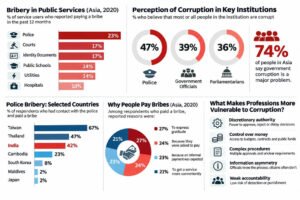
Asia: Police and courts feature prominently
Transparency International’s 2020 Asia survey covered nearly 20,000 people across 17 countries and territories.
| Public service | Service users reporting a bribe |
|---|---|
| Police | 23% |
| Courts | 17% |
| Identity documents | 17% |
| Public schools | 14% |
| Utilities | 14% |
| Hospitals | 10% |
Source: Transparency International — Global Corruption Barometer: Asia 2020.
The police recorded the highest bribery rate in the regional comparison. Courts and identity-document services followed.
The survey also found that 74% of respondents believed government corruption was a major problem in their country, while nearly one in five people who used public services reported paying a bribe.

India: What happens when citizens interact with public institutions?
India deserves particular attention because the survey identified a significant level of bribery in everyday public-service interactions.
In the 2020 Asia survey, India recorded a 39% overall bribery rate among people who accessed public services—the highest reported rate among the countries and territories covered.
For police interactions, the survey reported that 42% of Indian respondents who had contact with the police paid a bribe.
These are not estimates of how many police officers are corrupt. They measure the experiences of citizens dealing with the service.
The finding raises a more fundamental concern: when a citizen approaches an institution for protection, documentation or a service they are legally entitled to receive, why should an unofficial payment become part of the experience?
Source: Transparency International — Asia 2020 survey and full report.
Africa: Police, government officials and parliamentarians
Transparency International, in partnership with Afrobarometer, surveyed approximately 47,000 citizens across 35 African countries in its 2019 Global Corruption Barometer.
The report found that:
| Institution | Respondents who believed most or all people in the institution were corrupt |
|---|---|
| Police | 47% |
| Government officials | 39% |
| Parliamentarians | 36% |
The police were also reported to have the highest bribery rate among public services across the continent.
More than one in four people who accessed public services had paid a bribe during the previous year. The report estimated that this represented approximately 130 million people.
Source: Transparency International — One in four people in Africa pay bribes to access services.
The figures are perceptions of institutions, not findings that 47% of police officers or 39% of government officials have committed corruption.
Nevertheless, the concentration of public concern around law enforcement and government administration is difficult to overlook.
Latin America and the Caribbean: Political leadership and police face scrutiny
Transparency International’s 2019 Global Corruption Barometer for Latin America and the Caribbean surveyed more than 22,000 people across 20 countries.
Its regional findings identified police and politicians as the institutions most commonly perceived as corrupt, with almost half of respondents believing that most or all people in these institutions were corrupt.
The survey also reported:
| Public service | Service users reporting a bribe |
|---|---|
| Police | 24% |
| Utilities | 19% |
| Identity documents | 15% |
| Public schools | 12% |
| Courts | 11% |
| Public clinics and hospitals | 10% |
Source: Transparency International — Global Corruption Barometer: Latin America and the Caribbean 2019.
The report found that 51% of respondents in Mexico and 46% in the Dominican Republic said they had paid a bribe to access public services.
Across the region, 29% of people who had used a public service reported paying a bribe.
The survey also found that only 9% of bribe payers said they had reported the incident to authorities. Among those who did report it, 28% said they experienced negative retaliation.
That last finding is especially important. Corruption becomes harder to challenge when reporting it carries its own risks.
3. What about the world’s wealthier economies?
It would be a mistake to assume that corruption is exclusively a problem of developing countries.
The methods and scale may differ, but concerns about political influence, lobbying, conflicts of interest, procurement and the relationship between public office and private business exist in advanced economies too.
The OECD’s Government at a Glance 2025 provides an important perspective.
Across OECD countries:
- 49% of respondents considered it likely that a high-level political official would grant a political favor in exchange for a lucrative private-sector job.
- Only 31% considered this unlikely.
- Just 36% believed civil servants would reject a bribe intended to expedite access to a public service.
These are public-trust measurements, not observed rates of bribery or proven misconduct.
Source: OECD — Perceptions of Public Sector Integrity, Government at a Glance 2025.
The findings point towards a different form of concern: the relationship between political authority and private-sector opportunity.
A public official may never accept an envelope of cash. Yet decisions about contracts, regulation, appointments, licenses and government policy can still be influenced by private interests.
This is why corruption should not be understood only as a cash transaction. It can also involve favoritism, conflicts of interest, political patronage and the exchange of access for future benefits.
4. The uncomfortable comparison: What do these professions have in common?
Look at the institutions that repeatedly appear in the research:
- Politicians decide how public money is allocated.
- Police officers exercise enforcement powers.
- Judges and judicial officials influence access to justice.
- Government administrators control licenses, permits and approvals.
- Customs and tax officials oversee financial and regulatory obligations.
- Procurement officials influence who receives public contracts.
- Business executives can influence commercial decisions and, in some cases, public policy.
These roles are different, but they share a common characteristic: they can influence decisions that have significant financial, legal or personal consequences for others.
That creates an opportunity for abuse.
It also creates an obligation to establish safeguards.
The question is not whether people in these professions are inherently dishonest. It is whether the systems around them make it possible for a person to misuse authority without being detected or held accountable.
5. What makes corruption so convenient?
Corruption rarely survives because there is no law against it. Most countries already have anti-bribery legislation, investigative agencies, audit mechanisms and penalties.
The more difficult question is why these systems sometimes fail to prevent misconduct.
Several structural factors make corruption easier.
A. Discretionary power
When one official has the authority to approve, reject, delay or accelerate a decision without transparent criteria, the opportunity for favoritism increases.
A license, permit, inspection, police complaint or contract can become a point of leverage.
The more a process depends on an individual’s unexplained discretion, the harder it becomes to distinguish legitimate decision-making from improper influence.
B. Complicated procedures
Excessive paperwork, unclear requirements, repeated approvals and unpredictable timelines create dependency.
People who need a service urgently may become willing to pay someone who promises to make the process move.
The problem is not simply the existence of bureaucracy. It is bureaucracy without transparency, predictable timelines or effective grievance mechanisms.
C. Control over money and contracts
Public procurement is particularly vulnerable because large sums of money are involved.
A tender can be manipulated through restrictive specifications, tailored eligibility criteria, collusion, inflated pricing or undisclosed conflicts of interest.
The result may not look like traditional bribery. It may appear as a legitimate contract awarded through a formal process.
But the economic damage can be substantial.
D. Information asymmetry
An official may know exactly what is required to complete an application, while the citizen has limited knowledge of the rules or process.
A business may not know why its license is delayed or why a competitor’s proposal was accepted.
When information is controlled by one party and cannot be independently verified, the other party becomes vulnerable.
E. Weak accountability
Anti-corruption laws have limited deterrent value when investigations take years, evidence is difficult to obtain, whistleblowers are unprotected or enforcement is selective.
The likelihood of being caught matters.
If the potential gain from misconduct is high and the expected consequences are low, the incentive to abuse power increases.
F. Political and personal connections
Not every corrupt transaction involves money.
A contract awarded to a politically connected company, an appointment made through favoritism or a regulatory exemption granted to an influential business can all undermine fairness.
The exchange may involve access, influence, future employment or reciprocal favors rather than an immediate cash payment.
G. Normalization of informal payments
Perhaps the most troubling condition is when corruption becomes an accepted part of everyday life.
A citizen pays because everyone says it is necessary. A business pays because competitors do. An intermediary charges a fee to obtain an approval that should be routine.
Eventually, the distinction between an official process and an unofficial shortcut becomes blurred.
That is when corruption stops looking exceptional and begins to look convenient.
6. Corruption is not always about the person demanding money
One of the most revealing findings in the Asia 2020 survey concerns why people paid bribes.
Among respondents who paid a bribe, the reported reasons included:
| Reported reason | Percentage |
|---|---|
| To express gratitude | 27% |
| Because they were asked to pay | 24% |
| Because an informal payment was expected | 23% |
| To receive a service more conveniently | 21% |
Source: Transparency International — Global Corruption Barometer: Asia 2020.
The figures reveal something beyond direct demands for money.
Some payments were made because people believed they were expected. Others were made to save time or obtain a service more conveniently.
This is how a culture of informal payments can become self-sustaining.
It is also important not to blame people who pay under pressure. A citizen who pays an unofficial fee to obtain a legally entitled service may be a victim of extortion rather than a willing participant in corruption.
The responsibility for preventing such practices rests with the institutions that control the process.
7. The corporate world has its own corruption risks
Corruption is not confined to public-sector jobs.
The private sector can be both a victim and a participant.
Businesses may face demands for informal payments to obtain licenses, customs clearances, inspections or government contracts. But companies can also offer bribes, manipulate tenders, conceal conflicts of interest or use intermediaries to influence public decisions.
The World Bank Enterprise Surveys examine firms’ experiences with bribery, including requests for informal payments in dealings with public officials.
The risks extend to:
- Procurement and vendor selection.
- Construction and infrastructure contracts.
- Customs and cross-border trade.
- Tax assessments and regulatory inspections.
- Financial services and corporate reporting.
- Political donations and lobbying.
- Third-party agents and intermediaries.
The distinction between public and private corruption is often less clear than people assume.
A public official may misuse authority, but a private company may be the one offering the improper advantage.
Both sides can benefit from a system that lacks transparency.
8. How can societies make corruption harder?
The solution cannot be limited to telling people to be honest.
Institutions must be designed so that decisions are transparent, traceable and independently reviewable.
Some of the most practical measures include:
- Reduce unnecessary discretion: Publish eligibility requirements, decision criteria and approval timelines.
- Digitize with accountability: Maintain auditable records of applications, approvals, payments and changes.
- Open public procurement: Publish tenders, evaluation criteria, contract awards and beneficial ownership information.
- Protect whistleblowers: Provide confidential reporting channels and protection from retaliation.
- Strengthen independent oversight: Ensure investigators, auditors and courts can operate without improper interference.
- Enforce conflict-of-interest rules: Require disclosure of financial interests, relationships and relevant outside employment.
- Make public information accessible: Citizens and businesses should be able to track applications and challenge unexplained decisions.
Technology can help, but digitizing a flawed process does not automatically eliminate corruption. A poorly governed digital system can simply move discretion from a physical desk to an online approval screen.
The objective must be to redesign the process, not merely change the medium.
9. The real question is not which profession is corrupt
The data reveals recurring patterns.
Police services frequently appear in bribery surveys. Politicians and elected representatives attract substantial public distrust. Government officials, courts and other administrative institutions also feature prominently in regional research.
But the numbers do not establish that a particular profession is inherently corrupt, nor do they measure the proportion of employees in that profession who have committed misconduct.
They reveal where citizens experience bribery, where institutional confidence is weak and where the exercise of authority deserves greater scrutiny.
Lord Acton’s famous observation remains relevant:
“Power tends to corrupt and absolute power corrupts absolutely.”
The quotation is often used to describe the danger of unchecked authority. But the answer cannot be to distrust everyone who holds a position of responsibility.
It must be to ensure that responsibility comes with transparency, oversight and consequences.
A police officer should be accountable for the use of enforcement powers. A judge should be protected from improper influence and subject to appropriate accountability. A politician should be answerable for public decisions. A business executive should be accountable for commercial conduct.
The same principle applies everywhere: authority must never become immunity.
Perhaps the most uncomfortable conclusion is that corruption does not always need a particularly dishonest person. Sometimes it only needs an opaque process, a powerful gatekeeper, a desperate citizen and a system that makes reporting misconduct more difficult than paying for a shortcut.
So, are certain professions more corrupt—or have we created positions where corruption is simply easier, more profitable and less risky?
That is a question worth asking across every country, every institution and every level of authority.
Research sources
- Transparency International — Global Corruption Barometer: Asia 2020
- Transparency International — Global Corruption Barometer: Africa 2019
- Afrobarometer — Global Corruption Barometer Africa 2019
- Transparency International — Global Corruption Barometer: Latin America and the Caribbean 2019
- OECD — Government at a Glance 2025: Perceptions of Public Sector Integrity
- World Bank — Enterprise Surveys
- Financial Action Task Force — Corruption