


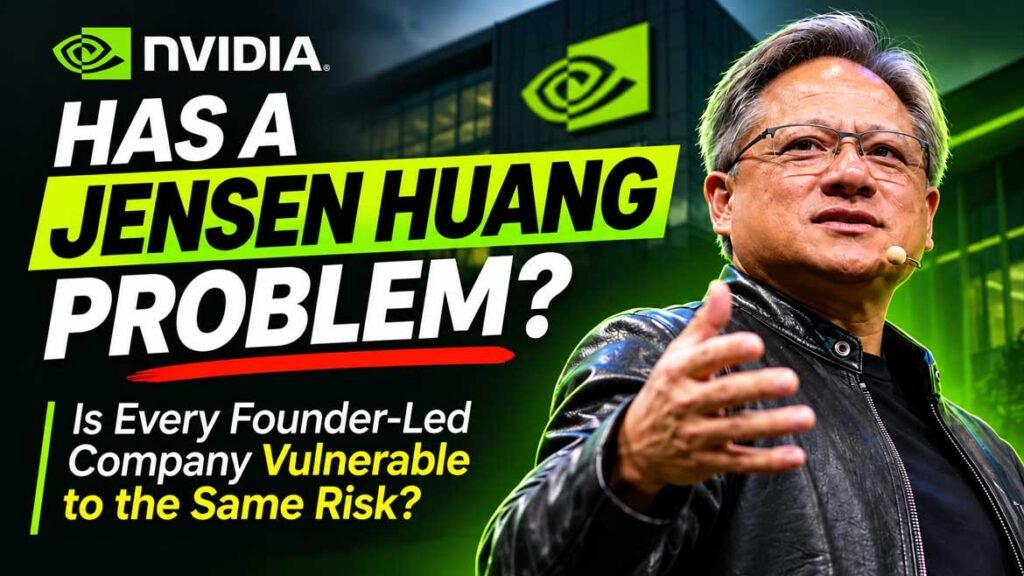
Jensen Huang has become almost inseparable from NVIDIA’s identity, strategy and extraordinary rise in the artificial intelligence industry. But when a company’s most valuable asset becomes one individual, an uncomfortable question emerges: has the founder built an enduring institution, or an organization that depends too heavily on him?
There is something unusual about NVIDIA.
The company makes some of the world’s most important computing technology. Its processors power AI infrastructure, its software ecosystem has become deeply embedded in the technology industry, and its business has positioned itself at the center of the global artificial intelligence race.
Yet, ask people to describe NVIDIA and the first image that often comes to mind is not a GPU, a data center or a software platform.
It is a man wearing a black leather jacket.
Jensen Huang.
The co-founder and CEO has become one of the most recognizable personalities in global technology. His keynote presentations attract enormous attention. His public appearances generate headlines. His vision has helped shape how investors, governments and technology companies understand the future of AI.
For more than three decades, Huang has been at the center of NVIDIA’s evolution.
But this extraordinary association between a company and its founder is now raising a question that NVIDIA, its investors and perhaps the entire technology industry cannot afford to ignore.
What happens when a company becomes so closely associated with its founder that the founder’s personal circumstances become a business risk?
Recent developments have brought this question into focus. Following reports concerning Huang and an alleged foreign intelligence effort, NVIDIA’s board announced an independent investigation on November 8, 2026. The board said it had no reason to believe that national security or NVIDIA’s confidential information had been compromised.
The investigation is ongoing. No finding of wrongdoing has been established.
But the development has placed something much bigger under the spotlight: the concentration of influence, leadership and public identity around one individual.
This is not simply an NVIDIA story.
It is a story about founder-led companies, corporate governance, succession planning and the difficult transition from building a successful business to building an institution that can survive beyond its founder.
And it raises a particularly uncomfortable question for today’s generation of entrepreneurs:
Can a founder become too important to the company they created?
The founder is the greatest asset. Until the company depends on the founder.
There is a reason founders often become the most powerful individuals in their organizations.
They understand the business at a level that few executives can replicate. They know why a product was created, which customers matter most, where the market is heading and which strategic decisions shaped the company’s identity.
More importantly, they often possess something that conventional corporate executives take years to develop: an unusually strong conviction about the future.
Jensen Huang is an example of this leadership model.
When NVIDIA was founded in 1993, its future was not obvious. The company initially focused on graphics processing technology, particularly for the gaming and computer graphics industries.
Huang and his co-founders made a series of long-term technological bets that eventually helped NVIDIA expand into accelerated computing, scientific research and artificial intelligence.
The transformation did not happen overnight. It involved decades of engineering, software development, ecosystem building and strategic investment.
Today, NVIDIA is much more than a semiconductor manufacturer. Its GPUs, CUDA software ecosystem and data-center platforms have become central to modern AI infrastructure.
Huang’s ability to communicate this vision, anticipate technological shifts and maintain relationships across the global technology industry has become an important part of the company’s competitive advantage.
This is what business analysts often describe as the founder premium.
Investors trust the founder’s judgment. Employees believe in the founder’s vision. Customers associate the founder with the company’s products. The market begins to see the founder and the business as almost interchangeable.
Initially, this is an advantage.
But somewhere along the growth journey, the same advantage can become a vulnerability.
A founder who once made decisions quickly may eventually become the person through whom every major decision must pass. An executive team that should be independently leading the business may become accustomed to seeking the founder’s approval.
The company grows. Its revenues expand. Its workforce multiplies. Its global footprint becomes increasingly complex.
But its decision-making architecture may remain concentrated around one individual.
The founder builds the company. The company builds its dependence on the founder.
And that is where the problem begins.
NVIDIA: When the CEO becomes part of the company’s identity
NVIDIA’s success is not the work of one individual. It is the result of engineering teams, researchers, software developers, business executives, customers and an ecosystem that has developed over decades.
Yet Huang’s public identity is unusually intertwined with the company’s commercial and strategic narrative.
He is its chief executive, a prominent technology spokesperson and one of the most influential personalities in the AI industry.
His presentations help define the company’s roadmap. His relationships with technology leaders and customers have become part of its global influence.
This creates an interesting organizational question.
Can NVIDIA maintain the same strategic confidence, market relationships and leadership continuity if Huang is suddenly unavailable?
There are reasons to take the question seriously.
Associated Press reporting in November 2026 highlighted the unusually broad span of Huang’s direct reporting relationships, with more than 60 executives reportedly reporting to him.
NVIDIA’s own FY2026 annual report also acknowledges its dependence on its longstanding executive team. It explicitly warns that failure to ensure effective succession planning, knowledge transfer and smooth leadership transitions could hinder its strategic planning, execution and long-term success.
That disclosure is particularly important.
It demonstrates that leadership continuity is not merely an external concern raised by investors or journalists. It is a risk that NVIDIA itself recognizes.
There is another dimension to consider.


In a company operating at NVIDIA’s scale, the CEO’s role extends far beyond managing internal operations. It includes relationships with hyperscalers, technology companies, governments, investors, research institutions and strategic partners.
Replacing an executive may be relatively straightforward on paper.
Replacing the trust, credibility and relationships accumulated over more than three decades is considerably more difficult.
And this is precisely why founder dependency deserves attention.
It is not about questioning whether Huang is a good CEO. His achievements are evident.
It is about asking whether NVIDIA has built enough institutional capability to ensure that the company can continue operating with confidence without requiring his personal involvement in every critical relationship and strategic decision.
The real danger: When the organization stops developing independent leaders
A founder-centric organization does not necessarily have weak executives.
In fact, many such companies employ some of the world’s most capable business leaders, engineers and strategists.
The problem is different.
Having talented executives is not the same as having an organization that can function independently of its founder.
Consider what happens when a company develops a culture in which the founder is the ultimate decision-maker.
Senior executives may become exceptionally good at executing the founder’s vision. They understand the founder’s preferences, anticipate decisions and coordinate their departments accordingly.
But are they equally capable of making independent strategic decisions?
Can they challenge the founder?
Can they disagree with the founder’s assumptions?
Can they make decisions that might be unpopular but necessary for the organization?
These are important questions because organizational maturity is not measured by how efficiently employees execute instructions from the top.
It is measured by whether the organization can make sound decisions at every level without waiting for the top.
This is particularly relevant in technology companies, where markets change rapidly and strategic decisions often need to be made before competitors recognize an opportunity.
A founder who remains the center of every important decision can unintentionally slow down the very organization they once accelerated.
The company may continue to grow, but its leadership structure may fail to evolve at the same pace.


Apple: Steve Jobs was irreplaceable. But Apple did not stop without him.
Perhaps the most compelling example of founder dependency in technology is Apple.
Steve Jobs was not simply the CEO of Apple. He was its product visionary, its most recognizable spokesperson and the person most closely associated with its transformation into one of the world’s most influential companies.
His influence on the iPhone, iPad, Mac and Apple’s broader product philosophy was extraordinary.
When Jobs resigned as CEO in August 2011 and Tim Cook took over, there was considerable uncertainty about Apple’s future.
Could someone who was not Steve Jobs lead Apple?
Would the company retain its innovation culture?
Would it continue to create products that changed entire industries?
Cook did not attempt to become another Steve Jobs.
He brought a different leadership philosophy, emphasizing operational excellence, supply-chain capabilities, services and disciplined execution.
Apple continued to grow.
Under Cook, the company expanded its global operations, strengthened its services business and developed its position in areas such as wearables and digital services.
The more recent transition to John Ternus, who became Apple’s CEO on September 1, 2026, offers another important lesson.
Apple announced the transition in April 2026, describing it as the outcome of a long-term succession planning process approved unanimously by its board.
Ternus had joined Apple in 2001 and progressed through its engineering leadership structure before becoming CEO.
Apple did not need to find an external celebrity to replace its CEO. It developed an internal leader who understood the organization, its products and its operating culture.
This is institutional leadership in practice.
The lesson is not that Apple has eliminated every risk associated with leadership transitions. No organization can do that.
The lesson is that a company must develop the capacity to move forward without relying on the continued presence of one extraordinary individual.
Jobs built Apple into a global institution.
Cook demonstrated that the institution could evolve beyond Jobs.
And Ternus now inherits an organization that has had years to prepare for its next leadership chapter.
Microsoft: When a founder steps back, the company can reinvent itself
Microsoft offers another interesting perspective.
Bill Gates co-founded Microsoft in 1975 and became one of the most influential figures in the history of computing.
For decades, his vision shaped the company’s products, business strategy and competitive position.
However, Microsoft’s transition through Steve Ballmer and subsequently Satya Nadella demonstrated that a technology company can evolve beyond its founding generation.
Nadella became CEO in February 2014 after leading Microsoft’s Cloud and Enterprise business.
He inherited a company with extraordinary technology capabilities but facing significant questions about its strategic direction.
Rather than attempting to preserve every aspect of Microsoft’s historical identity, Nadella pursued a substantial transformation.
Cloud computing became a central strategic priority. Microsoft expanded its enterprise platform capabilities, embraced a more open approach to technology partnerships and strengthened its position in artificial intelligence.
The company also underwent a cultural transformation, moving towards greater collaboration and a growth-oriented mindset.
The interesting part is that Microsoft’s transition was not about finding another Bill Gates.
It was about finding a leader who could take the company into a different technological era.
Gates remained involved in Microsoft’s history and governance for years after leaving the CEO position, but the organization progressively developed its own leadership identity.
For NVIDIA, this distinction matters.
The next leader does not need to be another Jensen Huang.
The next leader needs to understand NVIDIA’s technology, ecosystem and strategic position while having the authority and credibility to lead the company into its next phase.
Infosys: India’s experience with founder-to-professional leadership
This conversation is equally relevant to Indian businesses.
Infosys provides one of India’s most interesting examples of a company transitioning from founder leadership towards a broader professional management structure.
Founded in 1981 by N. R. Narayana Murthy and six engineers with an initial capital of US$250, Infosys grew into a globally recognized IT services company.
Murthy was central to its early identity, but the company gradually developed leadership beyond its founding generation.
In 2002, Nandan Nilekani took over as CEO from Murthy.
In 2007, Kris Gopalakrishnan became CEO, followed by S. D. Shibulal in 2011.
These transitions demonstrated the importance of developing experienced leaders within the organization.
Infosys has certainly experienced its share of governance disagreements, leadership controversies and periods of uncertainty. Its journey should not be presented as a perfect succession model.
Nevertheless, its history offers an important lesson for Indian entrepreneurs.
A business that begins with the founder’s personal vision must eventually develop professional management, independent leadership and institutional processes.
This becomes especially important when a company starts serving international customers, managing large workforces and operating across multiple markets.
The founder cannot remain the organization’s only source of strategic direction forever.
Berkshire Hathaway: The importance of preparing before the transition becomes necessary
If there is one company that demonstrates the value of long-term succession planning, it is Berkshire Hathaway.
Warren Buffett has been synonymous with Berkshire Hathaway for decades.
His investment philosophy, capital allocation decisions and reputation have become deeply connected to the organization’s identity.
Yet Berkshire did not wait for an unexpected event to determine its leadership future.
Greg Abel succeeded Buffett as CEO on January 1, 2026, following a transition approved by the company’s board.
Buffett remains chairman.
The company’s 2026 proxy statement also confirms that succession planning is discussed at every board meeting.
This is a significant detail.
It demonstrates that succession is not treated as an administrative matter to be addressed when a CEO is ready to leave.
It is an ongoing responsibility of the board.
Berkshire’s decentralized operating model also offers an interesting contrast to many founder-centric technology companies. Its numerous operating businesses have their own management teams and considerable operational autonomy.
The transition does not mean Buffett’s experience and influence can simply be replaced. His reputation and investment judgment are unique.
But Berkshire has demonstrated that the organization can prepare for a leadership change while maintaining continuity.
That is the difference between depending on a founder and building an institution around the founder’s legacy.
The uncomfortable question: Who really governs the founder?
There is another issue that deserves attention.
Founder dependency is not just a succession problem. It is also a corporate governance problem.
In a professionally managed organization, the board is expected to provide independent oversight, challenge management decisions and protect the interests of shareholders.
But what happens when the CEO is also the company’s founder, its most influential public personality and the individual most closely associated with its commercial success?
The relationship between the board and the founder can become complicated.
A highly successful founder may have extraordinary influence over the organization. Directors may have enormous confidence in their judgment. Employees may be reluctant to challenge their decisions. Investors may associate criticism of the founder with criticism of the company’s future.
This creates the possibility of a governance imbalance.
A board should not exist merely to endorse the founder’s decisions.
It should be capable of challenging them.
NVIDIA’s decision to appoint an independent committee to oversee its current investigation is an important governance development. The board has stated that it has confidence in Huang and his leadership team while also undertaking an independent review.
The two positions are not contradictory.
A company can have confidence in its CEO and still investigate concerns that deserve independent scrutiny.
Indeed, that is precisely what effective corporate governance should enable.
The real test of a board is not how it behaves when everything is going well.
It is how independently it can act when the company’s most influential executive becomes the subject of difficult questions.
The research behind the founder succession problem
This is not merely a theoretical discussion.
A January–February 2026 Harvard Business Review article, Leading After the Founder, examines the challenges associated with founder transitions.
The authors report that founder-CEO transitions carry a risk of failure or performance downturn that is two to three times greater than transitions involving non-founder CEOs.
That is a striking finding.
Founder transitions are particularly complicated because they involve more than changing the person occupying the CEO’s office.
The founder may have established the company’s culture, relationships, decision-making habits and strategic identity. Employees may remain emotionally attached to the founder, while the incoming CEO must establish credibility without undermining the organization’s history.
The successor is therefore expected to do two things simultaneously:
Preserve what made the company successful.
And change what must evolve for the company to remain successful.
This is not an easy balancing act.
A succession plan that simply identifies a replacement executive is insufficient. The company must also prepare its employees, board, customers and wider leadership team for the transition.
It must ensure that the incoming leader has genuine authority rather than becoming a nominal CEO while the founder continues making the important decisions.
A founder who steps aside but continues exercising informal control can create a second leadership center within the organization.
And that can be just as damaging as having no succession plan at all.
What founders should learn from the NVIDIA situation
There is a temptation to think that founder dependency is a problem for companies such as NVIDIA, Apple or Microsoft.
It is not.
It begins much earlier.
Consider a startup with 30 employees. The founder manages the biggest customer relationships, approves important expenditures, leads product discussions and makes the final hiring decisions.
This is understandable.
But the company grows to 100 employees, then 300, then 1,000.
If the founder continues operating in exactly the same way, the organization may eventually become dependent on their availability.
The founder becomes the escalation point for everything.
A customer wants a decision? Contact the founder.
A senior employee needs approval? Contact the founder.
A strategic partnership is being negotiated? Contact the founder.
A major operational problem emerges? Contact the founder.
The founder may feel indispensable. The organization may even celebrate this as evidence of strong leadership.
But there is a difference between being valuable and being indispensable.
If your business cannot make important decisions without you, you may have built a successful business, but you have not yet built a scalable institution.
There are five areas founders should begin addressing as their businesses grow:
1. Distribute decision-making authority.
Build a leadership team that can independently make strategic and operational decisions. Delegation should involve genuine authority, not merely responsibility for executing instructions.
2. Develop successors before they are needed.
Identify potential leaders, expose them to important decisions and allow them to manage business-critical responsibilities. Succession should be a continuous development process.
3. Institutionalize relationships and knowledge.
Important customer relationships, strategic partnerships, technical knowledge and operational processes should not exist exclusively within the founder’s personal network.
4. Strengthen independent governance.
Boards must be capable of questioning the founder, reviewing risks and making decisions in the long-term interests of the organization.
5. Redefine the founder’s role.
As a company matures, the founder must move from being the person who personally drives every outcome to the person who develops an organization capable of delivering those outcomes independently.
These are not signs of weakening founder influence.
They are signs of leadership maturity.
The ultimate test of a founder is what happens when they are no longer there
NVIDIA’s immediate circumstances will continue to evolve. The board’s investigation will establish what can be established, and the company will continue navigating the challenges of an increasingly competitive AI industry.
But the larger leadership question will remain relevant long after the current headlines disappear.
Jensen Huang has helped build one of the most consequential technology companies of our time. That achievement should not be diminished by a discussion about succession or organizational dependency.
If anything, it makes the discussion more important.
The greater a company becomes, the greater its responsibility to ensure that its future does not depend entirely on the continued presence of one person.
Apple has demonstrated that a technology company can move beyond its iconic founder. Microsoft has shown that a company can reinvent itself through successive generations of leadership. Infosys offers an Indian example of professional leadership transitions, while Berkshire Hathaway demonstrates the importance of preparing for succession well before it becomes unavoidable.
None of these transitions is identical. None eliminates every organizational risk.
But they share an important principle: enduring companies must develop capabilities that extend beyond the individuals who initially built them.
The next generation of entrepreneurs should think about this much earlier than they probably do.
Building a billion-dollar company is an extraordinary achievement.
Building a company that can continue to innovate, compete and grow without its founder is an even greater one.
A founder’s greatest achievement should not be becoming indispensable to the company. It should be building a company that no longer needs them to be indispensable.
And perhaps that is the most important question NVIDIA’s story leaves behind for every founder, CEO, investor and boardroom.
Are you building a business that depends on you, or an institution that can outlive you?