


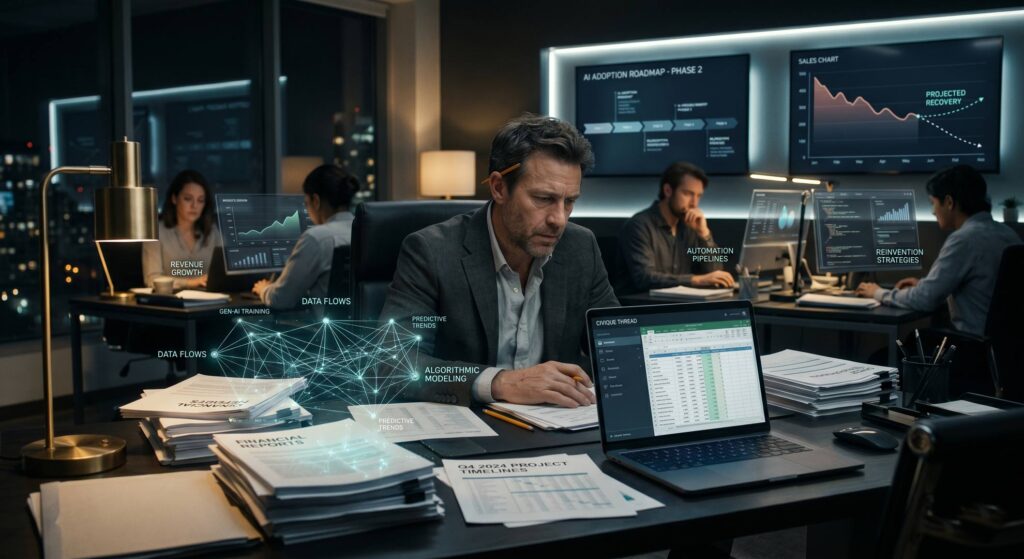
For many small and mid-sized technology companies, the current business environment feels less like growth and more like survival. Revenues are slowing, margins are shrinking, clients are demanding faster delivery at lower costs, and artificial intelligence is rapidly transforming industries faster than most organizations can adapt. While large enterprises are investing heavily into AI transformation, automation, and scalable digital products, many service-driven companies remain trapped in operational firefighting — spending all their energy delivering ongoing projects just to keep the business afloat.
This is not an isolated situation. It is becoming one of the biggest silent crises in the technology and consulting ecosystem.
At Chief Magazine, we believe this moment should not be viewed only as a threat. It should also be viewed as a turning point.
The harsh reality is that investors today are no longer impressed by companies that merely execute projects. Investors seek scalability, recurring revenue, intellectual property, AI-readiness, strong positioning, and future adaptability. A company surviving entirely on manpower-based services without innovation or product direction is increasingly vulnerable in the new economy.
But here is the important truth many founders forget:
A struggling company is not necessarily a failed company. Often, it is simply a company that has not yet repositioned itself for the future.
The Dangerous Trap of “Busy but Not Growing”
One of the most common problems founders face is operational exhaustion. Teams remain occupied with client delivery, bug fixing, support work, and chasing payments. The company appears active from the outside, but internally there is no innovation, no research, no experimentation, and no strategic direction.
Being constantly busy creates an illusion of progress.
However, activity without evolution slowly weakens a company. Over time, the organization loses market relevance while competitors adopt automation, AI-assisted workflows, SaaS products, and scalable solutions.
The biggest risk today is not AI replacing companies.
The biggest risk is companies refusing to redesign themselves around AI.
Why Investors Are Hesitating
Many founders complain that funding is difficult. But investors are responding to risk patterns they repeatedly observe:
- Heavy dependence on a few clients
- No recurring revenue streams
- No proprietary technology
- Outdated delivery models
- Weak branding and positioning
- Lack of AI integration strategy
- Founders operating reactively instead of strategically
In today’s environment, investors are looking for signals of long-term sustainability. Even a small company can attract attention if it demonstrates clarity of direction, niche expertise, operational efficiency, and a vision for scalable value creation.
A company does not need to become the next global unicorn overnight. But it must show that it understands where the future is moving.
The Shift Founders Must Make
The first transformation is psychological.
Founders must stop thinking like survival managers and start thinking like strategic architects. This means allocating time not only to delivery, but also to reinvention.
That reinvention may include:
1. Building Small Internal Products
Instead of waiting for massive funding, companies should start small. Internal tools, automation platforms, AI-powered dashboards, industry-specific solutions, or workflow products can evolve into scalable assets over time.
Even a modest SaaS product serving a niche industry can create more long-term value than dozens of low-margin service projects.
2. Adopting AI Internally Before Selling It
Many companies talk about AI but fail to use it operationally.
AI should first improve internal efficiency:
- Proposal generation
- Development acceleration
- Customer support automation
- Testing and documentation
- Data analytics
- Project estimation
- Sales intelligence
Companies that use AI internally become leaner, faster, and more competitive.
3. Choosing a Strong Niche
Generalist companies are facing increasing pressure. Specialized expertise creates differentiation.
A company serving healthcare automation, manufacturing analytics, government digital transformation, ERP modernization, logistics intelligence, or AI surveillance solutions has a stronger market identity than a company offering “everything for everyone.”
Clarity attracts trust.
4. Rebuilding the Brand Narrative
Sometimes the business capability exists, but the market perception does not.
Founders need to ask:
- Does our website reflect future readiness?
- Are we positioned as innovators or only vendors?
- Do clients understand our strategic value?
- Are we showcasing expertise or just portfolios?
Perception influences opportunity.
The Importance of Controlled Reinvention
One major mistake struggling companies make is attempting aggressive transformation overnight. That often creates more instability.
Transformation should be intentional and phased:
- Stabilize operations
- Improve profitability
- Reduce dependency risks
- Introduce automation
- Build strategic partnerships
- Develop small intellectual property assets
- Strengthen leadership visibility
The goal is not sudden disruption.
The goal is sustainable evolution.
Leadership During Uncertainty
The emotional burden on founders is rarely discussed openly. Many leaders silently carry financial pressure, employee responsibilities, family expectations, and fear of failure simultaneously.
But history repeatedly shows that some of the strongest companies emerge during periods of uncertainty.
What separates successful founders is not the absence of struggle. It is their ability to make thoughtful decisions while facing uncertainty.
This is the time for leaders to think clearly, not emotionally.
A Final Thought from Chief Magazine
The AI era is not the end of service companies. It is the end of outdated thinking.
Businesses that survive the next decade will not necessarily be the biggest companies. They will be the companies most willing to learn, adapt, specialize, automate, and reinvent themselves continuously.
Every founder must ask one difficult question:
“Are we building a company designed for the future, or are we only maintaining a company designed for the past?”
The answer to that question may define the next chapter of their business journey.