



Anthropic’s public listing could become a defining moment for the AI industry. But beneath the extraordinary growth figures lies a more important question: can the economics of artificial intelligence justify the capital required to build it?
On October 26, 2026, Anthropic, the company behind Claude, publicly filed for an initial public offering (IPO) in the United States. The filing could set the stage for one of the most closely watched public listings in technology history.
Reports suggest the offering could value Anthropic at between $1.5 trillion and $2 trillion and potentially raise as much as $100 billion. Neither figure is final: the company has not established its definitive offering price or the number of shares to be sold.
Yet the numbers already demand attention. Anthropic’s reported revenue reached $16.29 billion in the first half of 2026, compared with $1.16 billion in the same period a year earlier. At the same time, the company disclosed substantial losses and enormous long-term commitments to computing infrastructure.
For startup founders, SaaS companies and investors, this is more than another AI headline. It is a test of how the market values growth, technology, capital efficiency and the possibility of future profits.
Anthropic’s IPO raises a fundamental question: are investors valuing an AI business on the strength of its current economics, or on the scale of the future they believe it can create?
1. The growth is extraordinary. So is the financial commitment.
Anthropic’s growth trajectory helps explain the excitement surrounding its proposed listing.
According to Reuters’ October 26 report, the company generated $41 million in revenue in 2023, $386 million in 2024 and $4.59 billion in 2025. Its revenue for the first six months of 2026 reached $16.29 billion.
These figures illustrate how quickly enterprise demand for AI products can develop when a company finds commercially valuable applications. Anthropic’s focus on coding tools, business workflows and enterprise customers has helped it expand beyond the market for general-purpose chatbots.
However, growth alone does not tell us whether the business model is sustainable.
Reuters reported an operating loss of $693 million for the first half of 2026, compared with $2.14 billion in the corresponding period a year earlier. Separately, Anthropic reported a net loss of $80.7 billion for that half-year, much of which reflected a large accounting charge associated with the changing estimated value of financial instruments that may convert into shares.
These are different measures. The reported net loss should not be interpreted as $80.7 billion of ordinary operating cash expenditure. Nevertheless, the disclosures reveal the complexity of evaluating an AI company whose valuation, financing structure and infrastructure needs are changing rapidly.
The other major consideration is computing capacity.
Anthropic has made extensive long-term commitments to cloud and computing infrastructure. Reuters has reported commitments exceeding $500 billion across several partners over approximately a decade. These commitments are not equivalent to money already spent, but they represent significant future obligations and expose the company to questions about demand, utilization and returns on infrastructure investment.
The central tension is clear: AI companies can generate revenue at extraordinary speed, but serving customers and developing increasingly capable models also require substantial resources.

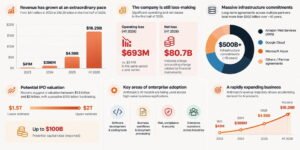
Anthropic’s growth story reveals both the scale of enterprise AI demand and the capital required to compete. Reported figures and valuation estimates reflect disclosures and reporting available in October 2026.
2. Why would investors consider a valuation approaching $2 trillion?
A valuation is not simply a reward for current revenue. It reflects expectations about future cash flows, growth, competitive position and risk.
In Anthropic’s case, investors are being asked to assess whether its current momentum can translate into a much larger business over the coming years.
The opportunity extends beyond individual subscriptions. Enterprise customers may use AI across software development, customer service, document processing, research and internal operations. As these applications become embedded in business workflows, usage and spending could increase.
The addressable market is therefore potentially much larger than consumer chatbot subscriptions alone.
But expectations matter enormously at this scale. A valuation of $1.5 trillion to $2 trillion would require investors to believe that Anthropic can sustain growth, retain customers, defend its position against competitors and eventually generate financial returns commensurate with its market value.
The Reuters report on Anthropic’s IPO provides useful context for understanding both sides of that equation.
A successful product can attract customers quickly. A durable business must also retain those customers, price its products appropriately, manage costs and withstand competition.
That distinction is particularly important for AI companies because access to powerful models is becoming more widespread. Differentiation may increasingly depend on proprietary data, distribution, workflow integration, reliability and customer relationships rather than model performance alone.
The potential valuation is therefore a statement about expectations, not proof that those expectations will be fulfilled.
3. The AI opportunity is bigger than building the next frontier model
One of the most important lessons for startup founders is that the AI market is not limited to companies developing large foundation models.
Anthropic is competing at the frontier of AI development, which requires substantial capital, specialized talent and access to computing infrastructure. Most startups cannot replicate that model of competition—and do not need to.
The opportunity for smaller businesses often lies in applying existing models to specific, expensive problems.
Consider a company building AI tools for insurance claims, financial compliance, healthcare administration or industrial maintenance. Its value may come from understanding a particular workflow, integrating with established systems, handling industry-specific documents and producing reliable results.
The underlying model may be available to competitors. The complete solution can still be difficult to replicate.
This is the distinction explored in Chief Magazine’s editorial, Everyone Is Building Bigger AI Models. But That’s Not the Real Race..
The next generation of successful AI businesses may emerge from different layers of the ecosystem:
- AI applications: Products that solve identifiable customer problems and generate recurring revenue.
- Industry-specific intelligence: Systems that combine models with specialized data and domain expertise.
- AI infrastructure: Tools for evaluation, security, data management, monitoring and deployment.
- AI-enabled services: Businesses that use automation to deliver better outcomes or improve service economics.
- Agentic workflows: Systems that do more than generate responses by executing tasks within defined permissions and controls.
For founders, the implication is encouraging. There is no requirement to build a trillion-dollar model company to build a valuable AI business.
The more useful question is whether the product solves a problem customers will pay to solve—and whether the company can deliver that outcome profitably.
4. What should investors examine beyond revenue growth?
Anthropic’s IPO highlights the need for investors to look beyond headline revenue and valuation.
Revenue quality
Rapid growth is valuable, but investors need to understand where revenue comes from. Are customers signing long-term contracts or using services on a flexible basis? Is spending recurring? Are a few customers responsible for a disproportionate share of revenue?
A company with predictable customer relationships may be better positioned to plan infrastructure investments than one whose revenue depends heavily on short-term usage.
Gross margins and infrastructure costs
AI economics differ from those of many traditional software businesses.
A conventional SaaS product can often serve additional customers at relatively low incremental cost. AI products may incur meaningful computing costs as customers generate more requests, process more documents or use more complex models.
Investors therefore need to understand the relationship between customer usage, pricing, inference costs and gross margins.
Revenue can grow rapidly while the cost of serving customers also increases. The critical question is whether the economics improve as the business scales.
Capital commitments and financing risk
Long-term infrastructure agreements can secure capacity, but they can also limit flexibility.
If demand grows more slowly than expected, a company may face commitments that are difficult to reduce. If demand grows faster than expected, it may need additional capacity and financing.
Investors should distinguish capital already deployed from contractual commitments, future spending plans and contingent obligations.
Customer concentration and dependency
AI businesses may depend on a relatively small number of cloud providers, infrastructure partners or major customers. These relationships can accelerate growth, but they can also create bargaining-power and continuity risks.
The same companies that supply infrastructure may also invest in AI developers or compete with them. Such relationships are not inherently problematic, but their commercial implications deserve careful scrutiny.
The path to sustainable profitability
A business need not be profitable immediately to be valuable. But investors should understand what must happen for profitability to emerge.
Will inference costs fall? Can pricing remain resilient? Will customers expand their use of the product? Can the company develop differentiated offerings that command higher margins?
A credible financial model should make these assumptions explicit rather than relying on the idea that scale will automatically solve the economics.
5. What should startup founders learn from Anthropic?
The most useful lesson is not that every startup should raise more capital or pursue a bigger valuation.
It is that founders need to understand which parts of their business become more valuable as they scale—and which become more expensive.
For an AI startup, that means answering five questions.
First, what specific problem are you solving? A broad claim about transforming an industry is not a substitute for evidence that customers have a problem worth paying to solve.
Second, why will customers choose you? The answer might be domain expertise, proprietary data, a better workflow, superior reliability or distribution. Simply adding a chatbot to an existing product may not provide lasting differentiation.
Third, do the unit economics work? Founders should measure the cost of delivering the service, including model usage, infrastructure, human review, customer support and integration.
Fourth, what happens when the market changes? Model providers may lower prices, introduce competing features or change access conditions. Businesses need to understand how resilient their value proposition is under those circumstances.
Finally, how much capital does the business actually need? Some AI companies require significant investment in research and infrastructure. Others can build valuable businesses by combining existing models with specialized workflows. The financing strategy should reflect the business model, not the prestige associated with raising a large round.
For further context, read Chief Magazine’s Surviving the AI Shift: A Wake-Up Call for Struggling Service Companies, which examines why businesses need to rethink their operating models and competitive positioning as AI adoption expands.
6. The public markets will test the AI investment thesis
An IPO changes the environment in which a company is evaluated.
Private investors can fund a long-term vision while relying on periodic fundraising rounds and private-market valuations. Public investors have access to more extensive disclosures and can reassess their expectations as financial results emerge.
That does not mean public markets always value businesses correctly. It does mean that companies face a different kind of scrutiny once they are publicly traded.
Anthropic’s proposed listing could become an important reference point for the broader AI market. It may influence how investors assess other AI companies, how founders approach fundraising and how enterprise customers think about the long-term stability of their technology suppliers.
But a single IPO will not establish a universal valuation formula for AI.
Anthropic operates at a particular scale, with a particular product portfolio, infrastructure strategy and competitive position. A smaller AI startup should not assume that its own valuation should follow the same revenue multiples or growth expectations.
Investors must evaluate each business according to its own economics, risks and prospects.
Conclusion: The AI boom needs more than belief
Anthropic’s IPO represents both the promise and the difficulty of investing in artificial intelligence.
The company’s revenue growth demonstrates that demand for advanced AI products can expand rapidly. Its infrastructure commitments and financial disclosures also show that building and operating AI at the frontier is an expensive undertaking.
For startups, the opportunity is to identify valuable problems, develop defensible capabilities and build business models that can withstand competition.
For investors, it is to separate genuine commercial progress from assumptions that depend on perpetual growth, cheap capital or an indefinitely expanding market.
For enterprise leaders, it is to distinguish between AI that generates impressive demonstrations and AI that delivers measurable operational or financial results.
The industry does not need every company to become the next Anthropic. It needs more businesses to turn AI capabilities into reliable products, sustainable economics and tangible customer value.
The biggest question facing AI is no longer just how intelligent the technology can become. It is whether the businesses built around it can convert that intelligence into lasting economic value.
Editorial note: Anthropic’s IPO valuation and potential fundraising amount remain estimates reported by media outlets, not final offering terms. Financial figures in this article refer to reported disclosures as of October 26, 2026. Operating losses, net losses, accounting adjustments and long-term infrastructure commitments are distinct measures and should not be treated as interchangeable.