


A regional sales manager in Pune spends Monday morning on a call with eight team leads, collecting updates on pipeline, blockers and forecasts. By the time the calls end, a dashboard already has the numbers — pulled automatically, updated in real time, more accurate than what any of the eight people just reported from memory.
By Tuesday, a meeting summary tool has produced cleaner notes than the manager would have taken by hand, flagged the two accounts at risk, and drafted a follow-up email nobody asked it to write.
By Wednesday, the manager is preparing a weekly report that, technically, no longer needs to be prepared. The system already knows.
So what was Monday actually for?
This is not a hypothetical. It is the quiet, unresolved question sitting inside a huge number of Indian and global organizations right now — asked less often out loud than it should be, because admitting it means admitting that a job millions of people hold, and millions more aspire to, is not what it used to be. The tools have changed faster than the job description.
The Manager’s Old Job Is Being Unbundled
For most of the last century, a manager’s core value proposition was coordination. Someone had to collect information from scattered individuals, make sense of it, pass it upward in usable form, translate strategy back down into tasks, track who was doing what, and chase the people who weren’t. This was not glamorous work, but it was necessary work, and it justified a layer of the organization chart.
That layer is now competing with software that does several of these things faster and, in some respects, better. Project-management platforms provide real-time visibility without anyone asking for a status update. Dashboards surface performance data continuously rather than in a weekly report. AI tools summaries meetings, draft documents, flag anomalies and prepare first-cut analysis before a manager has opened their laptop.
McKinsey’s research on the topic — most notably Power to the Middle, the 2023 book by McKinsey partners Emily Field and Bryan Hancock with senior partner emeritus Bill Schaninger — found something telling even before this latest wave of AI tools matured: middle managers were already spending less than 25% of their time actually managing people, buried instead under administrative and coordination work. Forty-three percent reported being burned out. This was the baseline the technology arrived into — not a well-functioning system being disrupted, but an overloaded one finally being offered relief, and simultaneously being asked to justify itself in the process.
Gartner has been blunt about where this leads structurally. In an October 2024 prediction, the firm forecast that by 2026, one in five organizations will use AI to flatten their structure and reduce reliance on middle-management layers — automating scheduling, reporting and performance monitoring so that remaining managers can, in theory, focus on higher-value work. Several large global employers have already begun doing exactly this, restructuring around wider spans of control and fewer coordination layers.
The problem isn’t that managers are becoming irrelevant.
It’s that some of the work historically used to justify management is.
Being Busy Is No Longer the Same as Being Valuable
For a long time, a manager’s value was legible through their activity. Attend the meetings. Chase the updates. Compile the report. File the escalation. Anyone observing that manager’s calendar could reasonably conclude they were doing their job, because the job was, in large part, that visible motion.
Automation strips away the ambiguity in a way that is uncomfortable for anyone whose value was tied to being the person who collected and relayed information. When a dashboard already has what a status meeting used to produce, holding the status meeting anyway does not make a manager more valuable. It makes the redundancy visible.
This is the trap many organizations — and many managers — are currently in without quite naming it: continuing to perform the old choreography of management, at the same cadence, with the same rituals, even as the underlying justification for that choreography quietly erodes. Busy is not the same as necessary. It never fully was, but technology has made the gap harder to hide.
Gartner’s HR research captures the resulting strain from the other direction: in a July 2024 survey of over 800 HR leaders, three-quarters reported that their managers are overwhelmed by the expansion of their responsibilities, and nearly seven in ten agreed that leaders and managers are not equipped to lead their teams through change. The workload hasn’t shrunk. It has shifted toward things that are harder to do well and harder to measure.
The Manager May Actually Need to Become More Human
Here is the counterintuitive part, and the real argument of this article: as coordination becomes automated, judgment becomes more valuable, not less.
A dashboard can tell a manager that a team’s output has dropped 15% this month. It cannot tell them whether that is because a top performer is quietly disengaged, because two team members are in unresolved conflict, because a client relationship has soured in ways nobody has documented, or because someone is dealing with something at home that hasn’t surfaced in any system. AI can summarize what was said in a meeting. It cannot reliably tell a manager what was meant, what was left unsaid, or why the tone in the room shifted when a particular topic came up.
Automation can flag an underperforming process. It cannot decide how a leader should respond to the person behind that process — whether the moment calls for a direct conversation, a structural fix, patience, or a hard decision about fit. That is judgment. It is built on context, trust and pattern recognition accumulated over years of actually knowing people — and it remains stubbornly, usefully human.
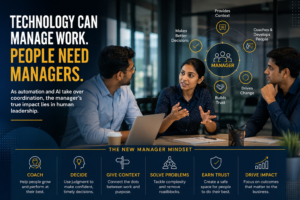

This is precisely the finding underlying McKinsey’s broader argument: companies that get the most out of their middle managers deliver several times the total shareholder return, over five years, of companies with average or below-average managers. The differentiator wasn’t administrative efficiency. It was managers who acted as what the researchers call navigators, coaches and talent magnets — providing context, guidance and psychological safety that made people’s work meaningful, not just monitored.
Forrester’s Future of Work Survey 2025 offers a related, quietly powerful data point: 54% of employees now describe their manager as a coach, up from 50% the year before, and employees with a coaching manager are 1.7 times more likely to say they plan to stay at their company over the next year. In a labor market where retention is expensive and hiring is harder, that single behavioral shift — from status-collector to coach — is doing measurable business work.
The Pressure Comes From Both Directions
None of this is happening in a vacuum where managers get to calmly redesign their own jobs. The pressure is coming from above and below simultaneously, and it is not always pulling in the same direction.
From leadership, the demand is speed, efficiency and accountability. Flatter structures. Wider spans of control. Fewer escalation steps. Faster decisions. Boards and CEOs increasingly ask why a decision needs to move through three layers of management before it’s made, when technology has already surfaced the information needed to make it two layers earlier.
From employees — particularly younger, more digitally fluent employees who have grown up with instant access to information and tools — the demand is different: autonomy, context, honest feedback, real development, and a manager who adds something beyond relaying instructions. Many of these employees can already access more real-time data about their own performance than their manager can meaningfully add to. What they want from a manager is not information. It’s meaning, mentorship and a reason to trust the direction they’re being asked to move in.
A manager caught between these two demands — deliver faster with less structure, while also becoming a better coach and change leader — is being asked to do more with genuinely less scaffolding, at exactly the moment their traditional toolkit is being automated out from under them. It is not surprising that research consistently shows managers among the most stretched, least prepared layer of most organizations.
AI Is Accelerating the Change, Not Causing It
It’s worth being precise here: AI did not create this tension. It is accelerating a shift that remote and hybrid work, flatter organizational ambitions and data-driven management had already set in motion over the past decade. AI is simply the most visible and fastest-moving force doing the unbundling.
Microsoft’s Work Trend Index research is useful for calibrating how fast. Its 2025 report — drawing on survey data from 31,000 workers across 31 countries — introduced the idea of the “Frontier Firm,” an organization restructured around on-demand intelligence and hybrid teams of humans and AI agents. In that research, 35% of managers said they were considering hiring dedicated AI trainers to guide their teams’ adoption over the following 12 to 18 months, and half expected AI upskilling to become a core part of their own responsibility within five years. Microsoft’s follow-up 2026 research — a survey of 20,000 knowledge workers across ten markets conducted between February and April 2026 — found that leaders were consistently more likely than individual employees to report psychological safety around experimenting with AI at work, and more likely to say their managers actively created space for that experimentation. In other words: where managers lead the adoption of these tools well, trust and experimentation follow. Where they don’t, employees are left to figure it out alone.
For Indian organizations, this shift lands on top of an already stretched managerial layer. India’s IT and technology services sector, its fast-growing startups, and a wide range of traditional businesses undergoing digital transformation are simultaneously managing hybrid work arrangements, a large cohort of first-time managers promoted for technical skill rather than people leadership, and rising AI adoption inside day-to-day workflows. This is a lot of change to absorb through a layer of the organization that was, in most companies, never properly trained to absorb change in the first place.
Middle Management May Get Smaller — But More Important
Put these threads together and a plausible future comes into focus: organizations will likely need fewer traditional managers, but the managers who remain will matter considerably more than they do today.
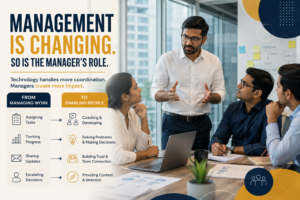

Fewer managers, because AI genuinely does remove a meaningful share of the coordination and reporting work that used to require a human layer, and organizations under cost pressure will act on that. Wider spans of control, flatter hierarchies and faster decision paths are not a passing trend; they are becoming a structural expectation in a growing number of companies.
But more important, because the residual job — the part software cannot do — is precisely the highest-leverage part: judgment under ambiguity, coaching people through change, holding difficult conversations, building trust, and translating a company’s strategy into something a human being can actually believe in and act on. That is harder work than compiling a status report, not easier, and it cannot be delegated to a dashboard.
This is a real risk for Indian companies specifically. If layers are cut primarily to reduce cost, without a deliberate investment in developing the judgment-based capabilities that remain, organizations may end up with fewer managers who are no better equipped for the job than the larger group they replaced — just carrying more people and more risk each.
What the New Manager Needs to Be Good At
The capabilities that separate a manager who thrives in this shift from one who is quietly made redundant by it are reasonably consistent across the research:
- Coaching, not monitoring — helping people improve, not just tracking whether they did the work
- Decision-making under ambiguity — using judgment where data runs out, not just executing where data is clear
- Context — connecting a team’s daily work to the larger “why,” something Bryan Hancock and Emily Field describe as the essential “sense-making” function of a modern manager
- Change leadership — helping a team move through disruption, rather than simply announcing it
- Cross-functional collaboration — operating horizontally across a flatter structure, not just vertically up and down a chain of command
- Trust-building — creating the psychological safety that lets a team experiment, including with new tools, without fear
- Developing talent — treating people development as core to the job, not an activity squeezed in around “real” work
None of these show up cleanly on a dashboard. All of them show up, eventually, in retention, engagement and performance — the outcomes every CEO ultimately cares about.
Questions CEOs Should Be Asking About Their Managers
- What work are we still asking managers to do that a system already does better?
- What decisions can teams now make without escalating to a manager — and have we actually removed the escalation step, or just the excuse for it?
- How much of a typical manager’s week is still spent collecting or relaying information rather than developing people?
- Are our managers being evaluated on coaching and judgment, or still, quietly, on compliance and task completion?
- What happens to a manager’s role, concretely, when AI removes 20% of their administrative workload — do they get that time back for higher-value work, or does it simply get filled with more direct reports?
- Are we promoting people into management because they were excellent individual contributors, or because they’ve demonstrated the judgment and coaching skills the job now actually requires?
- If we flattened a layer of management tomorrow, do the managers who remained have the capacity — and the capability — to absorb it well?
These are uncomfortable questions for many organizations, Indian and global alike, because the honest answers often reveal a management layer designed for a job that no longer fully exists.
What Managers Should Ask Themselves
The reflection has to run the other way too. A manager reading this has their own version of the question to sit with: if a system could handle every status update, every report and every routine follow-up I currently do, what would be left of my job — and would it still be worth having?
Source Links
McKinsey — “Power to the Middle” / middle manager time & performance data
- Main insight piece: https://www.mckinsey.com/featured-insights/mckinsey-live/webinars/unleashing-the-power-of-the-middle-manager
- “Are middle managers your next ace in the hole?” (podcast/article): https://mckinsey.com/capabilities/people-and-organizational-performance/our-insights/are-middle-managers-your-next-ace-in-the-hole
- “It’s time to rethink the role of the middle manager”: https://www.mckinsey.com/featured-insights/themes/its-time-to-rethink-the-role-of-the-middle-manager
- “Power to the Middle, one year later”: https://www.mckinsey.com/about-us/new-at-mckinsey-blog/power-to-the-middle-one-year-later
- “Will generative AI hurt middle managers—or help them?”: https://www.mckinsey.com/capabilities/people-and-organizational-performance/our-insights/will-generative-ai-hurt-middle-managers-or-help-them
Gartner — flattening prediction & CHRO survey data
- 2025 CHRO predictions press release (74% managers not equipped to lead change, 73% change fatigue, manager development as #1 priority): https://www.gartner.com/en/newsroom/press-releases/2025-01-08-gartner-identifies-top-nine-workplace-predictions-for-chros-in-2025
- Leader/manager development priority survey: https://www.gartner.com/en/newsroom/press-releases/2024-10-15-gartner-survey-finds-leader-and-manager-development-tops-hrleaders-list
- 2026 talent management trends (entry-level/mid-level pipeline pressure): https://www.gartner.com/en/newsroom/press-releases/2025-10-29-gartner-identifies-four-trends-talent-management-leaders-should-prepare-for-in-2026
- Secondary coverage of the Oct 2024 flattening prediction: https://www.personneltoday.com/hr/gartners-nine-hr-predictions-for-2025/
Microsoft Work Trend Index
- 2025 report (“The Year the Frontier Firm Is Born”): https://www.microsoft.com/en-us/worklab/work-trend-index/2025-the-year-the-frontier-firm-is-born
- 2025 report PDF/annual report: https://assets-c4akfrf5b4d3f4b7.z01.azurefd.net/assets/2025/04/2025_Work_Trend_Index_Annual_Report_680aaa7fe52dd.pdf
- 2026 report (“Agents, Human Agency, and the Opportunity for Every Organization”): https://www.microsoft.com/en-us/worklab/work-trend-index/agents-human-agency-and-the-opportunity-for-every-organization
- Work Trend Index hub: https://www.microsoft.com/en-us/worklab/work-trend-index
Forrester — manager-as-coach / retention data
- “Managers Who Coach Their Employees Drive Retention, 2025”: https://www.forrester.com/report/managers-who-coach-their-employees-drive-retention-2025/RES187660
Deloitte — 2025 Global Human Capital Trends (experience gap)
World Economic Forum — Future of Jobs Report 2025
- Full report: https://reports.weforum.org/docs/WEF_Future_of_Jobs_Report_2025.pdf
- Summary article: https://www.weforum.org/stories/2025/01/future-of-jobs-report-2025-jobs-of-the-future-and-the-skills-you-need-to-get-them/
- Press release: https://www.weforum.org/press/2025/01/future-of-jobs-report-2025-78-million-new-job-opportunities-by-2030-but-urgent-upskilling-needed-to-prepare-workforces/