

A CFO at a mid-sized Indian manufacturing firm was recently asked, in a boardroom review, a question that has quietly become the most uncomfortable one in Indian business: “We’ve spent on AI for eighteen months. What, exactly, has it changed?”
No one in the room had a clean answer. There were pilots. There were dashboards. There was a chatbot that customers mostly ignored. But nobody could point to a number that had moved — not revenue, not cost, not cycle time — and say, with confidence, that AI had caused it.
That scene, or something close to it, is now playing out in boardrooms across the country. India’s AI conversation has quietly changed register. A year ago, the dominant question inside Indian companies was whether to adopt AI at all. Today, it is whether AI is actually producing anything a CEO can point to on a balance sheet.
This is not cynicism about the technology. It is the natural next stage of any serious capital allocation decision. And the data suggests Indian CEOs are further along in asking this question — and further behind in answering it — than most people assume.
The Question Has Changed
For several years, the CEO conversation about AI was really a technology conversation dressed up in strategic language: which model, which vendor, which pilot, which department goes first. It was, in effect, permission-seeking — a search for proof that AI worked at all.
That phase is over. According to PwC’s 29th Annual Global CEO Survey, conducted among nearly 50 India CEOs between September and November 2025, AI continues to be viewed as a strategic enabler, but sustained value from it will depend on embedding trust into business strategy, building strong organizational foundations, ensuring data readiness, and aligning culture — areas where many India CEOs still see considerable room for progress.
That is a telling admission. It suggests Indian leaders are no longer debating whether AI matters. They are grappling with why, despite believing it matters, it isn’t yet showing up in performance.
The global data backs this up starkly. Across PwC’s full CEO sample, only 12% of leaders report that AI has delivered both cost savings and revenue benefits over the past year, while more than half — 56% — report neither. The survey describes a growing divide between companies that are piloting AI and those deploying it at real scale, with CEOs reporting both cost and revenue gains two to three times more likely to have embedded AI extensively across products, demand generation, and strategic decision-making.
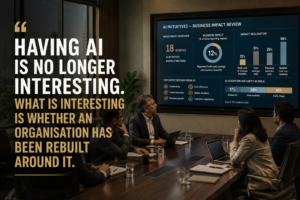
The lesson for Indian boardrooms is blunt: having AI is no longer interesting. What is interesting is whether an organization has been rebuilt around it.
Productivity Is No Longer the Finish Line
For a long time, “productivity” was treated as the destination of an AI strategy — proof, on its own, that the investment had worked. Employees produced more content, more code, more reports, more customer replies.
But CEOs have started to ask a sharper question underneath that one: more output toward what, exactly? A team that writes twice as many reports isn’t more valuable if nobody reads them faster or acts on them differently. Productivity without redirection is just noise at higher volume.
This distinction — between producing more work and creating more value — is becoming the dividing line between companies that talk about AI and companies that are actually changing because of it. India’s own numbers illustrate the gap. An IDC InfoBrief commissioned by Deel found that 45% of Indian firms remain at the early stage of AI adoption — the highest proportion among the countries surveyed — with 38% at an intermediate stage and only 17% at an advanced stage where AI is genuinely embedded in core business processes and innovation.
That “advanced” 17% is instructive. It is the segment where AI has stopped being a productivity add-on for individuals and has started reshaping how the business itself operates — where a faster first draft becomes a faster decision, and a faster decision becomes a faster customer response, a faster shipment, a faster close.
Encouragingly, some Indian enterprises are demonstrating that this leap is possible. Deloitte’s State of AI in the Enterprise report for 2026 found that Indian enterprises are moving beyond experimentation and leading global peers in at-scale AI adoption across most business functions, with deployment strongest in product development (62%), strategy and operations (56%), marketing and sales (55%), and supply chain (48%). Forty percent of Indian respondents reported significant or full AI usage, compared with a global average of roughly 28% — evidence that Indian organizations are not simply piloting AI but increasingly operationalizing it to unlock near-term productivity and business outcomes.
The takeaway for any CEO reviewing an AI roadmap: if the metric on the slide is “hours saved,” ask the harder follow-up — saved doing what, and redeployed to what?
What CEOs Actually Want Is Speed
Underneath the productivity conversation is something more specific, and more honest: Indian CEOs want their organizations to move faster. Not busier — faster. Faster research, faster reporting, faster customer response, faster product decisions, faster course correction when something goes wrong.
This is where AI’s real appeal to leadership lies, and it explains why the functions seeing the fastest at-scale adoption in India are the ones where speed compounds directly into competitive advantage — product development, sales, and supply chain, per Deloitte’s findings above. A pricing decision made a day earlier, a stock-out spotted a week earlier, a customer complaint resolved in minutes instead of hours — these are the kinds of gains that show up in results, not just in employee sentiment surveys.
Banking offers the clearest illustration of what this looks like in practice. HDFC Bank’s AI-powered assistant Eva reportedly answers tens of thousands of customer queries a day, while the bank has also built an in-house generative AI platform to speed up routine banking operations and customer service response times. ICICI Bank’s iPal chatbot performs a similar function, handling transactions and queries directly rather than routing every request through a call center. None of this is glamorous. It is simply faster resolution, at scale, for problems that used to sit in a queue.
That is the pattern CEOs are chasing everywhere else in the business: not intelligence for its own sake, but compressed time-to-outcome.
AI Has to Leave the IT Department
Speed at the level of an individual task is easy to demonstrate. Speed at the level of an organization is much harder — because it requires AI to move out of the technology function and into sales, operations, finance, HR, and customer service, where the actual decisions get made.
This is precisely where Indian companies are furthest ahead, and it is one of the more surprising findings in recent research. Deloitte’s data, cited earlier, shows AI already running at scale in product development, sales, operations, and supply chain — not confined to a lab inside the CIO’s organization. Mahindra & Mahindra’s supply chain transformation is a useful real-world case: the company had historically relied on manual, spreadsheet-based demand and supply planning, built on subjective segmentation rules that led to inefficient inventory allocation and inconsistent service levels. By rebuilding this planning process around AI-driven segmentation and forecasting — not a customer-facing gimmick, but a change to how a core operational function makes daily decisions — the company sought to improve responsiveness and reduce inventory costs simultaneously.
That is what CEOs mean, whether they use this language or not, when they say they want AI to be “business-led rather than technology-led.” A model sitting inside an IT roadmap changes nothing on its own. A model embedded inside how a supply planner, a underwriter, or a relationship manager actually makes a decision changes the business.
The organizational implication is uncomfortable for many technology teams: the CEO does not want an AI strategy. The CEO wants a sales strategy, an operations strategy, and a cost strategy — that happen to use AI.

Capability, Not Headcount
A persistent anxiety around AI is that it exists to shrink the workforce. Indian CEOs, at least based on where investment and attention are flowing, appear to be telling a more complicated story — one about building a more capable organization rather than simply a smaller one.
This is partly necessity. India’s own labor-market research suggests the country cannot treat AI purely as a cost lever, because the reskilling infrastructure to support workforce transitions is not yet where it needs to be. The same IDC/Deel study found that only 54% of Indian organizations report steady investment in reskilling — the lowest figure among the countries surveyed, compared with leaders such as Canada (77%), Brazil (76%), and Singapore (74%) — while 45% of Indian organizations have not yet started any reskilling effort at all, though they plan to within the next year. The same research found that despite India’s large technology workforce, 63% of organizations struggle to hire qualified AI talent, a scarcity that is pushing salary premiums for specialized AI roles.
Globally, the scale of workforce change ahead is significant. The World Economic Forum’s Future of Jobs Report 2025, drawing on data from over 1,000 employers across 22 industry clusters, projects that 170 million new roles will be created by 2030 while 92 million existing roles are displaced — a net increase of 78 million jobs, but with disruption equivalent to 22% of the global workforce. The report identifies the skills gap as the single most significant barrier to business transformation, cited by 63% of employers, and estimates that roughly six in ten workers globally will need reskilling or upskilling by 2030 — with more than a tenth of the workforce at medium-term risk of redundancy if that reskilling does not happen.
For an Indian CEO, this is less an ethical talking point than a hard operational constraint: an organization cannot convert AI into business value faster than its people can absorb new ways of working. A model that a workforce doesn’t trust, doesn’t understand, or actively works around delivers no value at all — regardless of how sophisticated it is.
The CEOs who are furthest ahead appear to grasp this instinctively. They are not asking “how many roles can this eliminate.” They are asking “how much more can each remaining role now be responsible for” — a very different question, with a very different set of investments attached to it.
The ROI Problem Nobody Can Avoid
Eventually, every version of this conversation arrives at the same uncomfortable place: money. And here, the research is unambiguous about how wide the gap still is between AI spending and AI return.
PwC’s global data shows that more than half of CEOs — 56% — have seen neither revenue gains nor cost benefits from their AI investments, while 30% report increased revenue and 26% report decreased costs. This is not a story of AI failing to work. It is a story of most organizations not yet having built the conditions under which AI can work — clean data, redesigned processes, and decision rights that actually change when a model produces an insight.
India’s own manufacturing sector illustrates a related pattern: enthusiasm for AI that has not yet translated into deeper investment. A PwC report found that only 45% of Indian executives view investment in research and development as a key lever for unlocking new opportunities, compared with 63% in China and 42% globally — even as, separately, nearly 59% of Indian industrial manufacturers said they believe AI will play a larger role in helping them meet strategic objectives. That is a gap between belief and commitment: Indian leaders are confident AI matters, but many have not yet backed that confidence with the R&D and process investment that turns a belief into a result.
This is precisely why the ROI conversation is no longer optional. Boards that once tolerated open-ended “AI experimentation” budgets are increasingly asking for the same discipline applied to any other capital expenditure: a baseline, a hypothesis, a measurement window, and a decision to scale or stop. The CEOs who will be able to defend AI spending in the next budget cycle are the ones who can already show, in specific and unglamorous terms, what changed because of it.
Trust, Governance and the Limits of Speed
The faster CEOs push AI into real decisions, the more exposed the business becomes to a different kind of risk — one rooted not in whether AI is capable, but in whether it can be trusted with judgment calls that carry financial, legal, or reputational consequences.
This is why governance has moved from a compliance footnote to a board-level agenda item. PwC’s India CEO research explicitly frames embedding trust at the core of business strategy as a leadership mandate, arguing that building frameworks rooted in transparency, ethical AI governance, and rigorous data stewardship demands decisive action from leaders regardless of industry or scale.
The scale of the readiness gap is notable. Separate industry research on India’s workforce found that over half of Indian companies are not familiar with local AI regulations — one of the highest such figures globally. That is a striking admission for a country whose enterprises are, by some measures, deploying AI faster than global peers. Speed of adoption and depth of governance are not the same curve, and Indian companies appear to be further along the first than the second.
In regulated sectors, this gap closes faster out of necessity. HDFC Bank’s approach to AI governance — linking every model to a single customer identity and one governance layer, rather than allowing fragmented, department-by-department deployment — is a useful template. It reflects a principle that applies well beyond banking: AI adopted piecemeal by individual functions, without a shared governance backbone, tends to create risk faster than it creates value.
For most CEOs, the practical question is not whether to trust AI, but how much autonomy to hand it, in which decisions, with what human checkpoint still in place. Getting that calibration wrong in either direction — too cautious to capture value, too permissive to manage risk — is now a leadership failure, not a technical one.
The Real Constraint Is the Organization, Not the Technology
Pull these threads together and a single argument emerges: the hardest part of AI was never the AI. Buying access to a capable model is now close to trivial. Rebuilding a process, a decision right, a performance metric, or an employee’s daily habits around that model is not.
This is the uncomfortable truth sitting underneath India’s adoption numbers. Indian enterprises are, by several measures, ahead of global peers in deploying AI at scale. But deployment and value creation are not the same achievement. Deloitte’s finding that 40% of Indian respondents report significant or full AI usage, against a 28% global average, is genuinely impressive — and yet it sits alongside PwC’s global finding that the majority of organizations still see no measurable financial return. The two data points, read together, suggest India has solved the easier problem — getting AI into the building — and is now facing the harder one: getting the organization to actually change how it works because of it.
That harder problem has a familiar shape to anyone who has led a transformation program before AI existed. It requires clarity about which decisions a manager is now expected to make differently. It requires performance metrics that reward the new way of working rather than quietly protecting the old one. It requires middle managers — the group most often overlooked in AI rollouts — to be equipped and incentivized to change how their teams operate, not just handed a new tool and left to figure it out.
Technology adoption can be mandated from the top in a single announcement. Process change, behavioral change, and skill change cannot. They have to be built, function by function, over quarters — which is precisely why so many Indian companies can report high AI usage and low AI-driven business impact in the same breath.
Chief Perspective
The gap this article has traced — between adopting AI and being changed by it — is not a technology gap. It is a leadership gap.
Every company now has access to broadly the same models, the same vendors, and increasingly the same pricing. That means AI itself is ceasing to be a source of advantage. What remains genuinely scarce, and genuinely difficult to copy, is an organization’s ability to convert that access into better decisions, faster execution, more capable employees, redesigned processes, and outcomes a CFO can actually verify.
That is a much harder thing to build than a chatbot, and a much harder thing to fake in a boardroom presentation.
So the question worth sitting with is not whether your organization has adopted AI. Almost everyone now can say yes to that. The question is whether your organization has changed how it decides, how it works, and how it measures success because of it — or whether it has simply added a faster way of doing the same things, for the same reasons, arriving at the same results.
Indian CEOs are no longer being judged on whether they moved early on AI. They are going to be judged on whether they built something that could actually use it.