

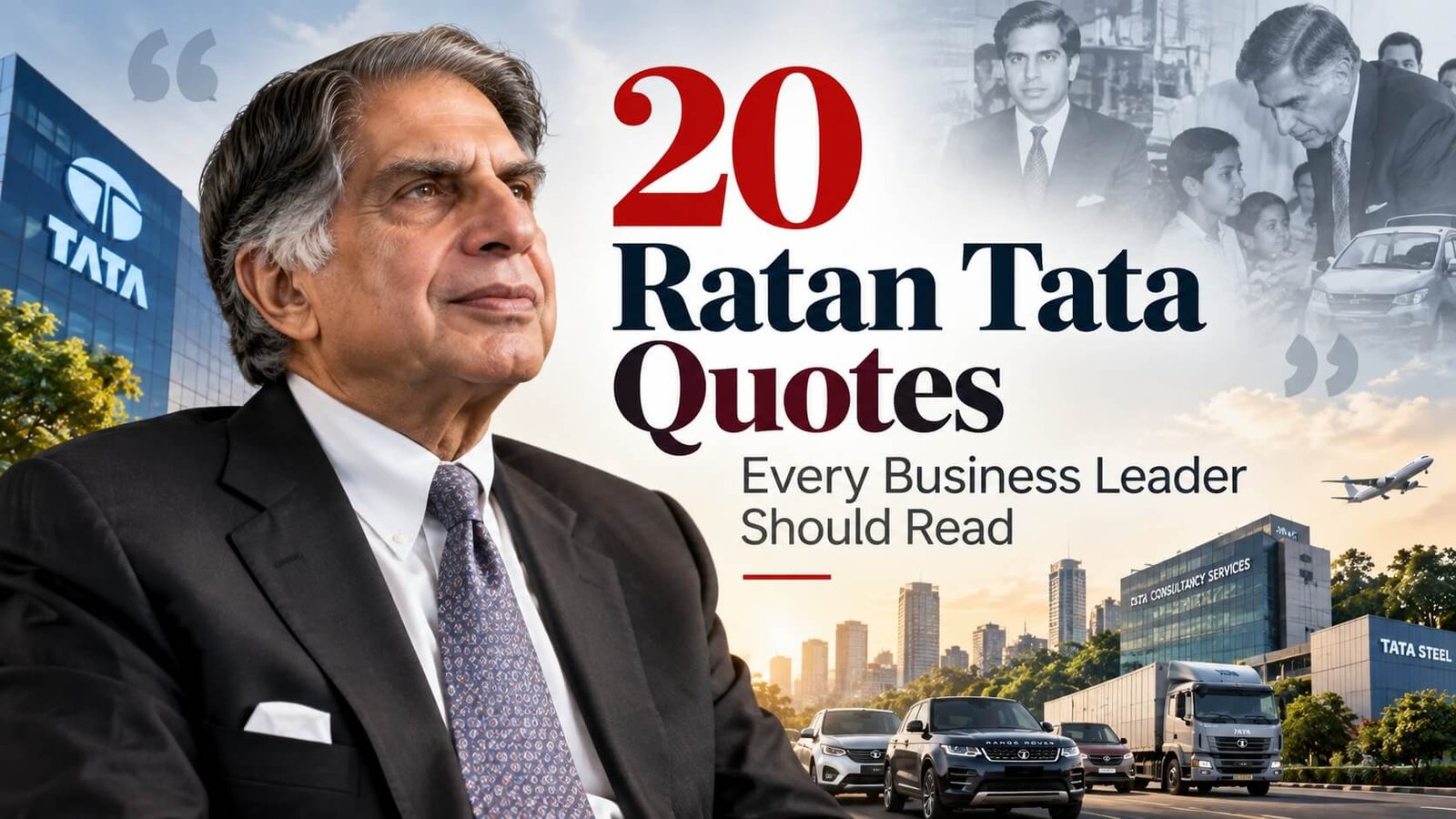
From business and leadership to ethics, innovation and resilience, Ratan Tata’s words offer a different way of thinking about success.
Ratan Tata’s influence on Indian business was never limited to the size of the companies he led or the acquisitions he made. During his years at the helm of Tata Sons, the Tata Group expanded internationally and became significantly more global, while Tata’s public image remained remarkably different from the stereotypical image of a powerful corporate leader.
His approach was often associated with restraint, long-term thinking and a strong emphasis on values. People who worked with him frequently described a leader who was comfortable listening rather than dominating a room. Nitin Nohria, former dean of Harvard Business School, described Tata as a quiet and thoughtful leader who demonstrated that effective leadership did not have to be loud or centered on personal visibility.
That makes Tata’s words particularly interesting for today’s business leaders. They are not simply motivational lines; many of them touch on decisions, competition, innovation, ethics, people and the responsibility that comes with building a business.
Here are 20 quotes associated with Ratan Tata, along with the leadership lesson behind each one.
1. “Power and wealth are not two of my main stakes.”
Tata made this observation in a 2011 interview with The Economic Times, while discussing what he wanted his legacy to represent. He said he would rather be remembered as a clean businessman who had been reasonably successful than someone defined by power or wealth.
For business leaders, the distinction is important. Wealth can be an outcome of building a successful company, but it does not necessarily define the quality of the leadership behind it. Reputation, principles and the way success is achieved can become part of a company’s long-term value.
2. “Businesses need to go beyond the interest of their companies to the communities they serve.”
This line has been widely cited in discussions around corporate responsibility and reflects an idea that was closely associated with Tata’s approach to business.
The lesson is particularly relevant today because businesses operate within communities, not separately from them. Customers, employees, suppliers and local communities are all affected by corporate decisions. Profit remains essential, but a business that ignores its wider impact can eventually undermine the environment in which it operates.
3. “If you want to walk far, walk together.”
Tata’s longer version contrasts walking quickly alone with travelling farther together. The quote has become one of his most widely circulated statements.
The business lesson is straightforward: individual brilliance can produce results, but sustainable organizations depend on teams. As companies grow, the ability to bring different people together becomes more important than the ability of one person to make every decision.
4. “There is no great innovation, no great idea that has not been criticized.”
Innovation inevitably creates resistance because new ideas challenge established assumptions. Tata’s observation is particularly relevant for companies attempting to change an industry rather than simply compete within its existing rules.
For leaders, criticism should therefore not automatically be interpreted as evidence that an idea is wrong. Sometimes it is simply evidence that the idea is different.
5. “If there are challenges thrown across, then some interesting, innovative solutions are found.”
Tata made this observation while discussing the development of the Tata Nano and the challenges involved in creating a low-cost car. The full interview shows that he saw difficult constraints as something that could stimulate innovation rather than simply restrict it.
That is an important lesson for modern businesses. Unlimited resources can sometimes encourage organizations to solve problems by spending more. Constraints force teams to think differently.
6. “I have always been very confident and very upbeat about the future potential of India.”
Tata expressed this view while discussing India’s future and its potential.
For business leaders, the broader lesson is about maintaining a long-term view of the market. Economies go through difficult periods, but leaders building enduring businesses cannot make every strategic decision based on the mood of the current quarter.
7. “Be persistent and resilient in the face of challenges.”
Tata’s words on resilience are especially relevant to entrepreneurship, where setbacks are inevitable. The Indian Express included this among the statements associated with his philosophy.
Persistence, however, should not mean refusing to change direction. Good leaders need enough resilience to continue through difficult periods and enough judgement to recognize when the strategy itself needs to change.
8. “Never underestimate the power of kindness, empathy, and compassion.”
For a corporate leader, this may sound less conventional than talking about strategy, execution or financial performance. Yet Tata repeatedly emphasized the human side of leadership.
Organizations ultimately consist of people. Employees remember how leaders behave during difficult moments, not just what targets they achieved during successful ones.
9. “Making money is not everything.”
Tata spoke about the importance of participating in the development of communities and improving people’s lives alongside making money.
That does not mean profit is unimportant. A business cannot survive without financial discipline. The point is that financial performance can be viewed as one measure of success rather than the only measure.
10. “I would like to be remembered as a clean businessman.”
Tata made this statement while discussing his future legacy and his decision not to enter politics.
There is a powerful leadership principle here: how you achieve success matters as much as the success itself. A company may produce impressive financial results, but unethical shortcuts can permanently damage the trust that took years to build.
11. “I admire people who are very successful.”
The quote continues with an important qualification: Tata said that when success is achieved through excessive ruthlessness, he may admire the achievement but not respect the person.
That distinction between admiration and respect is worth considering. Business success can attract attention, but sustainable leadership requires something deeper than results alone.
12. “If it stands the test of public scrutiny, do it.”
Tata’s observation was part of his approach to making decisions and maintaining transparency. The statement was included in The Times of India’s collection of his leadership quotes.
It offers a simple test for difficult decisions: would you still be comfortable with the decision if customers, employees and the public knew exactly how it was made?
For today’s companies operating in an environment of instant communication, that question has become even more relevant.
13. “Young people have the ability to challenge the status quo and drive change.”
Tata recognized the role of younger generations in questioning established ways of doing things.
That is particularly relevant for established companies. Experience brings knowledge, but newcomers often bring the willingness to question assumptions that existing employees have stopped noticing.
14. “Ups and downs in life are very important to keep us going.”
Tata famously compared the ups and downs of life with an ECG, observing that a straight line would mean something very different.
For entrepreneurs and executives, the point is not to romanticize failure. Difficult periods can be valuable because they expose weaknesses, force adaptation and prevent organizations from becoming complacent.
15. “I have always tried to do the ‘right’ thing.”
This simple statement appears in material reflecting Tata’s philosophy around values and principles.
The word “right” is deliberately broader than “profitable.” Business leaders regularly face situations where the commercially attractive option and the ethically comfortable option are not necessarily identical. Leadership becomes particularly visible in those moments.
16. “Never compromise on your values and principles, even if it’s the hard way.”
This statement has been repeatedly associated with Tata’s approach to business and leadership.
Values become meaningful when following them has a cost. It is relatively easy to talk about principles when they do not interfere with business objectives. The real test comes when maintaining them requires a difficult decision.
17. “I would like to leave behind a sustainable set of companies.”
Tata spoke about wanting to leave behind companies operating in an exemplary manner in terms of ethics and values.
This is a different definition of legacy from simply building the largest company possible. It focuses on whether the organization can continue creating value after the individual leader is gone.
That is perhaps one of the most important tests of leadership: Can the organization succeed without you?
18. “I have always been bullish about India’s potential.”
Tata repeatedly expressed confidence in India’s long-term economic potential and its human capital.
For business leaders, optimism is not simply about predicting growth. It is also about recognizing opportunities before they become obvious to everyone else and being willing to invest in them over the long term.
19. “I have endeavored to do the best I could.”
This modest statement came from a 2012 interview reflecting on more than two decades at the helm of the Tata organization. In that interview, Tata spoke about bringing the organization together, making bold decisions and pursuing international growth.
There is something revealing about the simplicity of the statement. After decades of leading one of India’s largest business groups, the description of his own contribution was not framed around being the greatest, the richest or the most successful.
It was about doing the best he could.
20. “People are at the heart of this story.”
In the opening of Horizons, the Tata Trusts publication, Tata wrote about a philosophy of philanthropy in which people were central to the story and society was viewed as a stakeholder.
That idea extends beyond philanthropy. Businesses are ultimately built around people — employees who build products, customers who buy them, partners who support them and communities in which they operate.
A strategy that forgets the people behind the numbers can eventually lose sight of what the business is actually trying to achieve.
What Ratan Tata’s Quotes Tell Us About Leadership
What makes Ratan Tata’s words interesting is that very few of the ideas are really about becoming richer, more powerful or more famous. The recurring themes are different: long-term thinking, responsibility, resilience, innovation, people and values.
His career also demonstrates why those ideas became associated with him. Under his leadership, Tata expanded internationally through acquisitions including Tetley, Corus and Jaguar Land Rover, while the group continued to emphasize its broader institutional identity. Tata Trusts’ own retrospective material describes his approach as one that combined business with social impact and responsibility.
Perhaps the most useful lesson for today’s business leaders is that leadership does not always have to be loud.
Nitin Nohria’s tribute to Tata makes that point particularly well. He described Tata as quiet, thoughtful and self-effacing, and argued that his career demonstrated that effective leadership does not require a leader to dominate the room or constantly occupy the center of attention.
In an era when leadership is increasingly performed in public — through social media, conferences, interviews and personal branding — that is a useful reminder.
A leader’s impact does not necessarily come from how much attention they receive. It can come from what happens inside the organization when they are leading.