

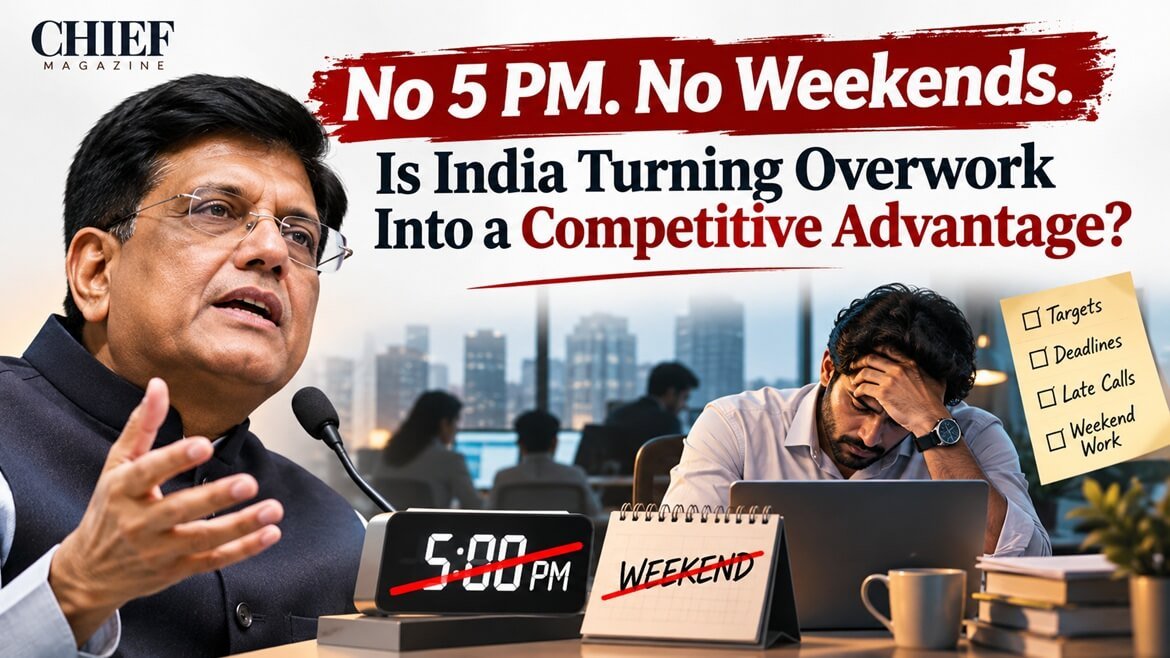
Piyush Goyal’s remarks to European investors have reignited a debate that India has struggled to settle. From Narayana Murthy’s 70-hour work week to the 90-hour prescription from L&T’s chairman, influential voices have repeatedly called for greater work commitment. But others in Indian business have challenged the idea that longer hours necessarily create a stronger economy. Perhaps India needs to rethink what it is actually selling to the world.
There was a time when India’s pitch to global investors centered on its engineering talent, cost competitiveness, technology capabilities and growing consumer market.
Now, it appears that another selling point has entered the conversation: Indians do not necessarily stop working at five.
During his visit to the Netherlands for the India-Netherlands Business Forum in October 2026, Union Commerce and Industry Minister Piyush Goyal was pitching India as an attractive destination for international businesses. Speaking to business leaders, he described India’s workforce as young, talented, skilled and willing to work hard.
Then came the line that set off a nationwide debate.
“Nobody in India will tell you it’s 5 o’clock. And certainly, no Indian will ever remind you it’s the weekend!”
Goyal connected this work ethic to India’s economies of scale and its ability to help businesses grow beyond dimensions they might otherwise imagine.
The statement was intended to communicate India’s competitive advantage. But for many Indian professionals, it raised a rather uncomfortable question: Is the country presenting its workforce as a source of exceptional talent—or as a workforce that can be expected to work without boundaries?
The Karnataka State IT/ITeS Employees Union (KITU) objected to the minister’s remarks, arguing that such statements risk normalizing excessive working hours and weakening the importance of weekly holidays and employee protections.
The criticism was not confined to trade unions. The remarks reopened a debate that has repeatedly surfaced in India’s corporate world over the past few years.
And Goyal’s statement was not the beginning of that debate. It was the latest chapter.
From 70 hours to 90 hours: India’s growing work-week debate
In October 2023, Infosys co-founder N. R. Narayana Murthy suggested that young Indians should work 70 hours a week if the country wanted to improve its productivity and compete with economies such as China.
Murthy framed his argument around national development. He spoke about the need for discipline, hard work and a stronger work ethic, drawing on his own experience of building Infosys. In a subsequent interview with CNBC-TV18, he said he had followed a demanding schedule himself, leaving for work at 6 am and returning home after 9 pm, six days a week.
His position was straightforward: India’s young workforce needed to put in more effort if the country wanted to achieve its economic ambitions.
But the suggestion attracted criticism from employees and professionals who questioned whether longer working hours were the right answer to India’s productivity challenge.
Then, in January 2025, the debate moved another step.
Larsen & Toubro chairman S. N. Subrahmanyan advocated a 90-hour working week and expressed regret that he could not make employees work on Sundays.
During an employee interaction, he asked: “What do you do sitting at home? How long can you stare at your wife? How long can wives stare at their husbands?”
The remarks triggered widespread criticism. The discussion was no longer just about how many hours young professionals should work. It had become a debate about whether corporate leadership was beginning to treat employees’ personal time as an expendable resource.
L&T defended its chairman’s broader message, saying extraordinary outcomes required extraordinary effort and linking the comments to India’s ambition to become a developed nation.
The contrast was striking. One side viewed longer hours as a necessary sacrifice for economic progress. The other questioned whether such sacrifices should become an expectation imposed on employees.
And now, with Goyal’s remarks, the discussion has moved beyond individual companies and their workplace cultures. It has entered India’s international investment narrative.
Not everyone in India Inc agrees that more hours mean more progress
What makes this debate particularly interesting is that disagreement has not come only from employees, unions or social media commentators.
Some of India’s most prominent business leaders have challenged the assumption that working longer automatically means performing better.
When the 90-hour work-week controversy erupted, RPG Enterprises chairman Harsh Goenka responded with a pointed remark on X:
“90 hours a week? Why not rename Sunday to ‘Sun-duty’ and make ‘day off’ a mythical concept!”
He went on to argue that working hard and smart was important, but turning life into a perpetual office shift was a recipe for burnout rather than success. He described work-life balance as essential, not optional.
Interestingly, Goenka’s position also illustrates the complexity of the current controversy. While he criticized the 90-hour prescription, reports around Goyal’s latest remarks indicate that Goenka supported the underlying argument that India’s work ethic gives the country an advantage. The two positions are not necessarily contradictory: valuing hard work does not require endorsing unlimited working hours.
Mahindra Group chairman Anand Mahindra offered another perspective during the 2025 debate.
He said the discussion was heading in the wrong direction because it was focusing on the number of hours rather than the quality of work.
“I don’t want it to be about time. I don’t want it to be about quantity. Ask me about the quality of my work. Don’t ask me how many hours I have worked.”
He added that meaningful work could change the world even in ten hours.
His argument was not that people should avoid hard work. It was that the value of work should be measured by its outcomes rather than by the time spent at a desk.
Serum Institute of India CEO Adar Poonawalla also questioned the assumption that longer schedules automatically produce better results. During the same debate, he said that eight hours a day was generally enough, while acknowledging that some circumstances, including the Covid-19 crisis, had required him to work significantly longer.
These are important distinctions.
A business leader can believe in extraordinary effort without believing that every employee should work extraordinary hours every week. A company can operate across time zones without expecting its people to surrender their weekends. And a country can promote ambition without making exhaustion a measure of commitment.
The uncomfortable numbers behind India’s work culture
The debate would be easier to dismiss as a disagreement between a few prominent personalities if the underlying working-hours data did not deserve attention.
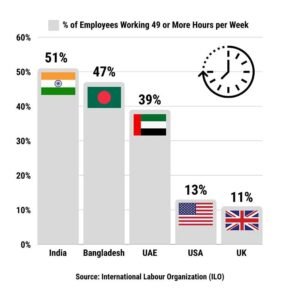
A Government of India statistical publication drawing on International Labor Organization data reported that approximately 55% of India’s employed population worked more than 48 hours a week in the data it examined.
The proportion was 63.8% among men and 30.2% among women.
This is a figure for the broader employed population, not just corporate employees or the IT sector. It includes people across different occupations and industries. Nevertheless, it offers an important indication of how widespread long working weeks already are.
India does not appear to be a country where people need to be persuaded that work matters. A substantial part of its workforce is already working beyond the 48-hour threshold referenced in the publication.
The more important question is whether extending working hours further is the most effective way to improve productivity.
Research suggests that the relationship between working time and output is not as straightforward as some corporate arguments imply.
The OECD’s Employment Outlook 2022 examined the relationship between working time and productivity, noting that productivity tends to decline as working hours increase beyond a point. Fatigue, reduced concentration and the organization of work all influence how much value people can create during additional hours.
There is also a public-health dimension that cannot be ignored.
A joint World Health Organization and International Labor Organization analysis estimated that 745,000 deaths from stroke and ischemic heart disease in 2016 were attributable to long working hours.
The analysis found that people working at least 55 hours a week had an estimated 35% higher risk of stroke and a 17% higher risk of dying from ischemic heart disease compared with people working 35–40 hours a week.
These are global estimates, not India-specific figures. But they underline an important point: excessive working hours are not simply a question of personal preference or office culture. They can have serious consequences for public health.
A country aspiring to become a global economic powerhouse cannot afford to treat the health of its workforce as an afterthought.
But are long hours sometimes necessary?
There is a legitimate argument on the other side, and it deserves to be heard.
Building a company is not always a nine-to-five exercise. Start-ups face intense competition, uncertain cash flows, demanding customers and tight deadlines. Manufacturing businesses may have production commitments. Technology companies operate across time zones. Entrepreneurs frequently make personal sacrifices to build something that does not yet exist.
India’s economic ambitions will require effort, discipline and a willingness to take risks.
There are moments when working late is necessary. There are projects that demand weekends. There are businesses that cannot simply stop operating because the clock has reached five.
But these circumstances should not be confused with a permanent operating model.
The founder who chooses to work through the weekend to build a business is in a different position from an employee who feels compelled to do the same because refusing may affect their appraisal, promotion or job security.
A team voluntarily putting in additional hours to meet an important milestone is not the same as an organization that routinely depends on unpaid overtime to compensate for poor planning or inadequate staffing.
The distinction is not about whether people should work hard. It is about whether they have a choice, whether additional effort is recognized and whether the organization is creating conditions in which exceptional effort becomes permanently necessary.
Hard work can be a competitive advantage. Making people permanently available should not be.
The problem with selling India on the promise of unlimited availability
This brings us back to Piyush Goyal’s statement.
As Commerce and Industry Minister, Goyal was speaking to an international business audience. His objective was to make India look attractive to investors. That is a legitimate responsibility, and India’s workforce is undoubtedly one of its most important economic assets.
But the way a country presents its workforce matters.
If India tells global businesses that its employees are talented, technically capable, adaptable and able to deliver at scale, it is communicating a compelling investment proposition.
If the message begins to suggest that Indian employees will not insist on leaving at five or taking weekends off, the proposition becomes more complicated.
Is that really the advantage India wants to advertise?
European businesses may operate under different labor regulations, social expectations and working-time practices. Global companies may need teams that can collaborate across time zones. But the answer cannot simply be that Indian employees should be expected to absorb the difference through longer working days.
India should be competing on the quality of its engineering talent, the sophistication of its technology ecosystem, the productivity of its businesses, the strength of its management and its ability to innovate.
Not on how much personal time its workforce is willing to surrender.
There is also a long-term business question here. Companies do not become more competitive simply by extracting more hours from their employees. They become competitive by improving processes, investing in technology, developing skills, reducing inefficiencies and creating teams capable of delivering consistently.
A workforce that is exhausted may remain online longer. That does not necessarily mean it is producing better work.
The leadership question: are we rewarding outcomes or visibility?
Perhaps the most important part of this debate is not the number of hours being proposed. It is what these statements reveal about how some organizations continue to think about performance.
In many workplaces, employees still feel that being seen working late demonstrates commitment. Responding to messages after office hours becomes a signal of dedication. Weekend availability is treated as a mark of loyalty.
This creates a dangerous incentive.
Employees begin to optimize for visibility rather than outcomes. Managers start measuring commitment by availability. Teams spend more time responding to work than improving the way work gets done.
The result can be an organization where everyone appears busy, but productivity does not necessarily improve.
This is a leadership problem.
Good leadership should create clarity about priorities, realistic deadlines, sufficient resources and accountability for results. It should encourage people to take ownership, but it should also recognize that people need time away from work to recover, maintain relationships and develop lives beyond their professional responsibilities.
The best organizations are not those where employees are afraid to log off. They are those where employees can deliver exceptional work without being expected to sacrifice their personal lives indefinitely.
India needs a better definition of its work ethic
There is no reason India should be less ambitious than any other economy.
Its young population, technical talent, entrepreneurial energy and growing industrial capabilities give it a genuine opportunity to become a major force in the global economy.
But ambition should not be confused with the number of hours people spend working.
A country can aspire to build world-class companies while protecting the right to rest. It can encourage entrepreneurs to take extraordinary risks without turning those risks into obligations for every employee. It can compete with China, Europe and the United States through technology, skills, innovation and productivity rather than through a contest over who can work the longest.
The debate sparked by Piyush Goyal’s remarks is therefore much bigger than a five o’clock sign-off or a Sunday holiday.
It is about the kind of economic model India wants to build.
Narayana Murthy argued for 70 hours. S. N. Subrahmanyan advocated 90. Piyush Goyal presented the absence of a five o’clock or weekend boundary as part of India’s investment appeal. Meanwhile, Harsh Goenka, Anand Mahindra and Adar Poonawalla offered a different view: hard work matters, but so do productivity, quality and the ability to sustain performance.
These are not merely disagreements about office schedules. They represent competing ideas about leadership, economic growth and the value of human time.
India should absolutely be a country where people are willing to work hard.
But it should also be a country where people are not made to feel guilty for having a life outside work.
If India’s greatest competitive advantage is its people, perhaps the real question is not how many more hours they can work. It is how much more they can achieve when businesses, leaders and policymakers learn to value their time.