

We have millions of entrepreneurs, a rapidly expanding startup ecosystem and a growing number of successful businesses. But are we creating enough original technologies, intellectual property and industrial capabilities to shape the world’s future — or becoming exceptionally good at building businesses around opportunities others have already created?
India knows how to celebrate an entrepreneur.
A person starts a tea stall, turns it into a recognizable brand, expands into new cities and becomes a social media sensation. A founder launches a packaged-food business, attracts investment and builds a national distribution network. Someone spots an opportunity in the consumer market, creates a business around it and eventually turns it into a profitable enterprise.
These are genuine achievements. They create employment, serve customers, generate wealth and demonstrate commercial instinct. India needs more entrepreneurs who can do precisely that.
But there is another kind of achievement that deserves a different conversation.
A young engineering team spends years developing a semiconductor technology. A scientist attempts to turn laboratory research into a commercially viable medical device. A startup builds industrial robotics that can reduce dependence on imported machinery. An entrepreneur develops a new material, battery technology or manufacturing process that could give Indian industry a competitive advantage.
These stories are harder to explain. They may not produce immediate revenue. Their founders may spend years solving engineering problems before finding customers. And their success cannot always be measured by the number of outlets, monthly sales or valuation.
Yet, these are the kinds of capabilities that can change the technological position of a country.
Which raises an uncomfortable question: Is India becoming an entrepreneurial country, or is it becoming an innovation country?
The two are not the same. And perhaps our inability to distinguish between them is one of the most important conversations India’s startup ecosystem needs to have.
Entrepreneurship creates businesses. Innovation creates new capabilities.
Peter Drucker, the management thinker, offered a useful distinction in Innovation and Entrepreneurship (1985):
“Innovation is the specific instrument of entrepreneurship. The act that endows resources with a new capacity to create wealth.”
The point is not that entrepreneurship and innovation are separate worlds. They are deeply connected. The point is that starting a business does not automatically mean creating something innovative.
A new restaurant may be an excellent business. A tea brand may build an impressive distribution model. A consumer company may find a smarter way to price, package or deliver an existing product. These businesses can innovate in marketing, operations, customer experience and commercial models.
But technological innovation asks a different question: have we created a new technical capability, product, process or intellectual property that advances what is possible?
Consider two hypothetical founders.
One identifies an opportunity in the packaged-food market, builds a strong brand and reaches ₹100 crore in annual revenue. Another spends seven years developing an industrial sensor that helps factories predict equipment failure, competing against established international technology providers.
The first founder has a clear commercial success story. The second may be building a technology that could improve industrial productivity and reduce dependence on imported systems.
Which founder is more likely to receive widespread attention?
There is no universal answer. But the first story is easier to communicate. Revenue, outlets, customers and expansion make for immediate headlines. The second requires readers to understand the technology, the problem it solves and why the capability matters.
This is not an argument against consumer entrepreneurship. It is a question about whether our definition of success has become too closely associated with the most visible forms of commercial achievement.
The numbers tell two different stories
India’s entrepreneurial growth is difficult to dismiss.
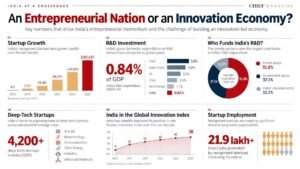
According to the Department for Promotion of Industry and Internal Trade (DPIIT), the country had 2,07,137 recognized startups by the end of 2025, compared with around 500 in 2016. These startups had reported generating more than 21.9 lakh direct jobs.
That is a remarkable expansion of business formation and entrepreneurial participation.
But a large startup ecosystem does not, by itself, establish that a country has become a global innovation powerhouse.
For that, we must look at what the country invests in research, what its institutions discover, what businesses develop, what technologies reach the market and what intellectual property is created and scaled.
Consider India’s research and development expenditure.
The Department of Science and Technology’s Research & Development Statistics 2025–26, presented to Parliament in July 2026, puts India’s gross expenditure on R&D at ₹2.45 lakh crore in 2023–24, equivalent to 0.84% of GDP.
There is progress: the private sector accounted for 51.8% of total R&D expenditure in 2023–24, compared with 33.8% in 2019–20. Business participation in research is moving in the right direction.
But the overall R&D intensity remains a serious strategic question. India has a much larger economy and a much larger pool of businesses than it did a decade ago. Is its investment in creating new knowledge and technology growing at the pace required by its ambitions?
The distinction becomes clearer when we look at the wider ecosystem. The Economic Survey 2025–26 also highlights the gap between India’s R&D intensity and that of major innovation economies, although its cited historical baseline differs from the latest DST figures.
The issue is not that India does not innovate. It is whether the scale of investment, institutional support and commercialization is sufficient to turn innovation into a defining economic strength.
Are we funding ambition, or only the business model?
The funding question is particularly important.
A consumer startup can often demonstrate demand through customer acquisition, repeat purchases, gross margins and distribution. Investors can evaluate the business using familiar commercial indicators.
A deep-tech startup may have a very different journey.
A company developing a new semiconductor component, advanced material, medical device or industrial technology may need years of research, specialized talent, testing facilities, regulatory approvals and manufacturing partnerships before it can generate meaningful revenue.
The risks are different. The timelines are different. The capital requirements are different.
This creates a financing challenge. Venture capital funds have their own investment horizons and return expectations. Not every fund is designed to finance a decade of technical development. And not every investor has the expertise to evaluate a complex engineering proposition.
That does not mean investors are wrong to back consumer businesses. They are responding to market opportunities and the expectations of their own investors.
But it does raise a larger question: Does India have enough patient, technically informed capital to finance technologies that may take years to become commercially successful?
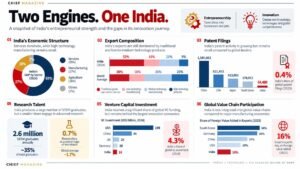
There are signs of progress. The India Venture Capital Report 2026 by Bain & Company and IVCA describes growing investor interest in areas such as deep tech, artificial intelligence, climate technology, robotics and space technology. IVCA-linked reporting also indicates that Indian deep-tech funding reached a record level in 2025.
The direction is encouraging. But capital concentration, funding cycles and the ability to support companies beyond the prototype stage remain important considerations.
A country cannot build technological leadership simply by announcing that it wants more deep-tech startups. It must create the financial and institutional conditions that allow difficult technologies to survive.
The attention economy has its own definition of success
There is another part of this discussion that deserves scrutiny: the stories we choose to celebrate.
A review of the startup-themed LinkedIn feed included in our earlier editorial research showed a mixture of entrepreneur profiles, consumer businesses, celebrity wealth, lifestyle stories and technology developments. Some stories concerned genuinely interesting engineering and technology ideas. Others focused on commercial expansion, luxury consumption and personalities.
That sample cannot establish what the entire Indian media ecosystem prioritizes. Nor does it tell us which stories receive the greatest engagement across every platform.
But it illustrates a question worth asking.
Are we covering entrepreneurship as an economic and technological force, or are we increasingly packaging it as entertainment?
A founder’s expensive car, luxury home or celebrity association can make an engaging social media post. A company developing a new industrial process may require an explanation of its engineering, market and potential impact before readers appreciate its significance.
The media is not solely responsible for this imbalance. Audiences decide what they engage with. Platforms reward certain forms of content. Advertisers and publishers operate within commercial constraints.
But editorial choices shape public imagination.
When a generation repeatedly sees business success represented through valuations, funding announcements, celebrity associations and personal wealth, what does it begin to aspire to?
And how many young engineers, scientists and researchers see building a technology company as an equally attractive ambition?
India is not short of innovation. But can it commercialize and scale it?
It would be unfair to suggest that India has no technological ambition.
The country’s space programme, digital public infrastructure, pharmaceutical industry, engineering talent and growing work in semiconductors, defense technology, drones, biotechnology and clean energy demonstrate real capabilities.
India’s Global Innovation Index position has also improved substantially, moving from 81st in 2015 to 38th in 2025, according to the government.
The startup ecosystem is changing too. The Nasscom–Zinnov Indian Tech Startup Report 2025, reported in March 2026, estimated that India had more than 4,200 deep-tech startups, including over 550 founded in 2025.
These are not insignificant developments.
But there is a difference between developing a promising technology and building a globally competitive industry around it.
A technology can work in a laboratory but fail under commercial operating conditions. A prototype can attract attention but struggle to achieve manufacturing consistency. A startup can develop intellectual property but lack access to customers, production facilities or distribution networks.
The journey has at least three demanding stages:
- Discovery: Creating new knowledge, science, engineering capabilities or intellectual property.
- Commercialization: Turning discoveries into reliable products and services that customers are willing to buy.
- Industrial scaling: Building the supply chains, manufacturing capabilities, talent and markets required to compete at scale.
Success at one stage does not guarantee success at the next.
This is why the words of Principal Scientific Adviser Ajay Kumar Sood, in the NITI Aayog report Pathways to Progress: Analysis and Insights into India’s Innovation Story, are worth considering. He identifies three foundations of a robust national innovation ecosystem: long-term vision, institutional capacity for discovery and commercialization, and integration of innovation into society.
That is a much broader ambition than increasing the number of startups.
Should we question where India’s largest business investments are going?
The discussion also brings us to India’s largest corporate groups and business leaders.
It is tempting to ask why wealthy industrialists invest in consumer brands, food businesses, retail and entertainment when India needs more advanced technology companies.
But that would be an incomplete argument.
Consumer businesses can create jobs, improve supply chains, generate cash flow and build distribution networks. Large conglomerates operate across sectors and invest according to their commercial strategies. Reliance, for example, has substantial interests in telecommunications, digital infrastructure and new-energy technologies alongside its consumer businesses.
There is no reason to suggest that a successful consumer investment is inherently a poor investment.
The more important question is whether India’s overall business ecosystem is allocating enough capital, research capacity and management attention to long-term technological development.
Do large Indian companies actively seek technologies developed by domestic startups? Are they willing to become early customers of new industrial products? Do they invest in research partnerships with universities? Are they helping create markets for technologies that do not yet have an established commercial ecosystem?
And when an Indian startup develops a potentially important technology, does it find a pathway to scale within the country — or must it look overseas for capital, customers, manufacturing partnerships or an eventual exit?
The responsibility cannot rest on a few billionaires. It must be shared across corporations, investors, universities, public institutions and entrepreneurs.
What exactly are we trying to become?
India’s ambitions are substantial. We want to become a developed economy, a manufacturing power, a global technology destination and a country that shapes the industries of the future.
These ambitions require entrepreneurship. They also require innovation.
But the two should not be treated as interchangeable measures of national progress.
A country can have millions of businesses without leading the technologies that power those businesses. It can become a major manufacturing location while depending on foreign intellectual property and critical components. It can build successful software services companies without necessarily owning the platforms and products that define the next technological era.
Equally, technological invention without commercial discipline does not create a sustainable innovation economy. Research must reach customers. Products must work reliably. Businesses must earn revenue. Technology must improve productivity and quality of life.
We need both entrepreneurial execution and technological ambition.
Perhaps the real challenge is not to decide whether India should be entrepreneurial or innovative. It is to build an ecosystem where entrepreneurship becomes the vehicle through which innovation reaches the world.
That requires more than startup registrations and funding announcements. It requires research institutions that collaborate with industry, investors willing to support long development cycles, corporations prepared to buy domestic innovation, public procurement that creates credible early markets, and a media ecosystem willing to explain difficult technological achievements.
It also requires a change in what we celebrate.
The founder who builds a profitable consumer brand deserves recognition. So does the engineer who develops a technology that reduces dependence on imported industrial systems. Their achievements are different, but both contribute to economic progress.
The question is whether our public conversation is mature enough to recognize that difference.
The question India should be asking itself
Perhaps we have spent years asking how many startups India has created, how many unicorns it has produced and how much venture capital has entered the market.
Those are useful measures of entrepreneurial activity.
But they do not tell us enough about the country’s technological future.
What technologies are being invented here? How much of the intellectual property belongs to Indian companies? How many research breakthroughs are becoming globally competitive products? How many Indian businesses are creating new industrial capabilities rather than simply competing within existing markets?
And, perhaps most importantly, what kind of ambition are we encouraging among the next generation of founders?
A country that celebrates entrepreneurship creates business owners and wealth creators. A country that builds an innovation culture creates problem-solvers, inventors, researchers, industrial leaders and businesses capable of changing the rules of global competition.
India needs both.
But if we want to become a nation that does not merely participate in the industries of tomorrow but helps define them, we must ask ourselves a difficult question:
Are we building businesses around the world’s opportunities — or building the technologies that will create the world’s next opportunities?
That is a question worth discussing. And perhaps it is a better measure of India’s entrepreneurial journey than the next unicorn headline.