

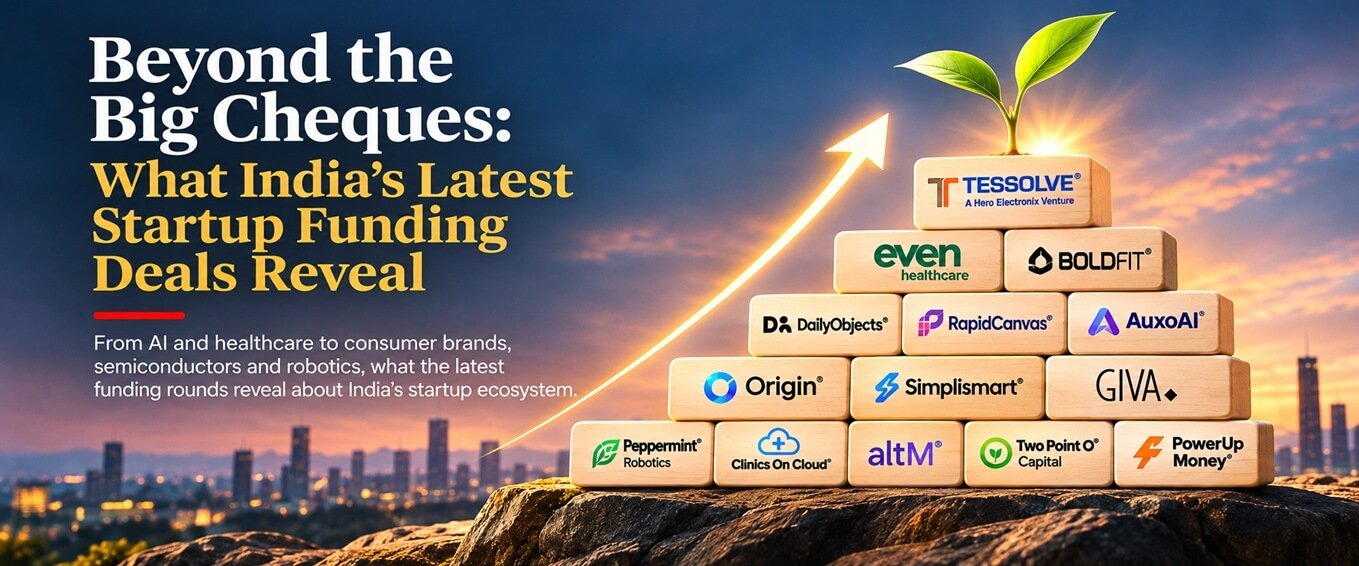
From semiconductor engineering and enterprise AI to healthcare, consumer brands and robotics, India’s latest funding rounds reveal where investors see the next wave of business opportunity.
India’s startup funding landscape delivered two contrasting signals over the past month. October witnessed a sharp decline in reported funding, with fewer large transactions, while the first week of November brought back some of the ecosystem’s appetite for bigger cheques.
But the more interesting story is not simply how much money startups raised. It is where that money went, which business models attracted investor confidence, and what the changing mix of investments tells us about India’s evolving startup ecosystem.
The funding announcements between October 8 and November 7, 2026, point towards an ecosystem that is becoming increasingly diverse. Consumer brands are raising substantial growth capital. Enterprise AI companies are attracting investors looking beyond experimentation. Healthcare businesses are expanding integrated delivery models. Meanwhile, semiconductor engineering, robotics and advanced materials are drawing attention as India looks to strengthen its industrial and technological capabilities.
The question is no longer just which startup raised the biggest round. It is what investors believe these businesses can become.
October’s funding slowdown: Fewer mega-rounds, but continued activity
According to Entrackr’s October funding report, Indian startups raised approximately $678 million across 108 reported deals, representing a 47.5% decline from September’s $1.29 billion. The total was also 60.8% lower than the $1.73 billion reported in October 2025.
The absence of mega-rounds was a significant factor. No startup raised $100 million or more during October, while only Tessolve Semiconductor and Even Healthcare crossed the $50 million mark.
However, the decline in total capital did not mean that investment activity had stopped. Entrackr recorded 79 early-stage deals worth approximately $263 million, alongside 20 growth and late-stage deals totaling $414.6 million. Nine additional deals had undisclosed amounts.
This distinction matters. A funding market can experience a decline in total capital while still supporting a meaningful number of emerging businesses. The headline figure alone does not tell us whether investors have stopped backing startups or have simply become more selective about the size and timing of their investments.
The deals that stood out
Several transactions during the period offer a useful view of where capital is moving.
1. Consumer brands are attracting serious growth capital
Consumer businesses were among the prominent fundraising stories, demonstrating that investors continue to see opportunities in brands that can combine product differentiation, distribution and repeat purchases.
Boldfit – $42 million
Sports and fitness brand Boldfit raised more than ₹400 crore in a Series B round led by Bharat Value Fund, with existing investor Bessemer Venture Partners also participating.
The Bengaluru-based company plans to use the capital for nationwide retail expansion, product innovation and manufacturing capabilities. Its portfolio spans sports apparel, fitness equipment, nutrition products and accessories.
The company reported FY25 operating revenue of ₹304 crore, up from ₹140 crore in FY24, while profit increased to ₹35 crore from ₹16.82 crore.
Read the Boldfit funding report
DailyObjects – $35 million
Design-led lifestyle and technology accessories brand DailyObjects raised ₹332 crore in a Series C round led by Xponentia Capital Partners, Anicut Capital and Axiom Asia Private Capital.
The round included primary and secondary transactions and valued the company at approximately ₹1,050 crore. The company plans to expand its retail network, invest in product development and research, strengthen its brand and explore international markets.
It also plans to open 150 exclusive brand outlets across India over the next five years.
Read the DailyObjects funding report
GIVA – $100 million
November began with a much larger transaction. Jewelry brand GIVA raised $100 million in a round led by Multiples Alternate Asset Management.
The transaction was one of the month’s biggest reported funding announcements and highlighted continued investor interest in consumer brands with the potential to build a national retail presence.
Read the November funding roundup
What this reveals: Investors are not looking only at digital customer acquisition. Physical distribution, brand recall, product development and the ability to build repeat-purchase businesses remain important parts of the consumer investment thesis.
2. Enterprise AI is moving towards business implementation
Artificial intelligence continued to attract investment, but some of the more interesting announcements were not about building another general-purpose AI application. They were about applying AI to enterprise workflows, infrastructure and business operations.
AuxoAI – $20.7 million
Forward-deployed AI company AuxoAI raised $20.7 million in a Series A round led by NTTVC, with participation from individual investors.
Founded in 2023, the company works with large enterprises to identify AI use cases, redesign workflows and develop production-ready systems. Its approach involves AI strategists and engineers working alongside clients to translate business requirements into operational AI solutions.
The capital will support its international expansion, proprietary technology development and AI-native delivery capabilities.
Read the AuxoAI funding report
RapidCanvas – $29 million
Enterprise AI platform RapidCanvas was among October’s notable growth-stage transactions, raising $29 million.
Simplismart – $14 million
AI infrastructure company Simplismart raised $14 million, reflecting investor interest in the infrastructure and deployment capabilities needed to operationalize AI.
Two Point O Capital – $10 million
In November, clean-energy platform Two Point O Capital raised $10 million in a round led by Transition Venture Capital.
Read the November funding roundup
What this reveals: The investment opportunity in AI is expanding beyond model development and consumer-facing applications. Enterprise integration, workflow transformation, infrastructure and measurable business outcomes are becoming important areas of investor interest.
For technology companies, this could create opportunities in areas such as enterprise automation, AI-powered analytics, intelligent operations and industry-specific platforms. The challenge will be demonstrating that AI deployments generate measurable value rather than simply adding another layer of technology.
3. Healthcare continues to attract investors
Healthcare remains a sector where technology, service delivery and physical infrastructure intersect. Recent funding announcements suggest that investors are willing to back models that attempt to improve how healthcare is accessed and delivered.
Even Healthcare – $50 million
Even Healthcare raised $50 million in a Series B round led by existing investor Khosla Ventures, with participation from Alpha Wave.
The company operates a membership-based healthcare model combining primary care, diagnostics and hospital services. It plans to use the fresh capital to launch five new hospitals across Bengaluru over the next six months.
The funding came after a period of significant business adjustments, including reported employee layoffs earlier in 2026. Its latest financial disclosures also showed rising revenue alongside continuing losses.
This makes the transaction particularly interesting: investors are backing the company’s expansion plans, but its ability to build a financially sustainable healthcare model will remain important.
Read the Even Healthcare funding report
Clinics On Cloud – $12.5 million
Pune-based healthtech company Clinics On Cloud raised $12.5 million in a Series A round from investors led by Model42.
The company develops automated diagnostic solutions, reflecting another dimension of healthcare investment: technology-enabled access to medical testing and diagnostics.
Read the November funding roundup
What this reveals: Healthcare investment is not limited to online consultations or appointment platforms. Integrated care, diagnostics, hospital infrastructure and technology-enabled delivery models are also attracting capital. The long-term test will be whether these businesses can improve access and outcomes while managing the cost of delivering care.
4. Deep tech, semiconductors and robotics are gaining visibility
Some of the most strategically significant funding announcements came from businesses operating outside conventional consumer internet categories.
Tessolve Semiconductor – $75 million
Tessolve Semiconductor, a Hero Electronix company, raised $75 million in a round led by Vector Line Capital.
The semiconductor engineering company provides services across chip architecture, design, validation, testing and embedded systems. It plans to use the funds to expand its capabilities, strengthen its global presence and pursue strategic acquisitions.
Tessolve’s scale is notable: it employs more than 3,500 engineers across 10 countries and operates nine laboratories globally.
Read the Tessolve funding report
Peppermint Robotics – approximately $10.5 million
Pune-based robotics startup Peppermint Robotics raised ₹100 crore in a Pre-Series B round led by pi Ventures and Crane Venture Partners.
The transaction reflects continued interest in robotics and automation businesses that can address industrial and operational requirements.
Read the November funding roundup
Origin – $20 million
Robotics startup Origin also secured $20 million during October, adding to the activity in this segment.
What this reveals: India’s technology investment story is not restricted to software. Semiconductor engineering, robotics, manufacturing technology and advanced materials are becoming visible parts of the startup funding landscape. These businesses often require more capital, specialized talent and longer development cycles than conventional software startups. Their ability to scale commercially will be an important measure of India’s deep-tech ambitions.
November’s funding rebound: A return of larger cheques
After October’s slowdown, the first week of November brought a noticeable increase in reported funding.
Entrackr reported that 28 Indian startups raised approximately $258.1 million between November 2 and 7, compared with around $115 million in the preceding week.
Three growth-stage transactions accounted for approximately $190.5 million:
- GIVA raised $100 million.
- EloElo Group raised $80 million in a Series C round.
- Peppermint Robotics raised approximately $10.5 million.
Early-stage companies raised another $67.6 million across 17 deals, including Clinics On Cloud, altM, Two Point O Capital and PowerUp Money.
The increase is encouraging, but a single strong week should not be mistaken for a sustained market recovery. A handful of large transactions can significantly change weekly funding totals.
Read Entrackr’s November 2–7 funding report
Where is the capital flowing?
October’s sector-wise distribution provides another useful perspective.
According to Entrackr:
| Sector | Funding reported in October |
|---|---|
| E-commerce | $182.69 million |
| Artificial intelligence | $131.12 million |
| Healthcare technology | $104.61 million |
| Semiconductors | $75 million |
| Manufacturing | $36.67 million |
Bengaluru led the geographic distribution with approximately $420 million across 52 deals, accounting for nearly 62% of the reported capital. Delhi-NCR followed with $110.26 million, while Mumbai recorded $57.53 million.
Hyderabad raised $41.22 million, and Bhubaneswar recorded $11.5 million from a single deal.
These figures underline two important developments. First, Bengaluru continues to dominate the funding landscape. Second, capital is reaching businesses across a wider range of sectors and locations, even though the distribution remains concentrated.
The bigger story: Investors are backing businesses, not just ideas
Taken together, the latest funding announcements reveal a few patterns.
First, consumer businesses are still investable. Companies such as Boldfit, DailyObjects and GIVA demonstrate that investors continue to see opportunities in brands that can build distribution, customer loyalty and differentiated products.
Second, enterprise AI is becoming more commercially focused. Companies such as AuxoAI and RapidCanvas represent an investment thesis centered on applying AI to business operations rather than simply demonstrating technological capability.
Third, healthcare and deep tech require a different investment horizon. Hospital expansion, diagnostics, semiconductor engineering and robotics involve operational complexity and capital requirements that cannot be measured using the same assumptions as lightweight software businesses.
Fourth, the funding market remains uneven. October’s decline and November’s early rebound show why monthly and weekly funding figures should be interpreted carefully. A few large transactions can distort the overall picture.
For founders, the message is equally important. Raising capital is not the same as building a sustainable business. Investors will increasingly want to understand the quality of revenue, customer retention, operating efficiency, scalability and the path to profitability.
What founders and investors should watch next
The next phase of India’s startup ecosystem may be shaped less by the number of funding announcements and more by the quality of the businesses receiving capital.
Founders should pay attention to three priorities:
- Build measurable business value: Demonstrate how the product solves a real problem and creates a measurable return for customers.
- Treat capital as a growth resource, not validation: A successful funding round does not eliminate the need for financial discipline.
- Build for scale from the beginning: Distribution, operational efficiency, technology infrastructure and talent will determine whether a promising startup can become a durable business.
For investors, the opportunity lies in identifying companies that can translate India’s growing digital, industrial and consumer markets into defensible businesses.
Beyond the big cheques
India’s startup ecosystem is often judged by the size of its largest funding rounds. But the more meaningful story is emerging across a broader range of businesses.
A semiconductor engineering company expanding its global capabilities, an enterprise AI company deploying technology inside large organizations, a healthcare startup building integrated care infrastructure, and a consumer brand investing in manufacturing and retail may appear to belong to different worlds.
Yet they share a common ambition: turning a market opportunity into a scalable business.
The latest funding announcements suggest that capital is still available, but it is flowing across different sectors, business models and stages of maturity. The real test will be whether these companies can convert investor confidence into lasting commercial success.
Because the next big Indian startup story may not necessarily be the company that raises the biggest cheque. It may be the one that builds the strongest business after raising it.
Editorial note: Funding figures in this article are based on publicly reported announcements and Entrackr’s October and November 2026 funding reports. Amounts may be rounded. Funding trackers can differ because of variations in deal coverage, reporting dates and classification methods. Undisclosed transactions are not included in the sector comparisons.