

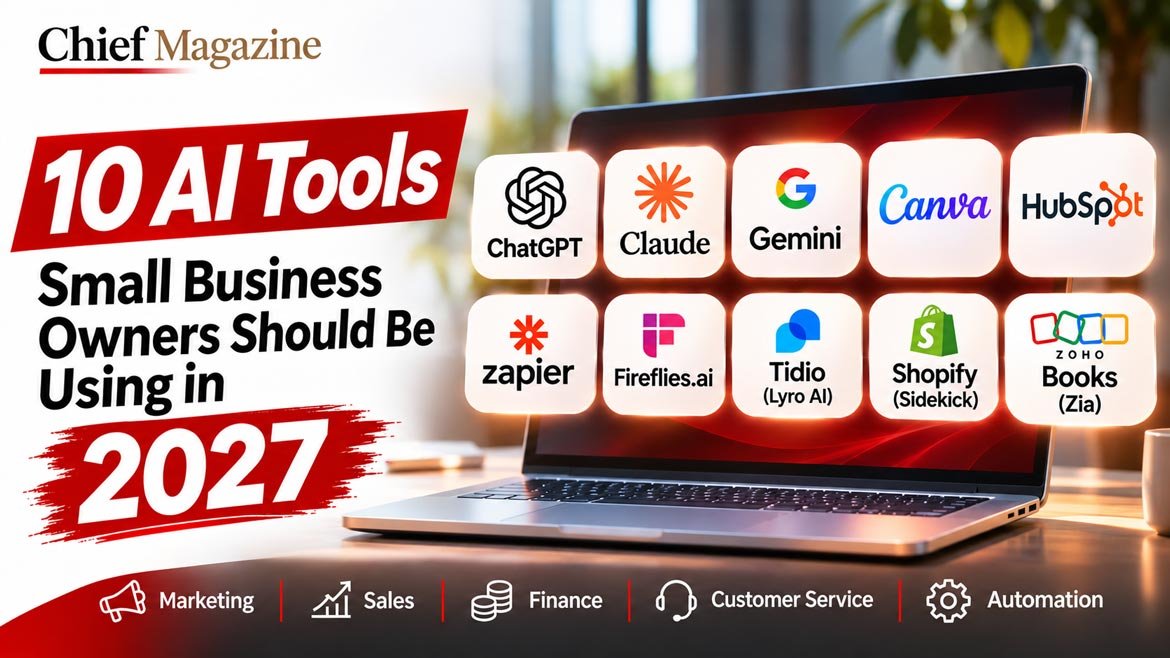
From marketing and sales to finance, customer service and business automation, artificial intelligence is giving smaller businesses access to capabilities that were once available mainly to large organizations.
A small business owner has traditionally had to wear several hats. One day, they are working on sales; the next, they are preparing a marketing campaign, following up with customers, reviewing cash flow, managing employees or trying to understand what competitors are doing.
Hiring specialists for every function is expensive. Building an internal technology team is often unrealistic. And spending hours on repetitive administrative work takes time away from growing the business.
Artificial intelligence is beginning to change that equation.
In 2027, a small business does not necessarily need a dedicated research analyst, content team, customer support team or automation specialist to perform many of these tasks. A carefully selected set of AI-enabled applications can help the owner and a lean team do considerably more.
But there is an important distinction: adopting AI tools is not the same as transforming a business. The real value comes from integrating them into everyday workflows.
AI adoption is moving from experimentation to business use
The numbers suggest that small businesses are taking AI increasingly seriously.
According to CPA Australia’s Asia-Pacific Small Business Survey 2025/26, the proportion of Indian small businesses investing in AI increased from 26% in 2024 to 36% in 2025. The survey also found that 41% of Indian respondents sought business advice from AI tools, compared with 25% in 2024.
The CII–Indian School of Business study published in October 2026 found that 65.8% of surveyed Indian MSMEs used AI tools. However, only 21% used ERP or customized business software to manage their operations.
That gap is revealing. Businesses are experimenting with AI, but many have yet to connect it to their core operating systems.
International findings tell a similar story.
The OECD’s 2026 D4SME Survey, covering more than 2,000 SMEs across 12 OECD countries, found that off-the-shelf AI tools were seeing sustained adoption. However, strategic integration, security and skills remained uneven.
Meanwhile, the US Chamber of Commerce’s 2026 Small Business Technology Report reported that 66% of small businesses surveyed used AI, up eight percentage points from 2025.
The direction is clear: AI is becoming part of the small-business technology toolkit. The next challenge is learning how to use it effectively.
10 AI tools worth considering in 2027
The following tools have been selected around practical business functions rather than technological novelty. They are not all interchangeable, and a business does not need to subscribe to every one of them.
1. ChatGPT – Your everyday business assistant
Business application: Research, planning, communication and analysis
For a small business owner, ChatGPT can serve as a versatile business assistant.
It can help research competitors, prepare business proposals, analyze spreadsheets, draft customer communications, develop marketing strategies, review documents and explore new business opportunities.
Consider a small consulting firm preparing a proposal for a prospective customer. Instead of starting with a blank document, the owner can provide the business requirements, relevant background and service details, then use ChatGPT to develop an initial proposal structure, identify gaps and refine the presentation.
Other practical applications include:
- Researching competitors and identifying market opportunities.
- Preparing quotations, proposals and business presentations.
- Analysing sales data and customer feedback.
- Creating marketing calendars and campaign ideas.
- Drafting standard operating procedures and internal documentation.
For teams, ChatGPT Business provides a shared business workspace and administrative controls.
Why it matters: It reduces the time required to move from an idea or business problem to a useful first draft, analysis or plan. Human review remains essential, particularly for financial, legal and customer-facing information.
2. Claude – Your document and knowledge-work partner
Business application: Document analysis, writing and complex business tasks
Claude is particularly useful for businesses that regularly work with lengthy documents, detailed requirements, reports and structured information.
A small consulting or professional services firm, for example, can use it to review a lengthy RFP, extract key requirements, identify compliance gaps and organize the information into a response plan.
Other applications include:
- Reviewing contracts and business documents for issues requiring professional attention.
- Summarising research reports and industry publications.
- Preparing detailed proposals and business communications.
- Analysing information from multiple documents.
- Developing internal knowledge resources and workflows.
Anthropic has also introduced Claude for Small Business, with integrations involving applications such as QuickBooks, PayPal, HubSpot, Canva and Google Workspace.
Why it matters: Small businesses often have substantial knowledge trapped in documents, emails and spreadsheets. AI can make this information easier to work with, provided the business handles confidential information appropriately.
3. Google Gemini – Your productivity assistant across Google Workspace
Business application: Email, documents, spreadsheets and presentations
Businesses already using Gmail, Google Docs, Sheets and Slides should explore Gemini’s integration with Google’s productivity environment.
Potential applications include:
- Drafting and refining customer emails.
- Summarizing long email conversations.
- Preparing documents and presentations.
- Working with spreadsheet information.
- Supporting research and brainstorming.
- Organizing information across business documents.
For a small business owner managing customer enquiries, suppliers, employees and administrative work through Google Workspace, these capabilities can reduce the time spent switching between tasks.
Why it matters: AI becomes more useful when it works within applications employees already use rather than requiring them to adopt an entirely new workflow.
4. Canva – Your design and marketing team
Business application: Marketing creatives, presentations and branded content
Small businesses frequently struggle to maintain a consistent marketing presence because professional design resources are expensive or unavailable.
Canva’s AI-powered capabilities make it easier to create marketing material without starting every design from scratch.
Businesses can use it to produce:
- Social media posts and advertisements.
- Product catalogues and promotional brochures.
- Business presentations and pitch decks.
- Marketing videos and campaign creatives.
- Branded templates for recurring communications.
- Visual content for websites and newsletters.
Imagine a small restaurant launching a new menu. It can use Canva to develop a coordinated set of promotional creatives for Instagram, Facebook, WhatsApp and in-store displays.
Why it matters: Consistent visual communication is important for building customer trust. AI-assisted design helps small teams produce more content while maintaining a recognizable brand identity.
However, AI-generated designs should still be reviewed for brand consistency, accuracy and image quality.

5. HubSpot – Your AI-enabled sales and marketing platform
Business application: Lead management, customer relationships and sales follow-ups
Many small businesses generate enquiries through websites, social media, referrals and advertising. The challenge is not always generating leads; it is managing them consistently.
HubSpot provides CRM, marketing, sales and customer service capabilities, with AI features available across its product ecosystem.
A small B2B services company could use it to:
- Capture and organize incoming leads.
- Track customer conversations and sales opportunities.
- Manage follow-up activities.
- Prepare sales communications.
- Organise marketing campaigns.
- Understand the movement of prospects through the sales pipeline.
For example, when a prospective customer submits an enquiry, the business can record the contact, assign an owner, schedule a follow-up and track the opportunity through the sales process.
Why it matters: A lead that is not followed up is a potential business opportunity lost. A CRM helps ensure that customer relationships are managed systematically rather than depending entirely on someone’s memory.
6. Zapier – Your business process automation assistant
Business application: Connecting applications and eliminating repetitive tasks
Small businesses often use multiple applications that do not automatically communicate with one another.
For example, a customer may submit an enquiry through a website, but the sales team still has to manually copy the details into a spreadsheet, notify a colleague and create a follow-up reminder.
Zapier helps connect applications and automate these workflows. Its AI capabilities also support building and managing more advanced automations.
Practical examples include:
- Sending website enquiries directly into a CRM.
- Automatically notifying sales teams about new leads.
- Creating tasks when a customer submits a form.
- Generating meeting follow-up workflows.
- Connecting marketing, communication and productivity applications.
Why it matters: Automation can eliminate repetitive administrative work and reduce the likelihood of important tasks being missed.
An alternative worth exploring is Make, particularly for businesses that need more visual control over complex workflows.
7. Fireflies.ai – Your meeting and conversation assistant
Business application: Meeting transcription, summaries and action tracking
Meetings are an important part of running a business, but the information exchanged during them is often poorly documented.
Fireflies.ai can record and transcribe meetings, generate summaries and identify action items, subject to meeting permissions and configuration.
A small consulting company can use it to:
- Document customer discovery meetings.
- Capture project discussions.
- Summarize internal team meetings.
- Identify decisions and follow-up actions.
- Search previous conversations for specific information.
For example, after a customer meeting, the team can review the transcript, extract requirements and create a list of agreed actions.
Why it matters: Better meeting documentation improves accountability and reduces the risk of misunderstandings.
Businesses should inform participants, obtain appropriate consent and follow applicable privacy requirements before recording conversations.
8. Tidio – Your AI-powered customer support assistant
Business application: Website chat and customer support
Customers increasingly expect businesses to respond quickly, even outside conventional working hours.
For a small e-commerce business, managing repetitive enquiries about delivery, returns, product availability and order information can consume considerable staff time.
Tidio’s customer service platform includes Lyro AI, which can help answer customer questions using information supplied by the business.
Potential applications include:
- Answering frequently asked questions.
- Providing product and service information.
- Supporting website visitors.
- Handling routine customer enquiries.
- Escalating conversations that require human attention.
Why it matters: A small business can improve the availability of customer support without requiring someone to monitor every incoming message continuously.
The important condition is that the chatbot should have reliable information and a clear way to transfer complex or sensitive issues to a human employee.
9. Shopify Sidekick – Your e-commerce business assistant
Business application: Online store management and business insights
For businesses operating online stores, Shopify Sidekick is an AI-powered assistant designed to help merchants work with their Shopify businesses.
Depending on availability and the store’s configuration, merchants can use it to:
- Understand store performance.
- Explore sales and customer information.
- Get help with Shopify features and workflows.
- Assist with store administration.
- Generate insights and recommendations.
Consider a small fashion retailer trying to understand which products are performing well, which categories need attention and where sales opportunities may exist.
An AI assistant can make it easier to explore these questions without requiring the owner to become an analytics specialist.
Why it matters: E-commerce owners need to make frequent decisions about products, pricing, inventory and customer experience. Better access to business information can improve those decisions.
10. Zoho Books – Your finance and accounting assistant
Business application: Bookkeeping, invoicing and financial management
Finance is one of the most important areas of a small business, yet many owners do not have a dedicated finance team.
Zoho Books offers accounting and financial management capabilities, including invoicing, expense tracking, bank reconciliation and reporting. Zoho’s broader Zia AI capabilities are being introduced across its application ecosystem; specific functionality depends on the product and subscription.
Practical applications include:
- Preparing and managing customer invoices.
- Tracking business expenses.
- Monitoring receivables and payables.
- Reconciling financial transactions.
- Reviewing cash flow and financial reports.
- Supporting routine accounting workflows.
For Indian businesses, local accounting and tax compliance requirements should be considered when selecting any financial application. Businesses using TallyPrime or other established accounting systems should also evaluate how AI can complement their existing processes rather than replacing them unnecessarily.
Why it matters: A business can generate revenue and still face cash-flow problems. Better financial visibility helps owners make more informed decisions.
AI-generated financial summaries should never replace proper accounting controls, professional advice or statutory compliance checks.
The tools are only half the story: How should a small business actually use them?
The biggest mistake a business owner can make is subscribing to multiple AI applications without deciding what each one is supposed to accomplish.
A small business does not need ten different AI subscriptions to become more efficient. It needs a connected set of tools that addresses its most important operational problems.
Here are three practical examples.
Example 1: A small professional services company
Imagine a consultancy with a team of five to ten employees.
Its typical challenges include generating leads, preparing proposals, managing meetings and following up with customers.
A practical AI-enabled workflow could look like this:
| Business activity | Suggested tool |
|---|---|
| Market and competitor research | ChatGPT |
| Proposal and document preparation | Claude |
| Lead and customer management | HubSpot |
| Meeting notes and action items | Fireflies.ai |
| Workflow automation | Zapier |
| Presentations and marketing | Canva |
A prospect submits an enquiry through the website. The lead enters the CRM, the sales team receives a notification, a discovery meeting is scheduled, and the meeting summary helps the team prepare a proposal.
The objective is not to automate every decision. It is to reduce the administrative work surrounding the sales process.
Example 2: A small retail or e-commerce business
Consider a business selling fashion, home décor or consumer products online.
| Business activity | Suggested tool |
|---|---|
| Marketing content and product descriptions | ChatGPT |
| Visual creatives and catalogues | Canva |
| Online store management | Shopify |
| Customer support | Tidio |
| Sales and customer management | HubSpot |
| Financial management | Zoho Books |
The business can use AI to prepare product descriptions, create promotional material, answer routine questions and understand sales performance.
This gives a small team more time to focus on merchandising, customer relationships and product quality.
Example 3: A small manufacturing or distribution business
For a manufacturer or distributor, the priorities are different.
The business may need better control over quotations, purchase orders, inventory, supplier communications and customer enquiries.
A useful starting combination could be:
- ChatGPT or Claude for analyzing documents and preparing business communications.
- Gemini for email and document productivity.
- Zoho Books for accounting and invoicing.
- HubSpot for managing customer relationships.
- Zapier or Make for connecting applications.
However, AI assistants are not substitutes for an integrated ERP system. A business with complex inventory, procurement, production, accounting and warehouse requirements should consider an appropriate ERP platform and use AI to enhance its workflows.
What does an effective AI stack look like for a small business?
Rather than adopting all ten applications, a small business can start with a smaller combination.
| Business requirement | Recommended starting point |
|---|---|
| General business assistance | ChatGPT or Claude |
| Research and productivity | Gemini |
| Marketing and design | Canva |
| Sales and CRM | HubSpot |
| Workflow automation | Zapier or Make |
| Meeting documentation | Fireflies.ai |
| Customer support | Tidio |
| E-commerce | Shopify |
| Accounting | Zoho Books |
The selection should depend on the business model, existing software, team size and budget.
For an Indian MSME, local support, GST compliance, data handling, integration options and the availability of payment methods should also influence the decision.
Five things small business owners should consider before adopting AI
The growing availability of AI tools does not mean every business should adopt every application. There are practical considerations that deserve attention.
1. Start with a business problem, not a technology trend.
Identify the activity consuming the most time or creating the greatest operational difficulty. It could be lead follow-up, customer support, reporting, documentation or repetitive administration.
Choose a tool that addresses that problem.
2. Calculate the actual return on investment.
Do not evaluate an AI application only by its subscription price.
Consider the time saved, reduction in errors, additional sales opportunities, improved customer response and implementation effort.
If an application costs money but does not improve a meaningful business outcome, it may not be worth retaining.
3. Protect customer and business information.
Employees should understand what information can and cannot be entered into AI applications.
Avoid uploading sensitive financial records, customer information, employee data, passwords or confidential business documents without checking the provider’s data-use policies, security controls and contractual terms.
4. Keep humans responsible for important decisions.
AI can produce incorrect information, make misleading recommendations or misunderstand context.
Financial decisions, legal documents, employment decisions, compliance matters and important customer commitments should receive appropriate human review.
5. Train employees instead of simply buying subscriptions.
A tool delivers little value if employees do not know how to use it.
Businesses should establish basic guidelines, share practical examples and encourage employees to identify repetitive activities that could be improved through AI.
The next opportunity: Moving from AI tools to AI-powered business operations
The next stage of AI adoption will not simply be about using chatbots to write emails or generate social media posts.
It will increasingly involve connecting AI to business applications, internal information and operational workflows.
Imagine a business where:
- New customer enquiries are automatically classified and assigned.
- Sales teams receive relevant customer and company information before meetings.
- Meeting outcomes are converted into follow-up tasks.
- Management receives regular summaries of sales performance.
- Customer support handles routine questions and escalates complex issues.
- Financial information is analyzed to highlight unusual movements and potential cash-flow concerns.
These are examples of how AI can become part of the operating model rather than remaining a separate application employees open occasionally.
The OECD’s 2026 SME research highlights this distinction: off-the-shelf AI tools are gaining traction, but secure and strategic integration into business operations remains uneven.
That is where the larger opportunity lies.
The final word: Small businesses do not need more tools. They need better systems.
For years, large enterprises have enjoyed an advantage through access to specialist teams, sophisticated software and substantial technology budgets.
AI is beginning to make some of those capabilities accessible to smaller organizations.
A business owner can now access tools for research, content creation, sales management, customer support, financial analysis and workflow automation without building every capability internally.
But technology alone does not create a competitive advantage.
The businesses that benefit most will be those that understand their processes, choose the right tools, connect them intelligently and train their people to use them.
In 2027, the question for a small business owner should not simply be, “Which AI tool should I try next?”
It should be:
“Which part of my business can operate better, faster and more intelligently if I bring AI into the process?”
That is a much more valuable starting point.