

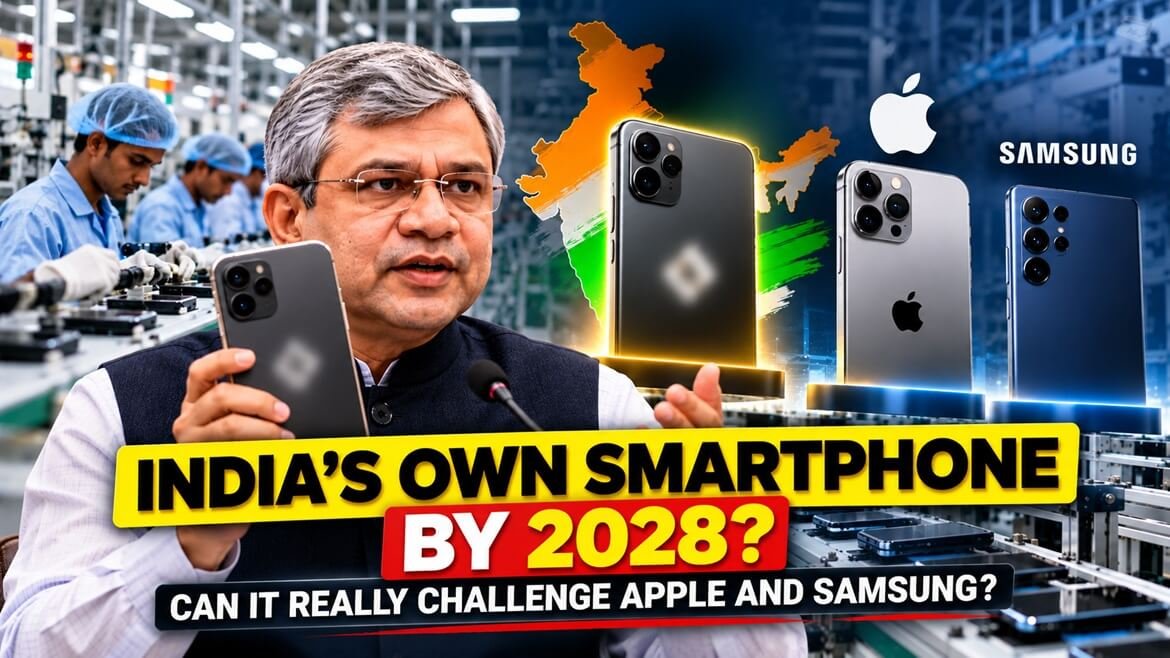
The central question is not whether India can manufacture smartphones. It already does, at substantial scale. The harder question is whether India can develop an Indian-owned smartphone brand with the technology, supply chain, software experience and consumer credibility to compete meaningfully with Apple and Samsung by 23 October 2028.
That distinction matters because the phrase India’s own smartphone can describe several very different achievements. A phone assembled in India is not necessarily designed in India. A phone designed by an Indian company may still rely on foreign chipsets, displays, camera systems and operating-system platforms. And a phone that carries an Indian brand is not automatically a technological breakthrough.
Union Minister Ashwini Vaishnaw’s reported statement has therefore opened a legitimate debate. Rather than dismissing it as impossible—or treating it as a guaranteed milestone—we should examine what would need to happen for the claim to become reality.
The starting point: India’s manufacturing success is real
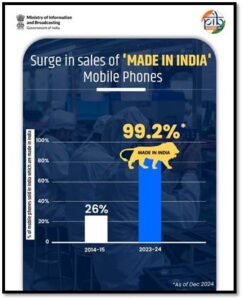
According to the Ministry of Electronics and Information Technology, India had more than 300 mobile manufacturing units by early 2025, compared with just two in 2014. The government reported that 99.2% of mobile phones sold in India were being manufactured domestically, and annual production had reached approximately 325–330 million devices. Mobile phone exports had also grown substantially. These are meaningful industrial achievements, not merely political talking points. The government’s February 2025 account of the sector provides the underlying figures.
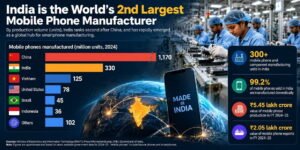
But these numbers measure manufacturing activity, not the nationality of the companies that own the product designs, control the technology or capture the profits.
The government itself recognizes the gap. Its Mobile Phone Manufacturing Scheme, approved in 2026, has a ₹62,500 crore outlay and explicitly aims to deepen domestic value addition, strengthen supply chains, support Indian brands and create Indian patents in design and R&D. The scheme includes additional incentives for Indian-brand design and research.
 That policy is important context for the 2028 claim. It suggests the ambition is not appearing out of nowhere: there are initiatives designed to move India beyond assembly. But a policy announcement is not the same as a commercially successful product, and a budget allocation is not evidence that a globally competitive phone is already in development.
What exactly did the minister promise?
The date matters. At the NDTV World Summit on 23 October 2026, Vaishnaw said: “23 October 2028. You will have Indian-designed, Indian-manufactured, Indian-branded mobile phones.” He described the complexity of integrating radio-frequency communication, antennas, computing, memory, passive components, cameras, displays and power management into a compact device. He also said two Indian companies had responded to a challenge to design smartphone printed circuit boards (PCBs), with one company’s design selected by a major US telecom provider. NDTV’s report of the statement provides the clearest published account of his rationale.
This is more specific than saying India will manufacture phones. It also gives us a useful starting point for assessing feasibility: the minister appears to be pointing to domestic product design and intellectual property, not merely a new assembly line.
However, the statement leaves several important questions unanswered. What proportion of the phone must be designed in India? Does “Indian IP” mean ownership of the motherboard design, the industrial design, the software layer, or the complete system? Does the target require a phone to be commercially available by the deadline, or does it imply a brand that can compete at scale? And what does “one of the largest-selling” mean in practice?
These are not technicalities. They determine whether the promise is achievable in two years or whether the deadline sets an expectation that the industry cannot reasonably meet.
India’s earlier attempts: a lesson in the difference between a brand and a technology business
India has not been waiting for this announcement to think about domestic mobile brands. It has tried before—and those attempts offer some of the most important lessons for the next one.
Micromax, Karbonn and Lava: early success, then a competitive reversal
In the early 2010s, Indian brands including Micromax, Karbonn and Lava built substantial businesses by offering affordable phones, multiple models and extensive distribution. Their success showed that domestic companies could understand local buyers and compete in a fast-growing market.
But their position weakened as Chinese manufacturers such as Xiaomi, Oppo and Vivo entered India with aggressive pricing, rapid product cycles and increasingly capable devices. The brands were competing not simply against foreign labels, but against businesses that had built highly efficient supply chains and developed strong product portfolios.
According to Mint, Micromax, Lava and Karbonn together accounted for around 40% of India’s smartphone market at their peak in September 2013, with Micromax alone holding 22%. India’s annual smartphone sales were then approximately 44 million units; by 2025, the market had grown to around 152 million. Mint’s account of the Indian-brand comeback illustrates both the opportunity and the intensity of the competition.
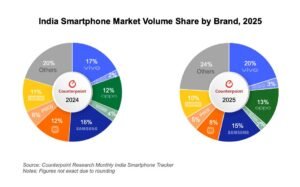
Their subsequent decline should not be reduced to one explanation. Product differentiation, access to components, capital, software quality, marketing, service networks and the speed of responding to competitors all mattered. But the larger lesson is clear: an Indian company can win market share without building a durable technological advantage—and can lose that share when competitors improve their products and economics.
Micromax’s 2020 comeback attempt reinforces this point. The company returned with its IN-branded phones amid heightened anti-China sentiment, but a favorable political moment could not substitute for a lasting product advantage. TechCrunch later described the comeback as unsuccessful and reported that Micromax had invested in the effort to strengthen its R&D and compete with Chinese vendors. Read TechCrunch’s analysis.
Lava’s continuing presence is another reminder that domestic smartphone development has not disappeared entirely. But having an Indian-owned brand on store shelves is different from controlling the most difficult or strategically valuable technologies inside the device.
JioPhone: an Indian-led product strategy, but not an entirely Indian technology stack
Reliance Jio’s JioPhone provides a different lesson. It combined a low-cost device with connectivity, digital services and a distribution strategy designed for a mass market. That was a meaningful product and business innovation.
Yet the operating-system story shows why the definition of “own technology” matters. KaiOS, which powered the JioPhone, originated from the Firefox OS open-source project and was developed by a company based in the United States. Its work with Reliance Jio illustrates how an Indian-led device and services strategy can rely on technology developed through international partnerships. KaiOS’s account of its work with Jio explains how the partnership brought internet services to affordable handsets.
That is not a criticism. Global technology products routinely depend on international collaboration. The important question is which capabilities the Indian company owns, which it licenses, and whether it can continue innovating without being dependent on another firm’s roadmap.
The next attempt: Indian brands with a stronger policy framework
The latest government initiative may give a new generation of companies a more deliberate route into the market. In August 2026, Mint reported that three unnamed homegrown companies were in discussions with the government about incentives under the new Mobile Phone Manufacturing Scheme. The minister said the scheme’s brand-focused segment would require core design-linked intellectual property to be owned by an Indian entity with at least 51% Indian-citizen ownership. The report did not identify the companies or establish that their devices were ready for launch. Read the report.
This is relevant evidence that work towards the goal may be under way. It is not, however, enough to conclude that a competitive product will be available by October 2028. The public information available so far does not provide the companies’ names, product specifications, R&D budgets, component plans, launch schedules or independent technical assessments.
The distinction between a serious programme and a public deadline rests on evidence such as these.
What does it take to build a competitive smartphone?
A modern smartphone is a system of tightly integrated technologies. A manufacturer can source many of its components from established suppliers, but turning them into a reliable, competitive product requires expertise across hardware, software, radio engineering, thermal management, power consumption, manufacturing and quality assurance.
The challenge is not that every component must be invented from scratch. Apple and Samsung also depend on global supply chains. Their advantage comes partly from their ability to combine components, software, industrial design, manufacturing processes and customer experience into products that people want to buy.
For an Indian brand, at least six areas require serious attention.
1. Product engineering and design. Designing a PCB is valuable, but it is only one part of the product. Engineers must ensure that the antennas, processors, memory, sensors, cameras, battery, display and other components work together reliably. The device must meet performance, durability, thermal and radio-frequency requirements, and it must be manufacturable at the intended price.
2. Chipsets and critical components. India has made progress in electronics manufacturing and is building semiconductor capabilities, but domestic smartphone assembly does not imply domestic production of every high-value component. Processor platforms, advanced displays, camera sensors, memory and other parts remain connected to global suppliers and manufacturing networks. A new Indian brand can use international components; the question is whether it can design a product with meaningful differentiation and secure reliable access to those components.
3. Software and long-term support. Most Android smartphone makers operate within an ecosystem shaped by Google, its services, chipset vendors and app developers. A brand needs a stable user interface, security updates, dependable compatibility and a credible commitment to software support. Building a completely new operating system is not essential to launch an Indian brand, but building a successful alternative to the existing smartphone ecosystem is a much larger undertaking.
4. Testing and manufacturing quality. A prototype can demonstrate that a design works. A commercially viable phone must work consistently across millions of units, different networks, climates and usage patterns. That requires extensive testing, quality control, supplier management and certification. Defects or unreliable updates can quickly undermine a new brand’s reputation.
5. Capital and research capacity. Hardware development requires funding before a company knows how much demand it will capture. A company must finance engineering, tooling, inventory, certification, marketing, distribution, warranty support and future models. The first phone is not the end of the investment: competitors will launch new models, and a brand that cannot keep up can become irrelevant within a few product cycles.
6. Intellectual property and supplier relationships. Owning the core design of a product is different from owning every technology it uses. Smartphone companies also need to navigate patent licensing, wireless standards and commercial agreements with component suppliers. An Indian brand can own meaningful IP while using global components, but it needs to be clear about what it owns and what it depends on others to supply.
These are demanding tasks, but none makes a 2028 launch inherently impossible. They make the ambition dependent on the scope of the promise.
The domestic value-addition gap is a warning, not a verdict
The most useful indicator is not the number of phones assembled, but how much of the product’s value India captures through components, design, engineering, intellectual property and manufacturing.
In April 2026, the Ministry of Electronics and Information Technology reported that domestic value addition across electronics manufacturing was estimated at approximately 18–20%. That is a broad electronics-sector estimate, not a smartphone-specific measure, and it should not be interpreted as the exact local-content share of every phone. Nevertheless, it highlights why a large manufacturing base does not automatically mean a deep domestic component ecosystem. The ministry’s update discusses the effort to expand local production beyond final assembly.
India is addressing this gap through component-manufacturing incentives and its semiconductor programme. The 2026 Mobile Phone Manufacturing Scheme also explicitly supports domestic sourcing and Indian-owned design and R&D. Those measures could make a difference over time, particularly if they attract sustained investment in components, engineering talent and supplier networks.
But two years is a short period in which to build an entirely new industrial ecosystem. The more realistic near-term objective is to deepen the capabilities that already exist while using global supply chains strategically—not to assume that every part of the value chain can be localized immediately.
Brand acceptance: the part a factory cannot solve
Even if a company delivers a technically sound phone by October 2028, it will still face a difficult commercial question: why should consumers buy it?
Indian smartphone buyers already have many options at different price points. Brands such as Apple, Samsung, Xiaomi, Vivo and OnePlus have built customer expectations around performance, cameras, battery life, design, software, after-sales service and resale value. Consumers do not usually choose a phone solely because of the country in which its brand is based.
An Indian brand must therefore give buyers a compelling reason to switch. That could be a significantly better experience at an affordable price, strong privacy or security features, excellent service, a distinctive product design, reliable software support or a specialized use case that existing phones serve poorly.
OnePlus is a useful comparison, though not a direct parallel. Its experience shows that technology credentials and an established customer base do not guarantee continued commercial momentum. Product quality must be matched by clear positioning, pricing, distribution, service and consistent execution. A new Indian brand would face the same basic commercial reality.
Patriotism may help a launch attract attention, but it cannot sustain repeat purchases on its own. Nor should the objective be to persuade consumers to buy a weaker phone out of national loyalty. The stronger outcome would be to give them a genuinely competitive product that also builds Indian technological capability.
The government and industry should therefore measure success not just through a launch event or initial sales, but through customer satisfaction, return rates, software support, repeat purchases, product margins and the ability to release competitive follow-up models.
Is the 2028 deadline realistic?
The answer depends on what the claim is intended to mean.
Possible interpretation |
Assessment by October 2028 |
|---|---|
| An Indian-owned company launches a phone designed in India and manufactured in India, using a mix of domestic and imported components | Plausible, if the reported design work progresses and the company has funding, suppliers and a product roadmap |
| A phone has meaningful Indian-owned design IP, rather than being only a rebadged or contract-manufactured product | Plausible, but not yet independently demonstrated by the public details cited here |
| India develops a largely domestic smartphone component supply chain in two years | Highly unlikely; this is a much longer industrial-development challenge |
| An Indian brand becomes a major global rival to Apple and Samsung by that date | Unlikely; global-scale trust, software, distribution, services and sustained product innovation take time |
| India produces a phone that is technically superior to the leading global devices across the board | Not a reasonable conclusion from the available evidence; no published product specification or independent testing supports it |
The minister’s claim should not be treated as impossible. A company does not need to invent its own processor, display technology or operating system to build an Indian-designed and Indian-branded smartphone. It can combine established components with its own product design, software, engineering and intellectual property.
However, a launch is a much lower bar than a globally competitive business. If the claim means that a phone will be available under an Indian brand by October 2028, the deadline is conceivable. If it means India will have created an equivalent of Apple or Samsung in technological breadth, ecosystem strength and global market power by then, the public evidence does not support that interpretation.
The reported PCB-design work is a promising signal, but a circuit-board design selected by a telecom operator is not proof that the complete smartphone platform, product portfolio and commercial business are ready. The next steps need to be visible: named companies, product milestones, technical capabilities, investment, testing and a credible launch plan.
What should the media ask instead of simply amplifying the headline?
This is where the coverage of the announcement matters. A precise deadline is naturally attractive to newsrooms and social media. But repeating the promise is not the same as evaluating it.
A serious follow-up should establish:
- Which companies are developing the phones, and what stage are their products at?
- What does “Indian-designed” mean in terms of hardware design, software, patents and ownership of intellectual property?
- Which critical components will be made domestically, and which will be imported?
- What R&D investment, engineering teams and testing infrastructure are committed?
- Will the phones target the entry-level, mid-range or premium market?
- What benchmarks will establish success: availability by the deadline, Indian IP ownership, sales, customer satisfaction, exports or global competitiveness?
- What happens after the first launch? Is there a roadmap for regular upgrades and long-term support?
These are not hostile questions. They are the questions needed to turn a public ambition into a credible industrial programme.
The real ambition should be bigger than one launch date
India has already demonstrated that it can become a major manufacturing base for mobile phones. The next stage is to capture more of the value created by that industry: product engineering, component manufacturing, design IP, software capabilities and globally competitive Indian companies.
That transition will not be accomplished by a single announcement or one successful product launch. It requires patient investment, engineering talent, strong suppliers, competitive research and development, reliable manufacturing and companies that can earn customer trust over multiple generations of products.
The 2028 deadline can be useful if it creates urgency and measurable milestones. It becomes counterproductive if the launch itself is treated as the destination, regardless of the product’s capabilities or commercial viability.
The practical verdict: India could plausibly launch an Indian-designed, Indian-manufactured and Indian-branded smartphone by 23 October 2028. But that would be the beginning of the test, not proof that India has built its own Apple or Samsung. The real achievement will be a product that people choose because it is excellent—and a company capable of making the next one even better.
For Chief Magazine, that is the more consequential story: not whether a minister’s prediction can go viral, but whether India can convert its manufacturing success into lasting technological ownership.
—————————————————————————————————
Editorial note: The assessment above distinguishes the minister’s reported statement and government-reported manufacturing figures from the article’s analysis. The public sources cited here do not independently establish that a complete smartphone is already ready for launch, nor do they provide enough detail to forecast its market performance with confidence. The supplied Deccan Herald, India Business Trade and Economic Times links should also be reviewed against their original full text before publication; the assessment relies on the statement as reported by NDTV and the additional sources linked above.