

Leaders spend enormous energy communicating their vision to employees. But as organizations grow, a different challenge emerges: understanding what employees are thinking, what is frustrating them and what they may be afraid to say. AI could help close that gap, but the real test of leadership is whether organizations are prepared to listen.
A CEO announces an ambitious vision. The leadership team translates it into strategic priorities. Department heads turn those priorities into targets, managers communicate expectations and employees are asked to execute.
The message travels downwards, often with considerable structure and consistency.
But what happens when information needs to travel in the opposite direction?
A project is failing, but nobody wants to challenge the manager responsible. Employees are frustrated with a new policy, but the feedback reaching the executive team is overwhelmingly positive. A sales team knows why customers are walking away, but its concerns are softened before reaching senior leadership. A workplace initiative is not working, yet everyone involved is reluctant to tell the person who approved it.
This is one of the most persistent blind spots in corporate leadership: organizations are often better at communicating what leaders want employees to hear than communicating what employees need leaders to understand.
A recent example from Databricks offers an interesting glimpse into how artificial intelligence might help change that.
When the CEO needs to hear what nobody is saying
On November 11, 2026, TechCrunch reported on how Databricks CEO Ali Ghodsi uses the company’s AI agent, Genie, to understand problems that might otherwise never reach him.
Rather than demonstrating a prepared product scenario, Ghodsi showed journalist Julie Bort how he uses the agent internally.
Genie had analyzed employee satisfaction survey results, identified areas where the company had scored poorly and helped Ghodsi evaluate proposed management interventions. It had also summarized an unsuccessful sales presentation, including the features a prospective customer said were missing before it would consider buying.
The more interesting aspect was not the technology’s ability to analyze information. It was the leadership problem Ghodsi was trying to solve.
Databricks has approximately 12,000 employees. Ghodsi acknowledged that he could no longer maintain direct relationships with everyone in the organization. In a smaller startup, employees may feel comfortable telling the founder that something is going wrong. In a large organization, that directness can disappear.
He referred to Dunbar’s number, the theory associated with anthropologist Robin Dunbar that suggests humans have a limited capacity to maintain stable social relationships.
As companies grow beyond the scale of personal relationships, leaders become increasingly dependent on layers of management and reporting structures. Information travels through those layers, but it does not always arrive unchanged.
Ghodsi’s use of Genie is an attempt to uncover the uncomfortable information that might otherwise remain hidden.
It raises an important question for every CEO:
If your employees are reluctant to tell you what is going wrong, how confident can you be about the information reaching your desk?
The CEO’s responsibility goes beyond communicating the vision
A CEO must communicate direction. Employees need to understand why the organization exists, where it is going, what success looks like and how their individual contributions connect to the larger mission.
Without that clarity, organizations become collections of departments pursuing disconnected objectives.
But communication cannot be a one-way management exercise.
A company’s vision may be strategically sound at the boardroom level and still encounter serious problems during implementation. Employees working with customers, products, systems and operational processes often see those problems before senior management does.
A strategy that looks efficient in a presentation may create additional workloads for frontline teams. A new performance target may encourage behavior that damages customer experience. A technology transformation may be welcomed by leadership but resisted by employees who have not received adequate training or clarity about its implications.
These are not necessarily signs of employee resistance. They may be early warnings that the strategy needs adjustment.
The best leaders understand that employees are not merely recipients of a vision. They are also an important source of intelligence about whether that vision is working.
Satya Nadella: Moving Microsoft from knowing to learning
One of the most widely discussed examples of leadership-led cultural transformation comes from Satya Nadella at Microsoft.
When Nadella became CEO in 2014, he inherited an organization that had experienced internal competition, rigid hierarchies and a culture in which individuals often felt the need to demonstrate that they were the smartest people in the room.
His response was to promote a shift from a know-it-all culture to a learn-it-all culture.
The distinction was more than a change in terminology. It was an attempt to make curiosity, collaboration, listening and continuous learning central to how Microsoft operated.
In his account of the transformation, Nadella described how hierarchy and organizational pecking orders had restricted spontaneity and creativity. He argued that a culture built around listening and learning could unlock the abilities of employees across the organization.
Microsoft has also developed formal employee-listening mechanisms. Its Employee Listening system includes periodic employee surveys, daily signals, manager and leader feedback, focus groups and direct conversations. The intention is to give employees opportunities to share their experiences while providing managers and senior leaders with information they can act upon.
This is particularly important because listening cannot depend entirely on whether an employee feels comfortable approaching the CEO.
It must be built into the organization.
Pixar: Creating an environment where people can challenge the work
Another instructive example comes from Ed Catmull and the culture developed at Pixar.
The company’s Braintrust meetings became an important mechanism for candid feedback during film development.
Directors, writers and other creative professionals review work in progress and openly identify problems. The objective is not to protect the person who created the work from criticism. It is to improve the work itself.
Catmull has described an important feature of these meetings: people with greater authority were expected to remain silent during the opening part of discussions. This prevented senior voices from setting the tone before others had an opportunity to contribute.
The principle is powerful.
In many organizations, the most senior person speaks first. Once a CEO or department head expresses an opinion, everyone else understands the direction in which the conversation is expected to move.
Even when leaders invite disagreement, their position can unintentionally influence what people feel safe saying.
Pixar’s approach demonstrates that creating space for honest feedback sometimes requires leaders to deliberately step back.
Adobe: Feedback should not be an annual event
The challenge of employee feedback is not limited to the CEO’s office. It also exists between managers and their teams.
In 2012, Adobe replaced its traditional annual performance review and rating process with a system called Check-in.
The company said employees found the old process cumbersome and bureaucratic. Waiting until the end of the year to receive feedback also meant that opportunities for improvement could be missed.
Check-in introduced ongoing, two-way conversations about performance, career development and business impact.
The important shift was from treating feedback as an annual administrative requirement to making it part of everyday management.
This is a useful reminder that employees do not necessarily need another survey or corporate town hall. Sometimes they need a manager who regularly asks what is working, what is not and what support is missing.
Can AI become the organization’s listening layer?
The Databricks example introduces a new possibility.
Traditional employee feedback systems depend on surveys, interviews, meetings, manager observations and HR processes. These remain valuable, but they can be fragmented, periodic and difficult to interpret across large organizations.
AI can potentially help leaders analyze information from multiple sources, identify recurring themes, compare employee sentiment over time and highlight areas that require attention.
Consider a few practical possibilities:
- Employee sentiment analysis: Identifying recurring concerns in anonymized survey responses.
- Management effectiveness: Analyzing feedback patterns to identify teams experiencing difficulties with communication, workload or leadership.
- Organizational friction: Detecting repeated complaints about processes, approvals, internal systems and cross-functional dependencies.
- Strategy implementation: Comparing leadership priorities with employee feedback to understand where execution is encountering resistance.
- Customer-facing intelligence: Combining employee observations and customer feedback to identify operational issues that management reports may overlook.
An AI agent could help a CEO ask better questions: Why are employees dissatisfied with a particular policy? Why are several departments reporting similar obstacles? Why are customer complaints increasing despite positive internal performance reports?
But there is a critical distinction.
AI can analyze what people have communicated. It cannot reliably know what employees are thinking but have never expressed. Nor can it automatically distinguish fear, frustration, sarcasm, disagreement and genuine dissatisfaction without context.
The technology can surface signals. Leadership must interpret them.
The danger: Turning employee listening into employee surveillance
There is a risk that organizations will misunderstand this opportunity.
If employees discover that every internal conversation, message or workplace interaction is being analyzed to assess their attitudes towards management, the result could be the opposite of what leaders intended.
People may become more guarded, less candid and less willing to share concerns.
Employee listening should not become a mechanism for identifying dissenters or measuring personal loyalty to leadership.
The purpose should be to understand organizational conditions, not to monitor individual attitudes.
Responsible implementation requires clear boundaries:
- Transparency: Employees should know what information is collected, how it is analyzed and why.
- Privacy: Sensitive personal information and confidential communications must be protected.
- Appropriate aggregation: Organizational trends should be prioritized over unnecessary individual-level profiling.
- Human judgement: AI-generated interpretations should be reviewed rather than treated as unquestionable facts.
- Visible action: Employees should see that raising concerns leads to consideration and, where appropriate, change.
Perhaps the most important requirement is that leaders must be willing to hear feedback they do not like.
A system that identifies problems but is ignored by management is not an employee-listening system. It is simply another reporting dashboard.
What CEOs should communicate downwards — and listen for upwards
Effective leadership requires two complementary communication systems.
The first communicates the organization’s direction. The second tells leadership what is happening as that direction meets reality.
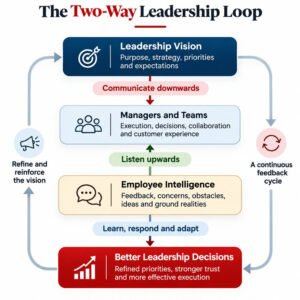
For CEOs, this means establishing a few non-negotiable practices:
- Communicate the vision repeatedly, but explain the reasoning behind decisions.
- Make it safe for employees to question priorities and raise concerns.
- Create direct feedback channels that do not depend entirely on reporting managers.
- Ask employees what leadership may be getting wrong.
- Review employee feedback alongside business performance.
- Close the feedback loop by explaining what was heard, what will change and what cannot change.
A particularly useful question for any CEO to ask is:
“What is something happening in this organization that you believe I should know, but that people may be uncomfortable telling me?”
The response may be more valuable than another presentation on organizational performance.
The best leaders do not just make themselves heard. They make themselves informed.
The Databricks example is interesting because it shows how AI could help leaders overcome one of the limitations of organizational scale.
But the underlying leadership challenge is much older than artificial intelligence.
As companies grow, the distance between decision-makers and the people executing those decisions can increase. Hierarchies develop, communication becomes formalized and uncomfortable information can get diluted.
Satya Nadella’s emphasis on learning, Pixar’s culture of candor, Bridgewater’s commitment to transparency and Adobe’s continuous feedback approach all point towards the same underlying principle: organizations improve when people can speak honestly and leaders are prepared to learn from what they hear.
AI may make it easier to identify patterns, connect information and surface issues that would otherwise remain buried in organizational data.
But it cannot manufacture trust.
Employees will speak honestly when they believe that their voices matter, that disagreement will not damage their careers and that leaders will respond constructively rather than defensively.
A CEO’s responsibility is therefore not limited to ensuring that everyone understands the company’s vision.
It also involves understanding how that vision is being experienced by the people expected to deliver it.
Leadership is not simply the ability to make an organization listen to you. It is the ability to build an organization in which you can hear the truth.